Euphorbia graminea
(Euphorbus was a physician in antiquity. The Gramineae are the grasses.)
Euphorbiaceae
This morning John and I photographed Maggy’s Hammock near Hobe Sound, Florida, one of the few great hammock remnants hereabouts. John’s working gradually on a photo guide to the natural areas in Martin and St. Lucie counties.
Maggy’s hammock abounds in biodiversity, and over several years the blog has embraced most of the botanical star players, the species you might expect. So today here is one you don’t expect.
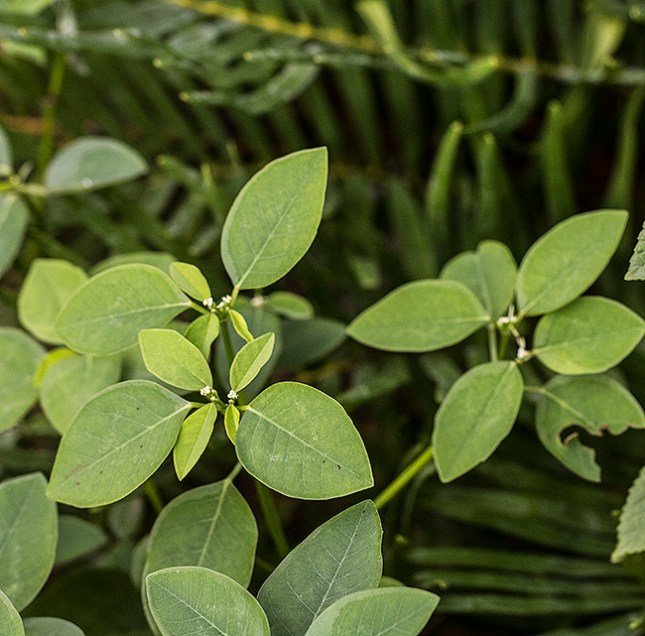
Grassleaf Spurge
Pronouncements in references on the native-ness of widespread tropical weeds always bug me. Weeds get around. That’s what weeds do. Where “native” ends and “invasive” begins is not always clear. Today’s little weed is indigenous from northern South America into Mexico. And yet here it is in Florida. Did it arrive unnaturally, oh say as seeds stuck in somebody’s shoe, or did it arrive without human assistance, oh say, seeds in a bird? Did Global Warming warm the welcome?
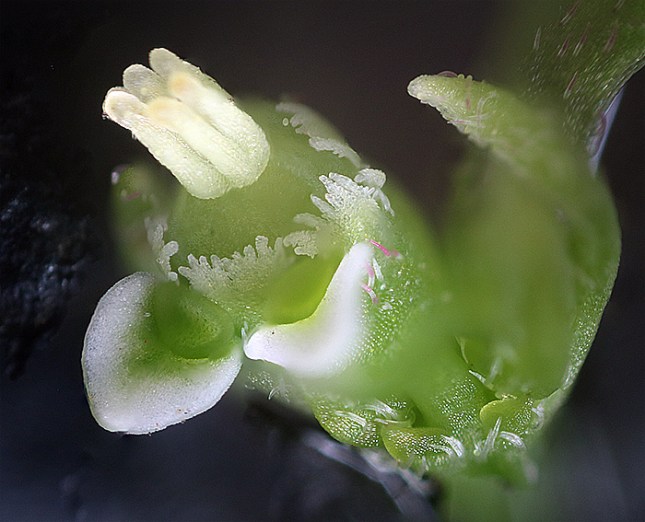
The “flower” (more precisely, the cyathium), microscope view.
In any case, in recent years the species has popped up in Africa, India, the Pacific Islands, and more. It is a tagalong in nursery plants, jumping from pot to pot using explosive fruits to fling seeds like shrapnel. Many members of the Spurge Family pop their fruits, famously Sandbox Tree, Hura crepitans, and Brazilian Rubbertree, Hevea braziliensis. But neither of those grow at Maggy’s Hammock.
The flowering structure, as with all Euphorbias is complex, to detail another day. Suffice it to say that the tiny “flowers” about one mm across almost all produce fruits, hinting that the species can pollinate itself, as many annual weeds do. That way, a single individual can found a new population. Handy in the weed world. Also, I witnessed today the world’s tiniest mini-fly visiting the flowering units.
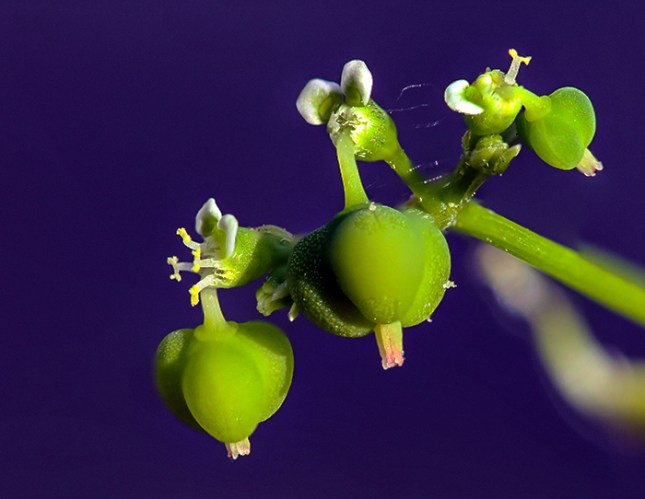
Big green poppin’ pods and little white “flowers.”
All who attempt to trace the origins of garden flowers wind up mangled by confusion and contradictions. The popular garden selection Euphorbia ‘Diamond Frost’ is, according to various sources, including especially the authoritative Flora North America, Euphorbia graminea all dressed up. But by contrast, the usually accurate Missouri Botanical Garden’s Kemper Center classifies it as Euphorbia hypericifolia. That too, is a common weed, in my back yard. The resemblance between it at the garden flower is not that convincing to my eye. And contradicting both, the company that patented the garden selection calls it a hybrid. So much for Googling. But a nice insight into how idiot arguments come about.
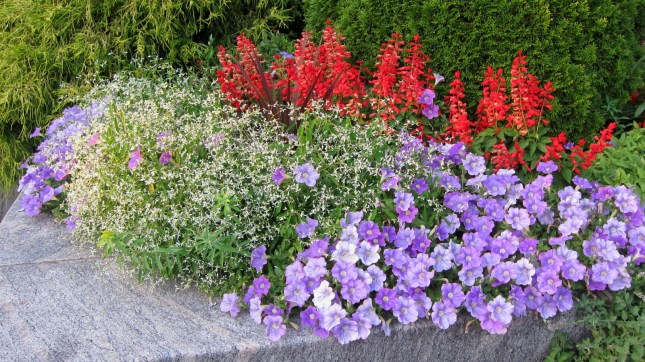
The white selection is Diamond Frost. Photo by Cultivar413, permitted use via Creative Commons.
 John Bradford
 George Rogers
 George Rogers
 Dee Staley
 Treasure Coast Natives