Agalinis linifolia and related species (about 11 species in Florida)
(Agalinis comes from Greek for “resembling flax,” linifolia refers to the linear leaves.)
Orobanchaceae (traditionally Scrophulariaceae)
Heavenly weather today, at long last, so I helped John with his megacool photo guide to local natural areas. An opportunity to visit Jonathan Dickinson State Park near Hobe Sound, Florida that was.
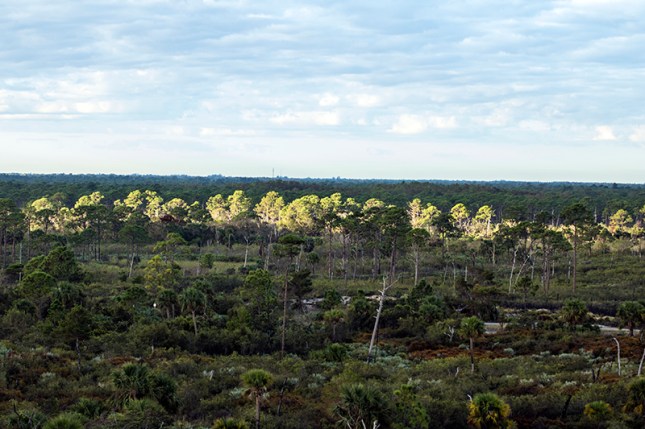
Jonathan Dickinson State Park.
Plenty in flower now, with the fairest of them all being False-Foxgloves with polka-dotted, yellow-streaked, ticklefuzz-enhanced, purplish blossoms all through a meadow. What red-blooded bee could resist?
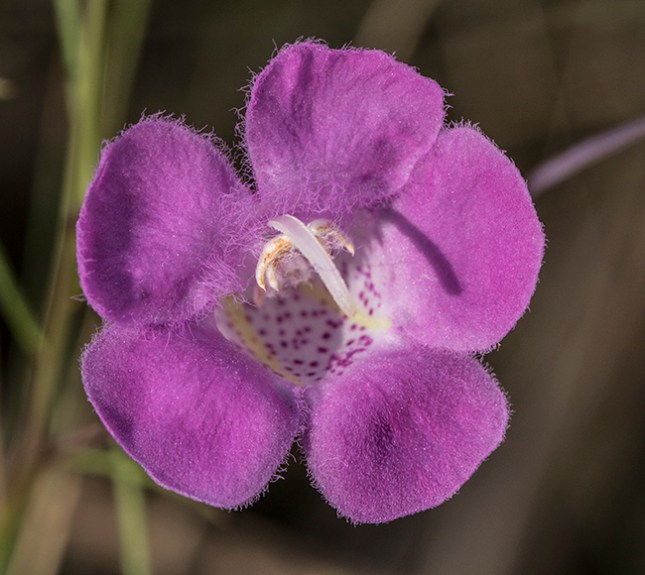
The white rod sticking out is the style and stigma, responsible for incoming pollen. Behind it you can see 3 (4th one hidden) downturned points. Those are the stamens in two pairs.
The inner flower structure reveals a feature known as didynamous (dye-DYE-neh-mus) stamens, which is a botanical way of saying four stamens in two pairs of different lengths, the members of each pair clinging edge to edge. Stamens are the pollen-making organs. The two different-length stamen pairs apparently cater to different types and sizes of bees, and if you look closely the longer pair is a little different from the shorter pair. Having the two members of a pair linked side to side demonstrably improves pollen delivery.
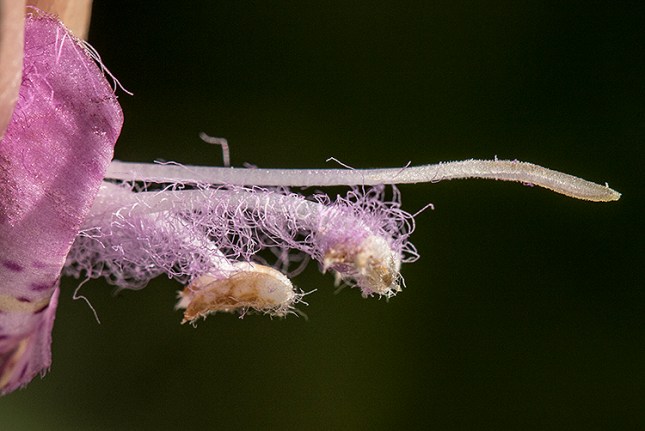
Flower with petals removed. The long hairless white bar on top is the style. The two shorter hairy units are the stamen pairs stuck together edge to edge, and of two different lengths and different orientations.
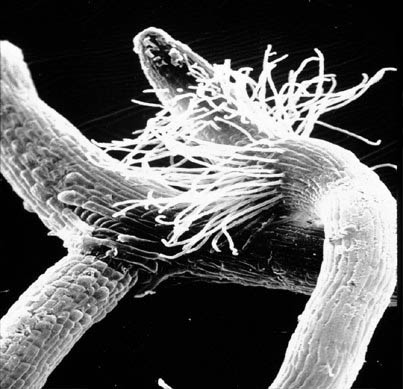
You can’t dig up the prettiest wild flowers in a State Park, so take the next part on faith. These plants are hidden root parasites on neighboring plants. The parasitic root tips grab victim roots and suck their vital juices just as a tick steals mine.
Gotcha! Agalinis root attacks its prey. Photo by William Vance Baird.
Now all this begs the question of how the little sucker finds a root to attack, answered in part by recent plant hormone research. The number of known plant hormones is expanding, and each new hormone has complex roles linked to other hormones.
A hormone family just discovered in the 21st Century is called strigolactones, part of a hormonal-genetic control system with remarkable duties. This system detects smoke, switching on genes to kickstart seed germination upon passage of a fire. (This suggests some low-tech experiments, although inconveniently complex variables may strike.)
Continuing the topic of underground detection, how does a plant root beckon beneficial soil fungi, “here I am ready to hook up” in a symbiotic relationship? Answer: Roots secrete strigolactone hormones into the dirt to entice fungal partners. And, yep you guessed it, as biologist Caitlin Conn and collaborators documented in 2015, parasitic interlopers such as Agalinis intercept those hormonal solicitations, exploiting them to find the neighbor who was expecting a friendly fungus, not a sap-sucking parasite.
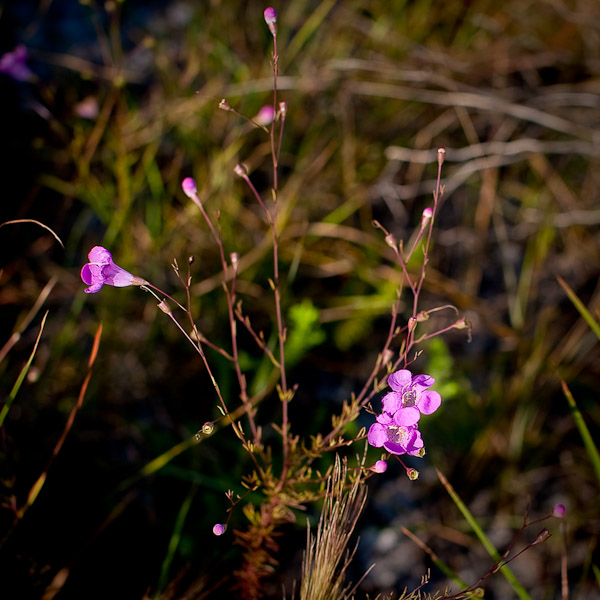
Agalinis linifolia by John Bradford.
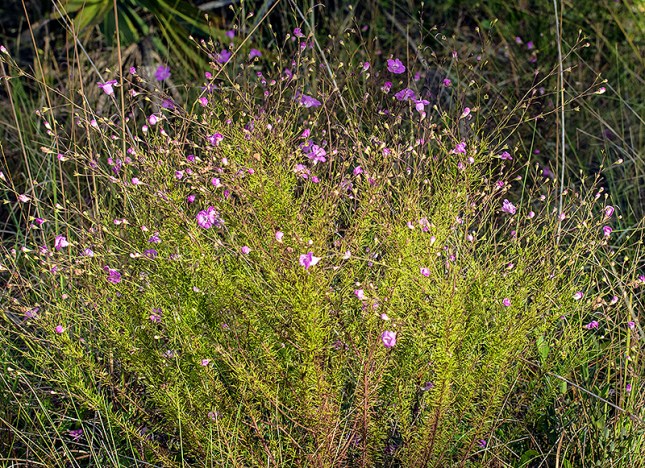
 John Bradford
 George Rogers
 George Rogers
 Dee Staley
 Treasure Coast Natives