Eupatorium capillifolium
Asteraceae
When it comes to enjoying plants I’ve developed the lifelong conviction that merely stepping into a meadow and making friends with the flora in front of you is a richer life museum than ecotouring in khakis to Shangri-la-de-dah. When you step outdoors in the autumn you may run into a big smelly herb —dog fenneI*. It grows from a seed to taller and stinkier than you in a season.
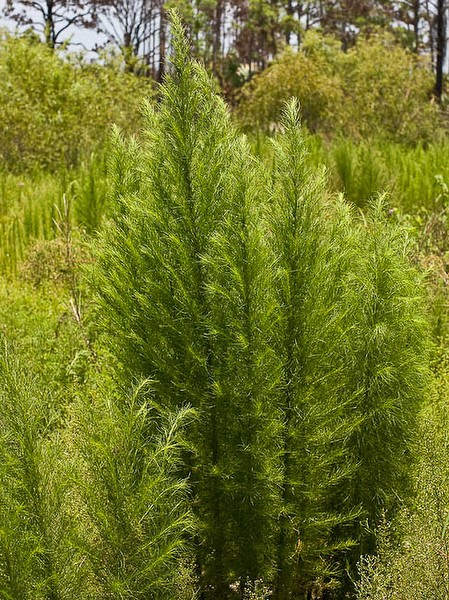
Fast and aggressive, a native weed (Today’s photos by John Bradford)
Right of the bat, this aggressive native weed has two distinctive features: a chemical odor when handled, and leaves divided into linear segments like dill. Both attributes are of interest.
I kind of like the smell. Its obvious interpretation is anti-herbivory, a skill well-developed in the Aster Family. Testing DF extracts as natural insecticides led one enthusiastic researcher to claim: “The dog-fennel oil was more potent than the conventional insecticide malathion.” I’m going to bottle this stuff and sell it!
The deterrence serves the scarlet-bodied wasp moth in such an oddball fashion. Although the moth larva feeds on related species in the hempvine genus Mikania, the adult male moth acquires protective toxins from dog-fennel, and the moth’s distribution seems possibly linked to that of the plant. Now if you worry the female moth is getting cheated out of the poison, she gets her share in a way that would make Masters and Johnson blush. At party time, the male moth mists the female in a frothy love net, followed promptly by copulation delivering the protective fennel juice along with the semen. The STI** then protects the female and her eggs.
The leaf fragrance brings us to the second talking point: blades divided into hairlike threads, which is common in aquatic plants exchanging gas with surrounding water, but frilly fringy foliage on land plants? Why? One thought is to dispense aromatic products—disperse the feeding deterrents into the air like fogging for mosquitoes, maybe even airborne plant hormones. Perhaps those brushlike leaves are “painting” the air.
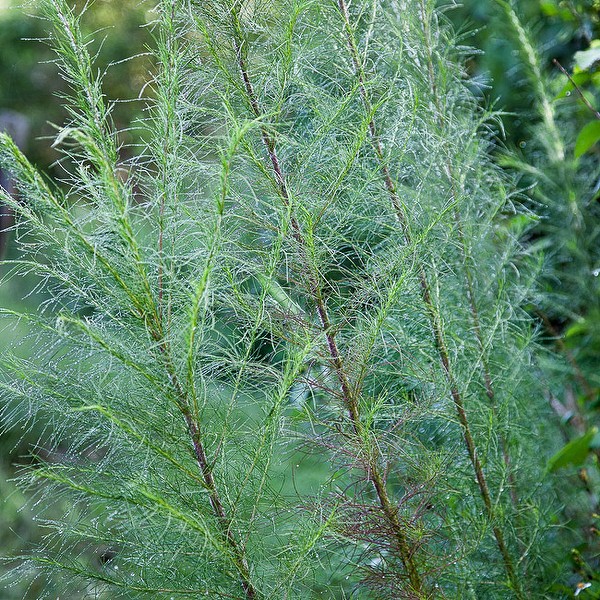
Painting the air, or just chillin?
But to be honest, a more likely (but not mutually exclusive) interpretation is the usual explanation for threadlike leaves–heat exchange with the air, preventing leaves from overheating, the same explanation as the plates on the back of Stegosaurus. Ventillation. Dog-fennel occupies hot sunny meadows where heat stress hurts. Many meadow/scrub species have similar leaves: Queen Anne’s Lace, Yarrow, Ragweed, Prairie-Clover, Clammyweed, some Tickseeds, Herb William, and others.
Search the Internet and conclude that wind pollinates dog-fennel. Baloney! Here is how one blogger with more poetic ability than mine described the blossoms (accurately): “Sometime in October, tiny white blossoms burst out, abuzz with bees, butterflies, and other insects. If you get close enough, you can detect the flowers’ delicate scent.” Does “abuzz” suggest wind-pollination!? I think that line of malarkey represents misinformation spreading and magnifying from web site to web site like gossip through the congregation. Or then again, maybe I’m wrong, but “flower’s delicate scents” do not contribute to wind pollination.
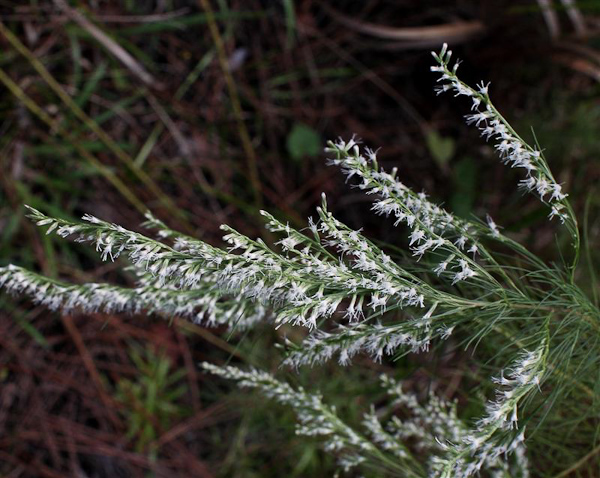
Those plants are so pretty you can buy dog-fennel as a sterile garden attraction under the name ‘Elegant Feather’. It looks like something from an aquarium.
————————————————————————–
*Dog-fennel is part of a complex consisting locally of three highly similar variants: dog-fennel, yankee-fennel, and false-fennel.
- Eupatorium leptophyllum (false fennel): hairless, flowering branches bent down. Very wet habitats.
- E. capillifolium (dog fennel): hairy, flowering branches not bent down, leaf blades under ½ mm wide, floral bracts (phyllaries) hairless and not glandular.
- E. compositifolium (yankee weed): hairy, flowering branches not bent down, leaf blades wider than ½ mm, floral bracts hairy and glandular.
** Sexually Transmitted Insecticide
 John Bradford
 George Rogers
 George Rogers
 Dee Staley
 Treasure Coast Natives