Sand Mats
Chamaesyce species
Euphorbiaceae
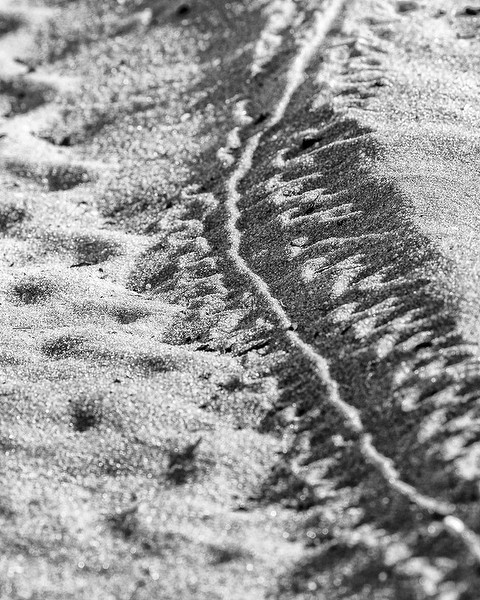
Whose little footprints are these, in the Seabranch sand? Photo by John Bradford.
As a teaching-botanist since the 70s, something that’s always bugged me is a commonplace sense that ”the” interesting plants are the far-flung exotic species, or are the rare species with their paparazzi. Why? Why do early students have to be flown to Costa Rica? Why do the books get glossier and more loaded with photos of plants from other lands? Wouldn’t learning botany be more meaningful and engaging if the examples were handy? Maybe right here in front of us? Don’t the same principles and mechanisms apply in Palm Beach County?
My teaching career sprouted in the Michigan State Penitentiary. Ha, ha, I know, you are already speculating on my misdeed. No, it wasn’t Murder-One, Sedition, or removing the mattress tag. It was just being a poverty-stricken grad-student who accepted a PT job at a local Community College where they send the newbie to the prison outreach program. And I’m glad of it—in the Big House I realized you can learn as much about plants in your own back yard (or wearing orange in the exercise yard, as the case may be) as on an eco-tourism trip wearing khakis. Didn’t the Bird Man of Alcatraz discover the same?
It seems to me the most important plants to comprehend are the ones that cross our daily paths. So today it’s one directly in our path, sidewalk-crack-dwellers, the Sand Mats, species of Chamaesyce (kam-eh-SIGH-see).
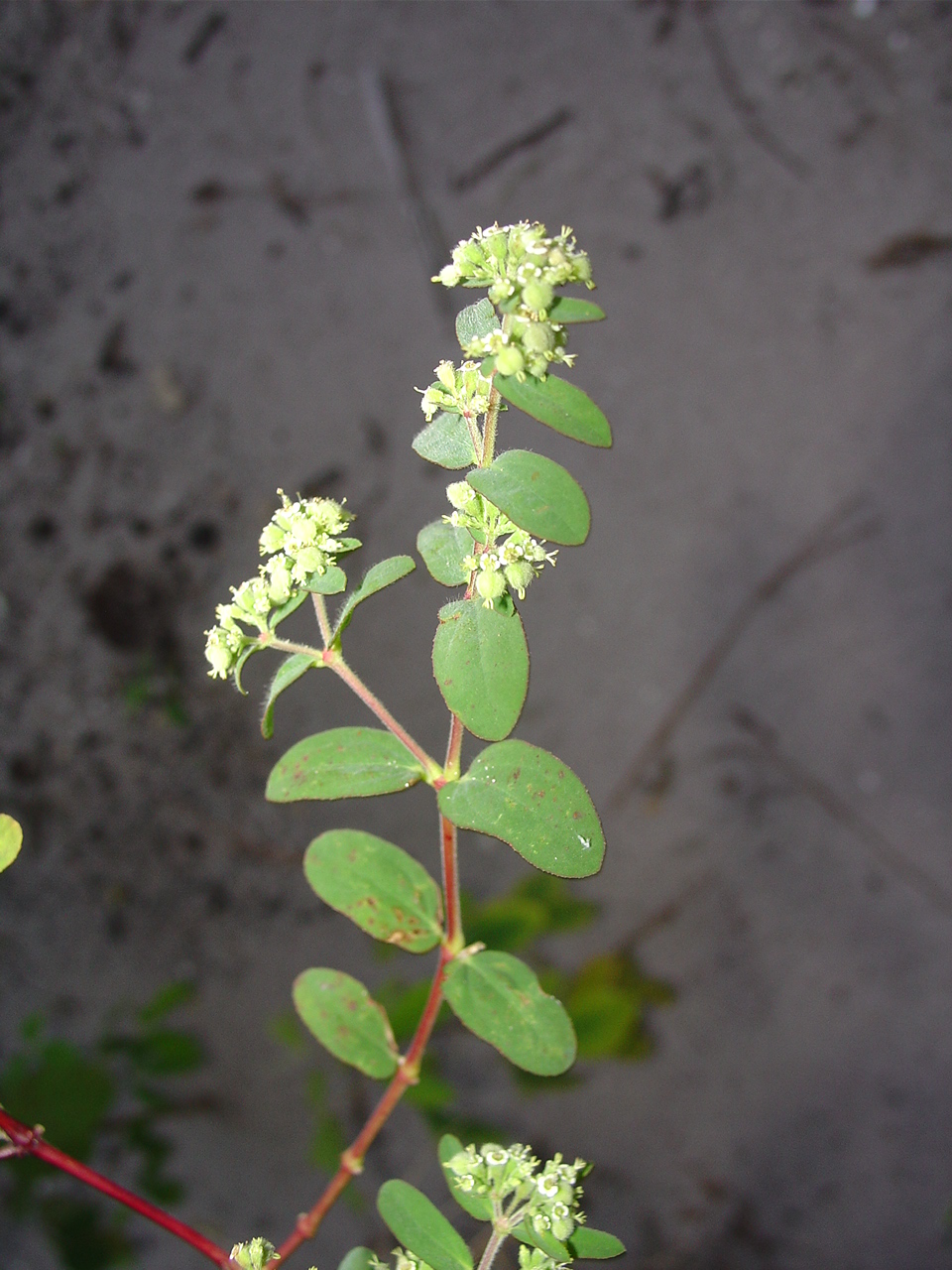
Sand Mat.
I forget who shot this.
These modest weeds tie in with John’s and my visit to Seabranch State Park today. Upon arriving there a little late, escaping gleefully from the oral surgeon who today yanked my molar, I encountered John filming a busy ant nest. We watched the insects bearing seeds “the wrong way”: outbound from their tunnel. How and why were the seeds in there to begin with? To eat? Then why did the house-cleaning anties lug them out apparently intact?
Like little miners, the ants were marching one by one hauling seeds to a refuse heap with hundreds of seeds at the edge of their mound. We think we know the species of seeds but being unsure, mum’s the word. Not important. The thing is, the activity got us interested in ants moving seeds around, and we do in fact know of one documented case where ants remove intact seeds from the nest to the trash pile. You guessed it: Chamaesyce, which by elegant coincidence our blog friend Katie MacMillen suggested as this week’s plant to feature.
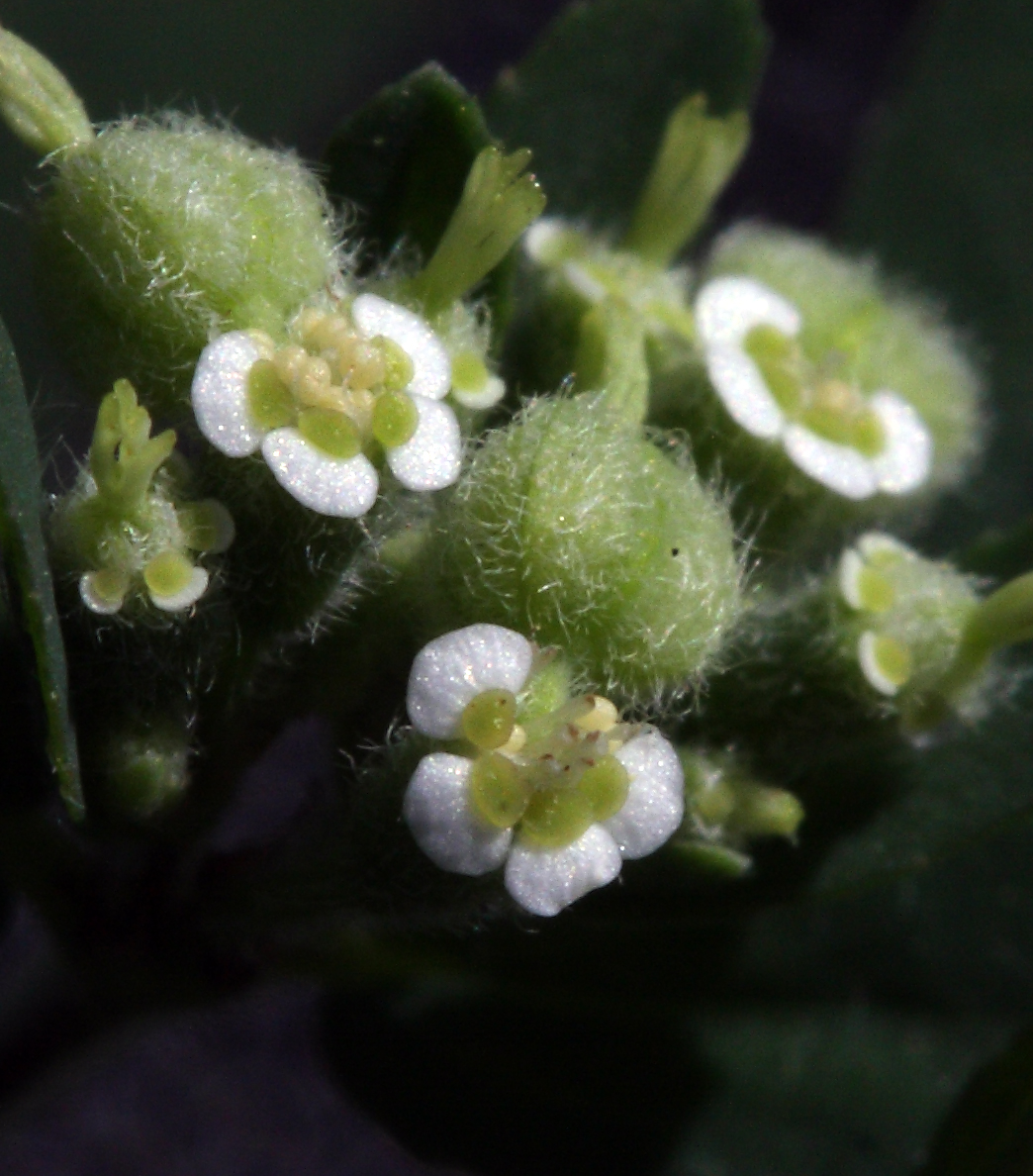
Sand Mat cyathia.
I forget who took this photo.
We’ve all stepped on Sand Mats. Next time you park at a supermarket if there is a plant coming up out of a crack in the pavement it may be one of the approximate dozen mostly native Chamaesyce species in our area. Too many to sort out here. They are sometimes called Sand Mats, and are among the most abundant and conspicuous urban weeds, and occur in scrubs, beaches and additional usually sunny sandy disturbed habitats. Several creep, while others are small sub-sub-shrubs. The leaves are opposite, and the stems drip milk when broken. The flowers are a small fraction of an inch across, usually white or greenish. Technically each “flower” is a unit called a cyathium beyond your attention span today, but here’s a handy link to CLICK for the curious.
Now at long last on to the real reason for today’s blog:
Species of Chamaesyce are emerging in ongoing research, mostly in Japan, as having unprecedented seed distribution relationships with ants. Fancy symbiosis is always a tale to tell.
Three different means of seed dispersal occur among the Sand Mats. First of all, the tiny fruits explode to pop the seeds away from the mother plant. They are Mini-Mes to thier cousins, big forest-dwelling rubber trees, with their own exploding fruits launching the rubber seeds as far as 150 feet. (Do they bounce when they hit the ground?)
Seed dispersal device #2 in Chamaesyce requires birds. Famous botanist Sherwin Carlquist back in the 60s explained the broad distribution patterns as Sand Mat seeds sticking onto migrating birds. The seeds of many Chamaesyce species have little pustules of mucilage that release sticky goo upon wetting. So far, ho-hum. Patience: Next comes the noteworthy…
Japanese ecologists studying Chamaesyce maculata, a species we too have here in Florida, discovered the plant adjusts its seed dispersal system to the season, an ability possibly unknown elsewhere in the plant world. In summer in Japan Chamaesyce detonates its pods as we just discussed. But in the autumn, the same species entrusts its seeds to ants who carry them home, dispersing the species. Don’t they eat and destroy the seeds though? Read on…
The plot thickens. Only two species of Japanese ants like Chamaecyse seeds. Of these, one ant species is probably not very useful. It takes the seeds to its nest and eats them. The second ant species is far more useful to the plant. Recall the mucilage in the seed coats. It’s utility apparently goes beyond sticking to plumage. The second ant species drags the seeds into the nest and nibbles the mucilage-laden seed coat off, leaving the rest of the seed intact. I’m not 100% sure the coating the ants eat is the same mucilage coating that Dr. Carlquist talked about years ago, but it sure seems to be. You can see its bubble packets on the seeds.
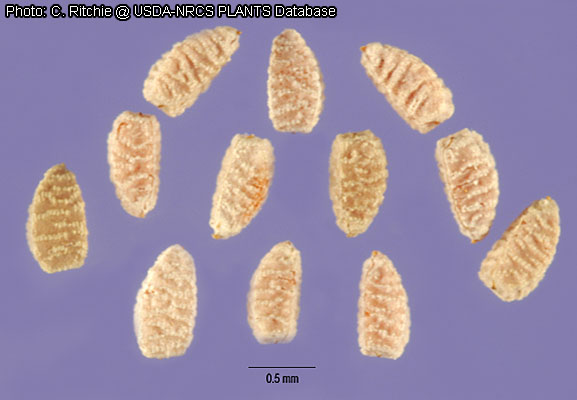
Chamaesyce seeds with presumed mucilage-bumps. Photo from USDA, by Carole Ritchie.
And there’s more. Removal of the seed coat turned out to make the Sand Mat seed comparatively resistant to fungal infection. That is fortunate because the ants toss the lightly nibbled seeds onto their dumpster of decay. But it is all a matter of standpoint. The seeds see the ant dump as a tilled, composted, garden bed with 24/7 security.
It just goes to show you that even a lowly weed sprawling across the gravel is potentially as complex and intriguing as that rare Orchid in Bali you’ll never see again. And no Land Rover required.
 John Bradford
 George Rogers
 George Rogers
 Dee Staley
 Treasure Coast Natives