Burnweed (Fireweed)
Erechtites hieraciifolius
Nice photo link CLICK
Asteraceae
Instead of botanizing Florida, over the last week or so I’ve been fooling around Mt. Vernon near Alexandria VA, the National Zoo in Washington DC hoping to see a Panda baby, and Duke University in Durham, NC. What do these places have in common with each other and with my back yard? The weeds. The more years I spend around botany, the more fascinated I become with weeds. Part of the fascination is in their botanically unifying presence. Anywhere you go, you see shared weed species. I can see the same weeds in my back yard and George Washington’s. Mary, you and I share species between Worcester and Florida, including probably Burnweed (which is in Europe but I do not know about the U.K.) The same would be true in India, or in Seattle.
My weedy greeting upon returning home was a Burnweed growing uninvited in the center of a flower pot once occupied by a tomato. The potted Burnweed looks like it was planted, and is attractive. I’ll let it grow.

And it was perfectly harmonized with a trip to Duke University and Washington DC, because botanist James Duke in his “Handbook of Edible Weeds” mentioned its abundance in Washington DC, and suggested using it as a free inner city salad. (Not a good idea, as the plant contains alkaloids toxic to at least the liver, and it stinks.)
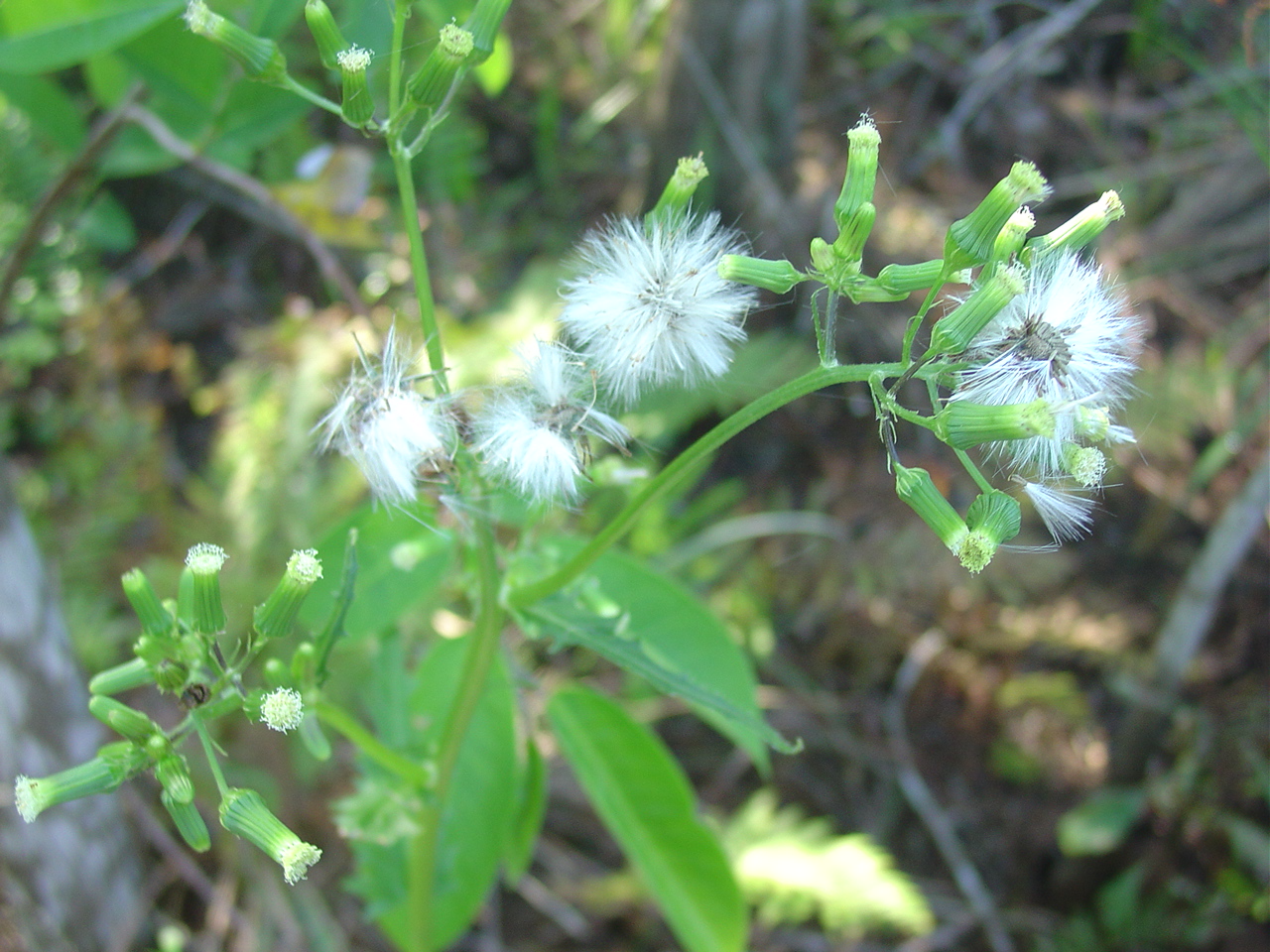
The para-fruits.
The plant is well named. Burnweed (aka Firewood, a name applied confusingly to other species) rises up after fires, as well as after other disturbances. The seeds apparently can lie dormant in the soil for long times, possibly in massive quantities. The photo below of a Burnweed monoculture after herbicide application (from the Canadian Journal of Plant Science 92: 736. 2012) attests to some colonization abilty. If I had to bet on a source, I’d put my money on the soil seedbank. Big populations sometimes appear as ground dries after flooding. Contrary to reports of wasp pollination, the plants are probably self-fertilizing, which is handy for pioneer species.
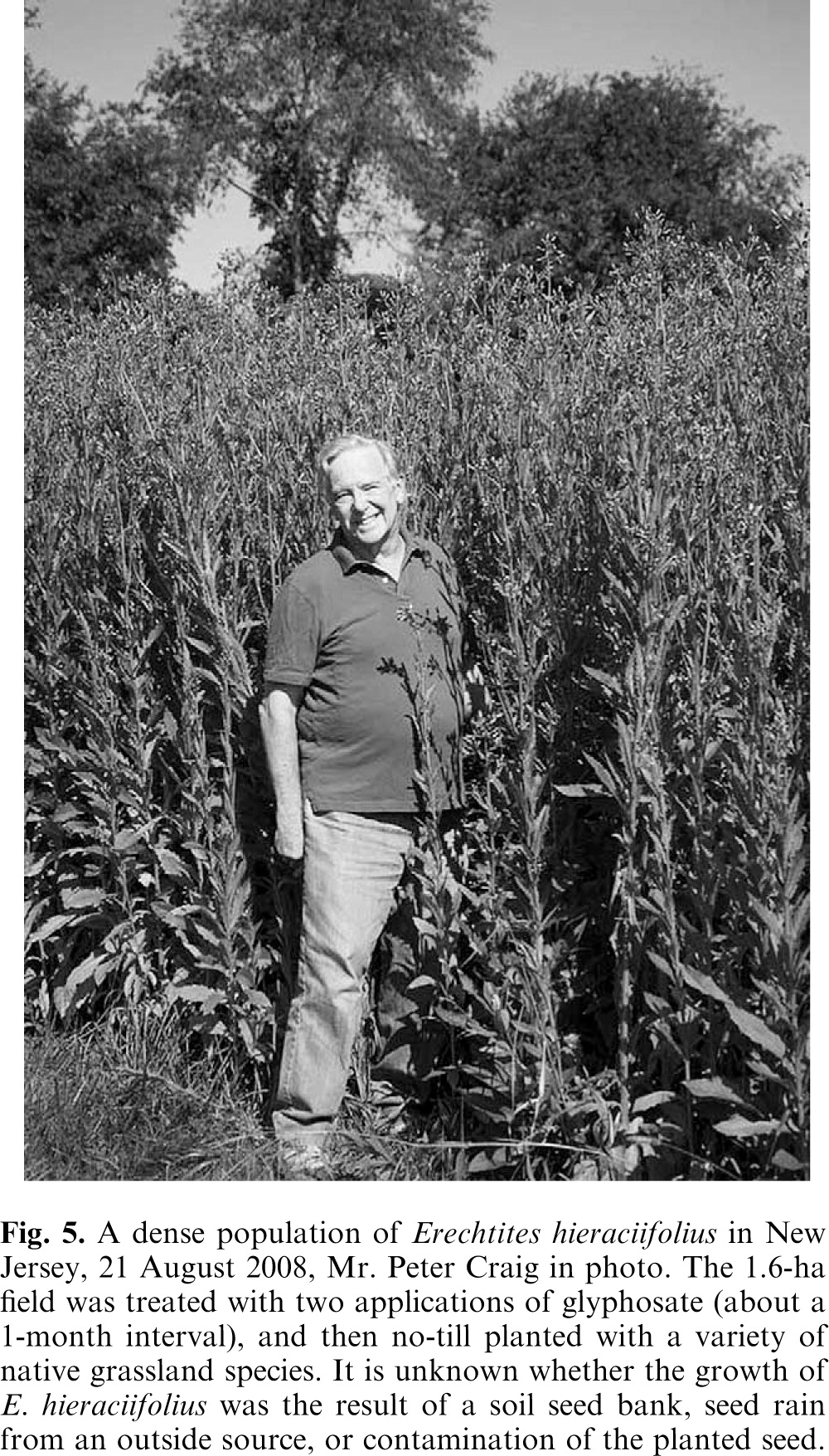
That’s a lot of Burnweed.
Maybe we have the wrong origin for the name Burnweed. What about the “burn” and itch of, well, ahhh, ummm, hemorrhoids. Another name for our Burnweed is Pileweed, if you know what I mean. They say the juice is astringent. Actually, the plant has a wide history of medicinal uses based on its smelly oil (not all “Burnweed oil” comes from Erechtites), and once fetched 2-3 cents per pound in Georgia.
As a Biology teacher, I often tell students, “plants can’t extract nitrogen from the air.” A lie! Research in Japan has shown our species to take in air-borne nitrogen dioxide, a pollutant, and to use that nitrogen. As much as 10% of the plant’s organic nitrogen can enter from the air. So maybe James Duke’s observation that Burnweed tolerates urban conditions is useful, not for inner city salad, but planted in lush abundance to suck in nitrogenous air pollution, reducing the hot air and hemorrhoids inside the Beltway.
 John Bradford
 George Rogers
 George Rogers
 Dee Staley
 Treasure Coast Natives