RSS

Author Archives: George Rogers

Unknown's avatar

About George Rogers

Florida botanist

Rogation  Floures

Polygala species

(Polygala means “much milk.”)

Polygalaceae
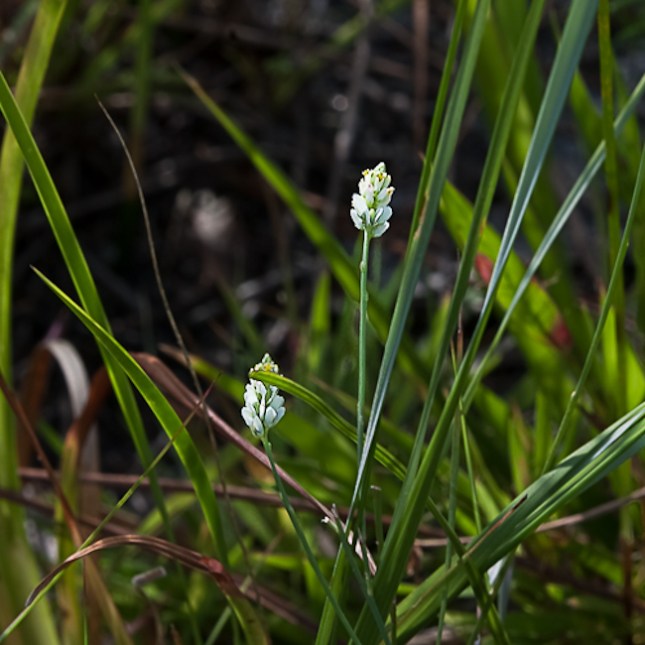
Polygala setacea 2

Polygala setacea.  All flower photos today by John Bradford.

Halpatioke Regional Park near Stuart, Florida, was the venue today where John and I encountered a WWII Vet (repeat:  WWII, do the math on your cell phone calculator) out alone with canteen on his belt and armed with one of those grabber tools cleaning up litter.   Some folks have a sense of purpose.
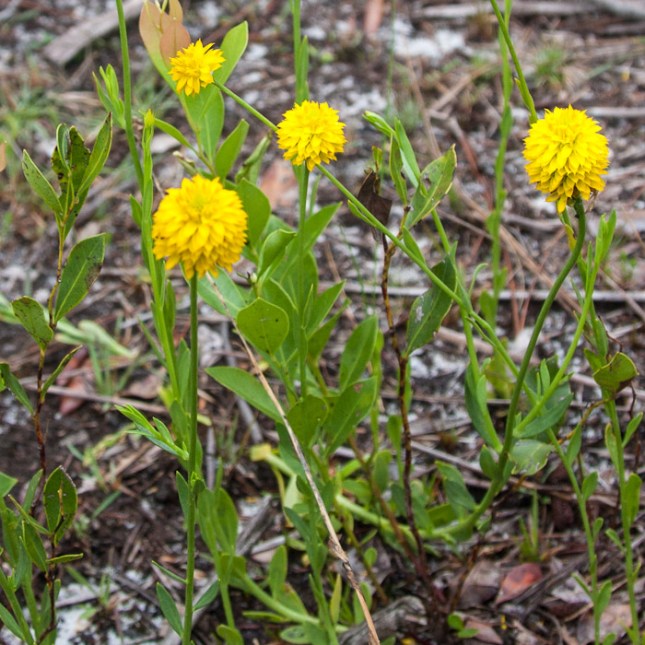
Polygala rugelii 2

P. rugellii

We also encountered scattered members of the genus Polygala.    Polygala is one heck of a genus…a few hundred species around the world, twenty-some in Florida, several in our general area.    You could scarcely find a more variable and more colorful plant group, our local rainbow including orange, yellow,  violet,  and white blossoms.   The flowers can be single,  or in branched candelabras,  or in congested heads or spikes.    The plants can be an inch tall, or three feet. (In other regions they can be big and woody.)
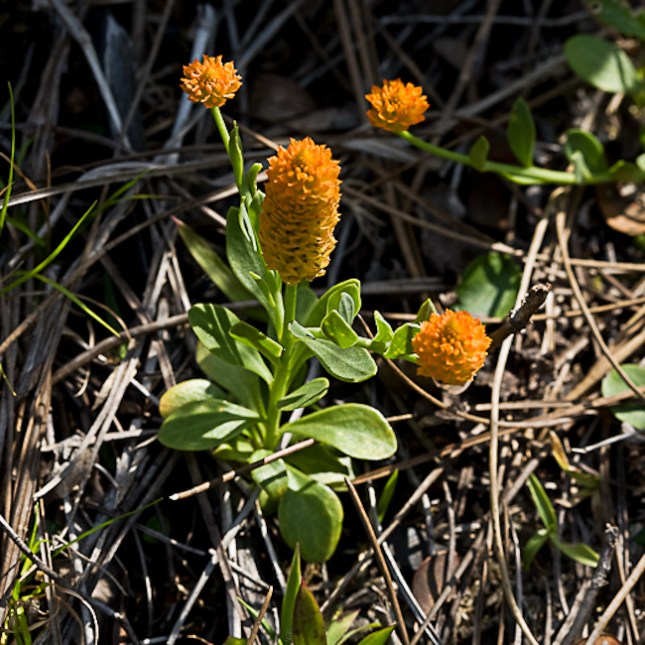
Polygala lutea 1

P. lutea

That kind of color and variation remind you of any other plant group?    Methinks Orchids, and the flowers do have features in common with Orchids, including extreme bilateral symmetry,  similar  overall shapes,   often a decorated or complex  “lower lip,”  and precision pollination.   At least one species of Polygala reportedly forces the pollinator to enter a tunnel and scrape inward past the pollen-receptive stigma, and then to exit via a different tunnel, brushing over the pollen-producing anthers.  That would not be dismaying in an Orchid, but Polygalas are completely unrelated.
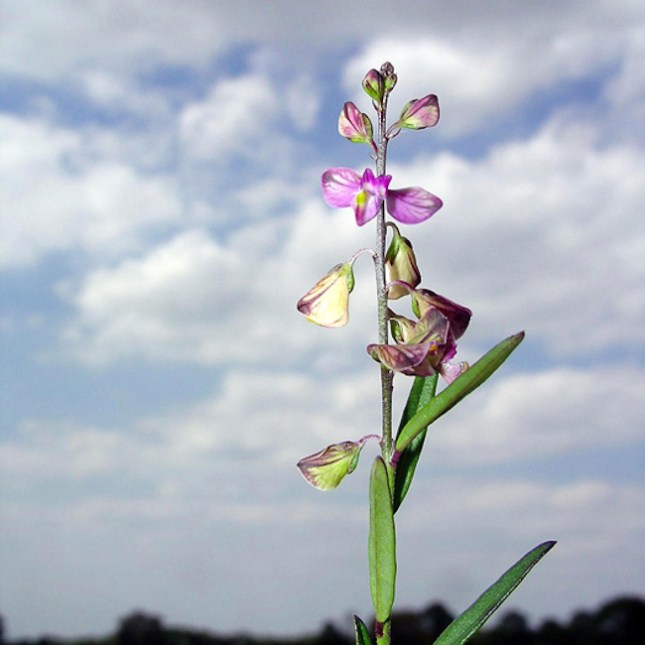
Polygala grandiflora 1

P. grandiflora

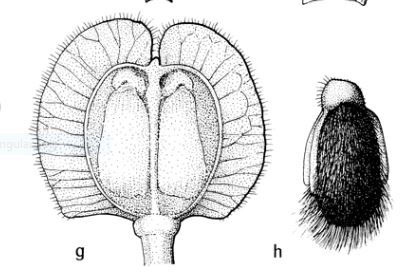
Polygala fruits and seeds have odd features.  Most have furry seeds.   I don’t know why but a guess is protection from the ants usually responsible for seed dispersal.  Most Polygala species offer a food packet on the tip of the seed.    Ants drag the seeds with benefits back to their nests for lunch, and maybe the hairy coat deters overzealous munching.    Some species have no ant help, and have the seed hairs modified into hooked VELCRO, apparently snagging fur or feathers of passing creatures.      Additionally, some species have thin wafery wings on the fruits, suggesting a role for wind in relocation.  Most or all of our local species seem to be ant-dispersed.
Po;ygala rhinanthoides Fl Malesiana

Winged fruit, and hairy seed, the food packet at the tip.  From Flora Malesiana.

Because the genus is beautiful,   and has historical virtues, and is in Europe, let’s see what they thought of it in Merry Olde England.  Well, how handy, I have a reprint copy of Gerard’s 1636 Herbal at my elbow.   Now read together from Gerard:
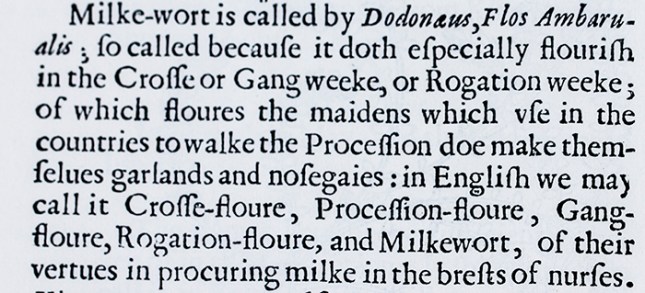
Polygala Gerard

I always assumed the modern name “Procession Flower” for our Polygala incarnata to reference the inflorescence blossoming over time into a “procession” of individual flowers, but, looky there,  Gerard  already had the name in the air centuries ago with an entirely different meaning.
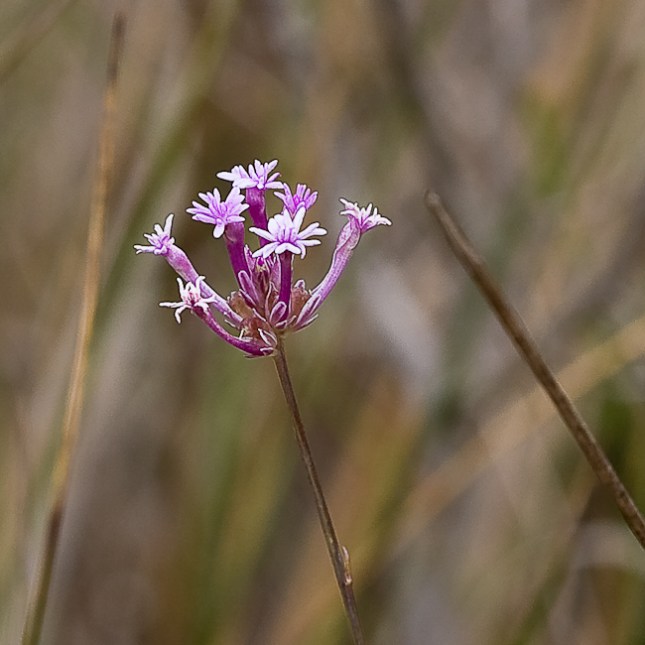
Polygala incarnata 2

Procession Flower, P. incarnata

Speaking or processions, Rogation is the Christian celebration immediately before the Ascension, traditionally observed with processions, apparently enhanced in Gerard’s world with garlands and “nosgaies.”  Wouldn’t Rogation time be soon,  with the Polygalas here in Florida on schedule?
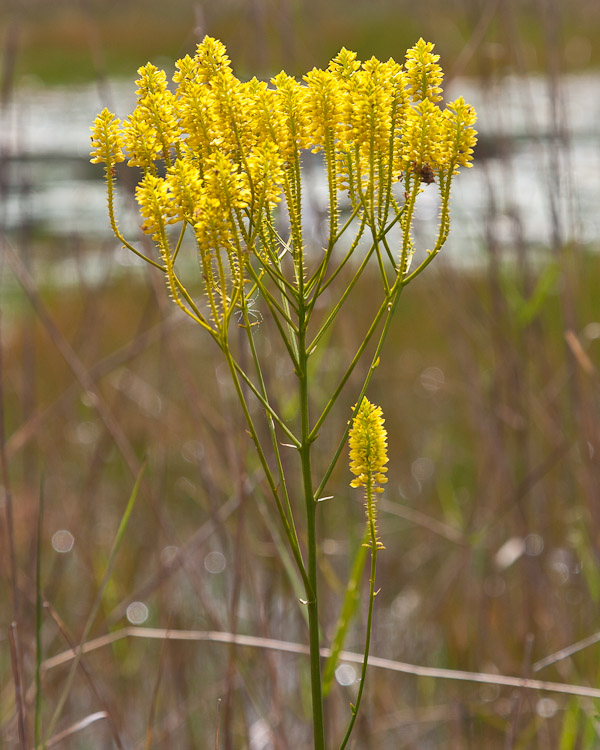
Polygala cymosa 7

P. cymosa

These are bioactive plants, some having wintergreen essence in the roots.   Being worldwide and conspicuous, no surprise they have a catalog of historical medicinal uses, too many to probe here, and not that interesting.    Except for one,” procuring milke in the brests of nurses.”   That would explain the common name we really use for Polygalas nowadays,  milkworts.  I love the sources that say the name has to do with cows in pastures, yea, sure, a pre-GMO BST.   In fact, Gerard goes on to say milkworts to promote lactation date back into ancient times.  Does it work?  I do not know.  But I do know it contains poisons procuring vomit.
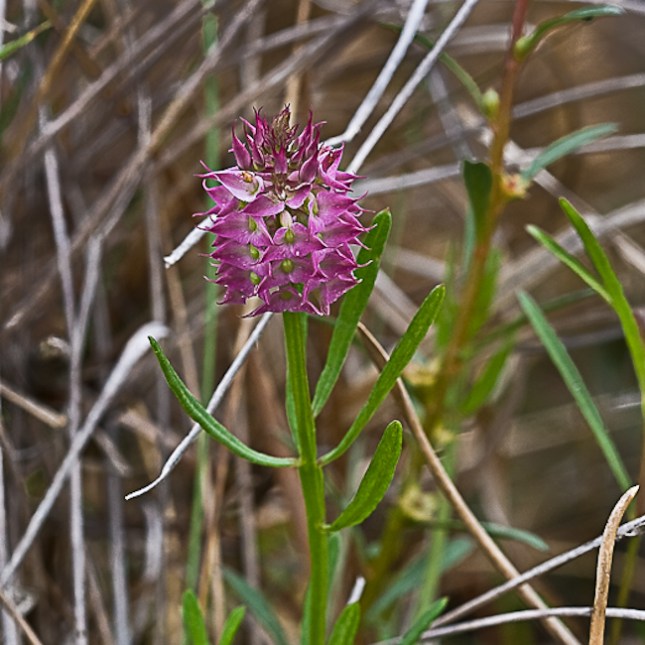
Polygala cruciata 1

P. cruciata

So don’t eat the milkworts, just head out anywhere open and moist, and seek out the color.  To quote Gerard one last time, ”these  plants or milk-worts grow commonly in every wood or fertile pasture whereforever I have travelled.”
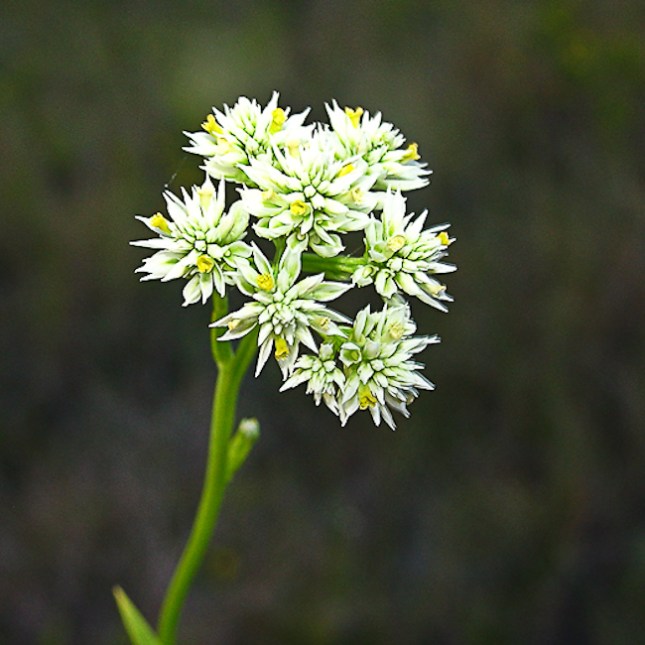
Polygala balduinii 2

P. balduinii
 
5 Comments

Posted by on April 28, 2017 in Uncategorized


Three Invaders – However Did They Come?

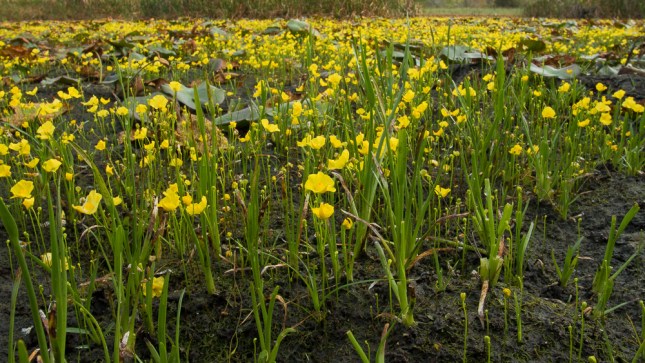
This afternoon was hot!  John and I sweated  90 degrees to sink to our ankles in warm stink-mud near Jensen Beach, Florida to behold a zillion Bladderworts.  The site is about half overpowered with invasive exotic species and about half restored to an intriguing dried pond carpeted with carnivorous yellow Bladderworts.

Utricularia subulata 10

Bladderworts in the mud.  Photo by John Bradford.

Because we’ve covered these greedy meat eaters previously, let’s turn to the invasive exotic species.  For most of the hundreds of unwelcome escaped plants in Florida it is easy to surmise how they got here:  running away from gardens, or feeding livestock,  or hitchhiking as seeds or spores.    Some pests have have more-interesting histories.

Let’s take a shot at the novel cases, with a disclaimer that just because somebody introduced a species once does not mean nobody else did before or after.   That is impossible to pin down, and records are murky.

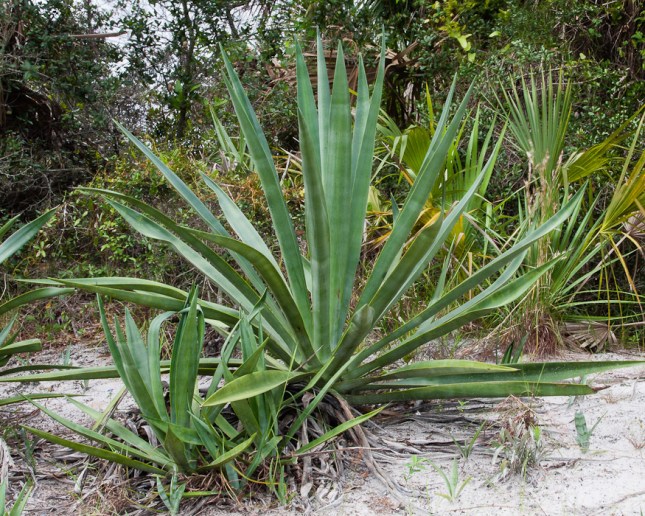
Sisal Agave

Sisal is a Category II invasive exotic species looming large in hot dry habitats locally.  It dates back to Florida’s first well documented horticulturist, Dr. Henry Perrine.(1797-1840).   Dr. Perrine had an eventful life, first as  “The Little Hard Riding Doctor” in Illinois, where, oops,  he accidentally drank a bottle of arsenic.   That mishap drove him to Mexico, the toxic damage causing a craving for a warm climate.  In Mexico Perrine  doctored a cholera epidemic, which he caught of course, and yet survived as his second brush with death.

Agave vivipara 1 - Copy

Sisal in Jensen Beach, by JB

In addition to doctoring,  Perrine served as U.S Consul to Mexico, coming under a presidential executive order to ship Mexican crop plants back to the U.S.   He sent them to Indian Key in the Florida Keys, and took a special interest in Agaves, including Sisal, writing a book on the plants.  Sisal was and remains a commercial source of fibers.  To this day Indian Key houses Sisal Agaves, as does much of South Florida.   Perrine retired from Mexico moved to Indian Key to tend his introduction garden, and to be a doctor where one was needed, but never lived to see the literal fruits of his labor, as he suffered “strike three,” death at the hands of angry Indigenous People in 1840, and thus ended Florida’s first botanical garden.

Water Hyacinth

Water Hyacinths are lovely floating plants with spikes of  attractive purple flowers.

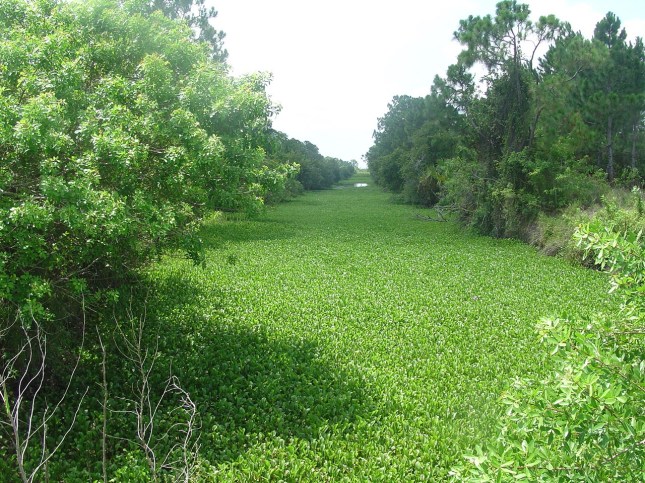
All well and good if under control, but Water Hyacinth broke out and conquered Florida waters and beyond, sometimes smothering watery  acres with millions of  itself, clogging waterways and interfering with ecology.   Maybe it should become a biofuel.

Eichhornia crassipes 2 - Copy

Hyacinth to the horizon

How did a bad deed like that get started?  A careless lily pool owner?   No.  Hyacinth Hell traces back to the 1884 New Orleans Cotton Exposition (World’s Fair), where they had a mammoth greenhouse with mind-blowing horticultural exhibits.    Not bad for 1884!    But that is not exactly where the Hyacinth originated.     Each Fair visitor received one as a keepsake, only to go home all over the South and unleash the scourge.   CLICK for cinematic documentation.

Showy Rattlebox

Mirror mirror on the wall, who was the biggest plant introducer of them all?   That is easy, David Fairchild (1869-1954), namesake of Fairchild Tropical Garden in Miami.   No space here for a long biography, so suffice it to say  Fairchild had a penchant for cultivating the rich and famous, and for marrying their daughter.  He was Alexander Graham Bell’s Son in Law, and hob-nobbed with luminaries of the era, oh say Orville Wright for instance.   The opportunities and funding from his VIP connections put Fairchild and his team in a position to travel the world and introduce, via the USDA maybe 200,000 different plants into the U.S.

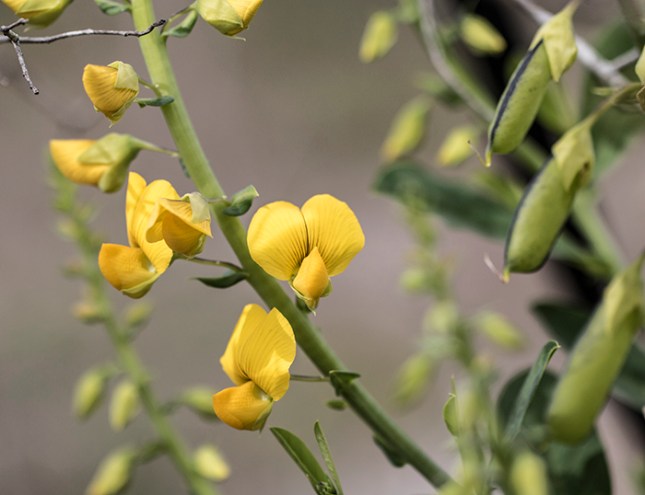
Crotalaria spectabilis flowers Cypress Creek - Copy

Showy Rattlebox, by JB

Included in his voluminous records are species of Crotalaria, beautiful yellow-flowered Rattleboxes, species now scattered abundantly in every disturbed site locally.    Some gardeners know Sunn Hemp (yes with double-n) as one example, although it is not commonly escaped in Florida.  A similar, gorgeous species is all over our area, well named “Showy Rattlebox.”    It is so colorful this species must have come as a garden ornamental.  Wrong.

Fairchild and his crew cultivated Showy Rattlebox and related species as companion crops for citrus and other fruit species.   Fairchild thought C. spectabilis dated to around 1920 in his Miami experimental gardens.
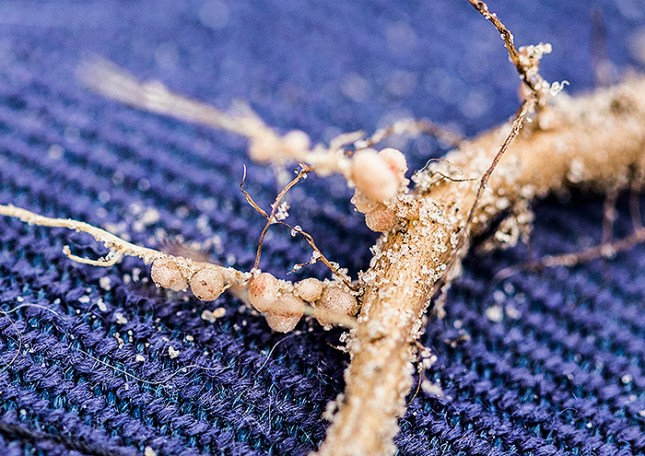
Crotalaria spectabilis nodules

Showy Rattlebox nitrogen fixing nodules

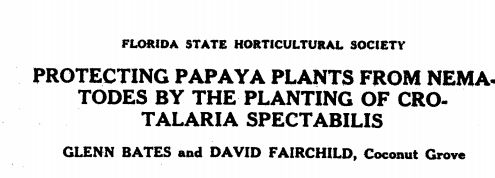
Beyond good looks, the species has nitrogen-fixing nodules, as a good legume should.  And willing to prosper unwatered on terrible soil in brutal sun.    Maybe that ability should have been a red flag,  but trouble took time to appear.   In the meantime, Fairchild and others waxed eloquent on the virtues of Showy Rattlebox, not only for nitrogenating fruit crop soils, but also for fighting soil parasitic nematodes attacking Papayas.

crot fairchild article

 
8 Comments

Posted by on April 21, 2017 in Uncategorized


A Mighty (Small) Oak and its bigger buddies

Quercus minima

Fagaceae

Today John and I haunted Jonathan Dickinson State Park, near Hobe Sound Florida, finding  the flora abloom, at least in  marshy meadows,  nature’s garden complete with blooming butterworts,  orchids, meadowbeauties, milkworts, sundews, tillandsias, and too much splendor to portray with a list.

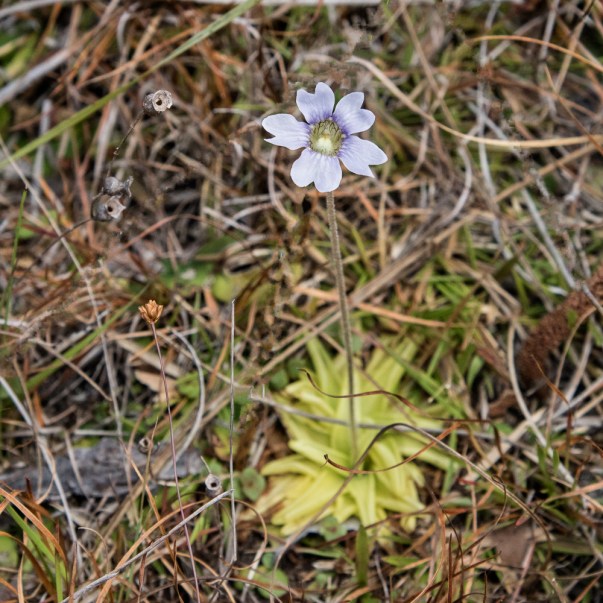
Pinguicula caerulea 3

Butterwort today.  An insectivorous plant.  All photos today by John Bradford.

The practical mission  is John’s serial  long-term photo record of “what happens after a burn.”

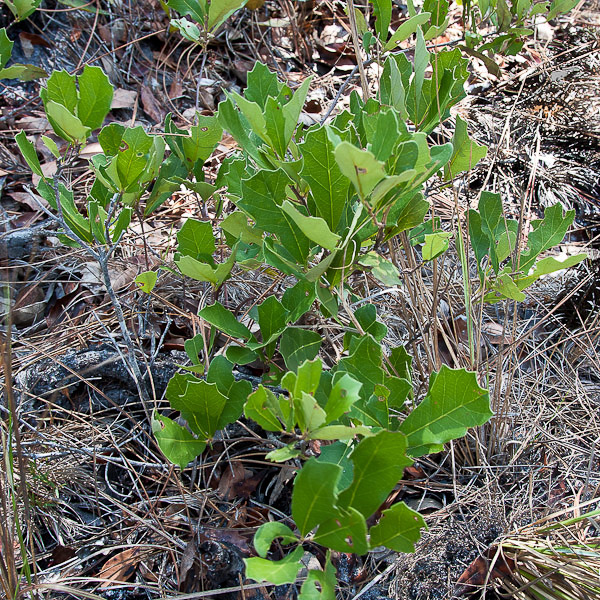
The blaze was about a year ago, and by now the scorched earth lies under fresh green oak boughs.   Oaks resprouted “from scratch” in a year?    Well yes, about a foot tall with no  ambition to rise higher.    These are dwarf live oak, Quercus minima, resurrecting to new life from fireproof subterranean rhizomes.

Quercus minima 2

Quercus minima towering to 9 inches tall.   The first-formed leaves are toothy lobed.

Are dwarf live oaks tiny representatives of the big  live oaks (Q. virginiana) shade trees festooned with Spanish moss across the South?    Almost.   Harvard University botany demigod Charles Sprague Sargent long ago perceptively classified both as extremes of a single species.

Quercus virginiana 8

Quercus virginiana can be huge and old.

The same question extends to a second locally abundant small oak plausibly interpretable as a variant of big Quercus virginiana.   This is sand live oak, Quercus geminata.   With variation, it is most often a shrub or smalli tree intermediate in size between big virginiana and little  minima.

What is the relationship among the three? Molecular data can settle kinship, whether for  Maury Povich or for curious botanists.    A useful DNA-centered study for today’s tree trio shows  live oak, sand live oak, and dwarf live oak together to comprise one exclusive branch on the oak evolutionary tree.  The three are most closely related to each other than any is to any other oak.    In short, it would be “legit” to see three varieties of one variable species,  or alternatively as three sister species, the latter interpretation prevailing nowadays.

Quercus germinata 3

Sand live oak

There is a compelling case for giving each its own species designation.  Chevrolet and Buick are varieties of GM yet have their own “species” identities.   Our three live oaks have diverged from a common origin over time into fairly distinct identities.    Oaks are famous for hybridizing, yet live oak, sand live oak, and dwarf live oak, all living intermixed, seem to have evolved barriers to criss-crossing, although Q. geminata and Q. minima can form a rare hybrid called Q. succulenta.     More prevalent is hybridization by each with distant cousins outside the trio.

The DNA study mentioned above is the 2015 work of botanist Jeannine Cavender-Bares and collaborators.  They noted how our  three live oaks diverge most saliently along lines of response to fire:  Q. virginiana massive, long-lived, sturdy, and intolerant of fire;  sand live oak mid-sized with grudging ability to regrow after fire; and  dwarf live oak dependent on fire.   Maybe it is all about diversification into habitats with different fire patterns.

Quercus minima hybrid

This looks like a hybrid, maybe, between dwarf live oak and Chapman’s oak.

All that said, there is an asterisk.  Quercus virginiana seedlings make a thick underground tuber before the tree grows into a mighty oak for 500 years.  Should the baby seedling be grazed, burned, or flooded it can resprout from its tuber for a second chance.   Could Quercus minima be sort of an “infantilized” live oak that remains small and took that original fireproof  temporary  “tuber” from its ancestor and expanded upon it?

Dwarf live oak has an odd foliar feature.  The earliest leaves on a branch have lobed toothy margins.  As the branch elongates, however, the younger leaves develop toothless.

Why make a transition like that?  Here is a speculation.  I think teeth and lobes on leaf margins help dissipate heat.  Maybe when the twigs are young and close to the sun-baked Florida sand below the cooling wind, where fire burned away all shade, perhaps the leaves need to shed heat.   Later, as the branches rise into the breeze, and as overhead shade increases during fire recovery, the overheating problem diminishes, making the lobed heat-shedding leaves obsolete.  Only a guess.

 
5 Comments

Posted by on April 14, 2017 in Uncategorized


Iris hexagona (or I. savannarum)

(Iris is Greek for rainbow.  Hexagona counts the angles on the seedpod.  Savannarum is where it lives.)

Iridaceae, The Iris Family

The geographical consequences of evolution do not always fit our tidy 18th Century classification categories,  iris for instance    My two favorite go-to references disagree on the species identify for the wild blue-violet iris around town.  No surprise.  Irises defy easy species classification:   they hybridize, they spread as clonal populations each with its own character,  they vary geographically.   You get the picture.  Messy.  Naming iris species is like naming clouds merging and separating across the sky.  A rich, dynamic tapestry of ever-evolving variation overmatches a classification system based on sorting dead pressed museum specimens..

Call it what you will, sometimes you just have to put a plant in the blog for its celebrity good looks.  What flower is prettier than these?  John and I stumbled upon a natural iris garden blossoming by a muddy pond near Jensen Beach, Florida.

Iris hexagona 5

The big showy droopers with yellow marks are the sepals.  Lying tightly on top of them with tips elevated are the styles.  The petals are upright between the sepals.   Photos by John Bradford.

Standby for pollination complexity. Those big showy drooping “falls” with the beckoning yellow nectar guides are the sepals, which in most other flowers are green no-count lobes upstaged by colorful petals.  The iris petals are less showy and less involved than the sepals, a case of role reversal.    Lying intimately atop the colorful sepals are the styles, likewise fancy and out of character.  In most flowers the styles are nondescript green stalks connecting the pollen-receptive stigma to the seed-making ovary. Ho hum.

Iris hexagona 1

But the iris style is a horse of a different color.   It is as colorful as the sepals, lying intimately atop them. The visiting bumblebee, the predominant pollinator in our species, pushes into the blossom squeezing between the sepal and style covering it.     The pollen-snatching stigma lies within a  hinged flap on the underside of the style, scraping pollen off of the inbound bee’s back.   Then deeper in the blue tunnel new pollen dabs onto the bee seeking its nectar reward.   As the bee backs out upon completing its mission, it pushes the stigma-covering flap closed, preventing self-pollination

Someday somebody’s going to study the hormonal life of rhizomatous clonal plants sprawling as single genetic individuals covering acres.  A single big plant with the leaves and flowers scattered across a broad network of rhizomes has a problem—how does a plant stretching all the way across a marsh communicate from one side to the other?   They do not have nerves or circulating blood.

Iris hexagona 4

The best way for the point of attack to communicate impending trouble perhaps is across the air.   Iris hexagona has attracted research attention in this connection, most prominently by biologist Susan Mopper in Louisiana.    Iris hexagona uses a hormone called jasmonic acid in conveying a danger signal probably over long distance, given that jasmonic acid volatilizes for airborne delivery.  This is extra interesting because jasmonic acid has not been a known plant hormone for very long.  And yes, it is named for jasmines where it was discovered.   Dr. Mopper and collaborators showed that saltwater stress prompted Iris hexagona to bolster its defenses against leaf-damaging insects, in other words, one “attack” spreading the alarm girding the plant for the next battle.

To linger a moment on jasmonic acid,  it seems more or less to form from damaged membranes, pretty ingenious, a warning based directly on the immediate debris of damage, sort of like pulling the fire alarm upon smelling smoke.

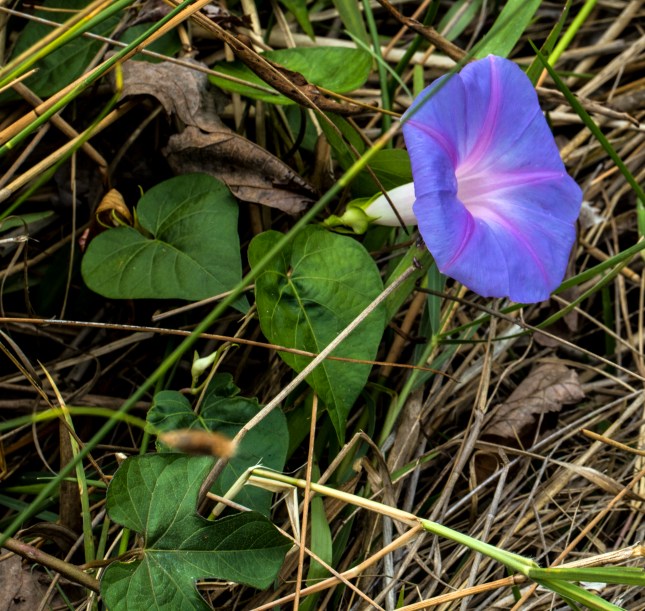
Ipomoea indica Baker Rd.

Morning Glory hanging around the iris, the same color.

 
5 Comments

Posted by on April 7, 2017 in Iris, Uncategorized


Leafless Beaked Ladiestresses, Dressed Up But No Visitors

Sacoila lanceolata

(Translates roughly as sac-lip, referring to the chinlike sac near the flower base.  Lanceolate leaves resemble a spear tip.)

Orchidaceae, the Orchid Family

Florida is an isolated long thingamabob jutting rudely into the almost-tropics off of the mainland U.S.    Except for raised sand ridges, scrub, South Florida was underwater until not many thousand years ago, a wink in evolution time.  Where did Florida acquire its hot-climate species? From the American Tropics in large part.  Many Florida species extend southward to South America.

Given the need to cross water to get here, you might then expect many of our species to be dispersed easily…by sea currents, by storms, by birds, by pre-European ancient seafarers.    Fern spores and orchid seeds are dust in the wind, no doubt arriving by airmail daily.

Sacoila lanceolata 6

Sacoila.    All photos today by John Bradford.

Showing up precedes the greater challenge of taking hold and spreading, which brings us to today’s orchid.    Sacoila lanceolata ranges from its origins probably in South America to a marginal outpost in Florida.  It likely had no problem arriving in the sunshine state, but multiplying and spreading presented a special hurdle.  Let me explain.

Over the last couple weeks Sacoila has flaunted its red flowers on a near-leafless stalk  in a soggy shaded swamp.  It displays those big blossoms proudly, but to whom?  Any textbook will tell you red tubular flowers that size with no fragrance are all about hummingbird pollination.  And that is a problem, because hummingbirds are  too scanty for reliable floral sex services in South Florida.  Why then is this little showoff  putting on the ritz for nobody?

The first part of a reasonable answer is easy:   it evolved elsewhere with plenty of hummingbirds, and then seeds blew to Florida and grew where it does not know its display is useless.   A little depressing, and then we wonder how without being able to complete its sexual cycle the forlorn orchid managed to spread across much of Florida.

Botanist Paul Catling looked into this question back in the 80s.    The answer split surprisingly into two answers.    First answer:  in South Florida these orchids, instead of pollination, form clonal seeds where the embryos are tiny bits of the mother plant.  No hummer help required.

Sacoila lanceolata 2

The second answer is that one population of today’s species, called variety paludicola, has a different skill, pollinating itself.

How bout that!  A species stranded in Florida without its natural pollination agents “invents”  not one but two birdless ways to make seeds.   Evolution is inventive.

Which came first, the orchid coming to Florida and then evolving pollinator-free seeds?    Or, alternatively,  did members of the species somewhere else develop one or both of the sexless seed-making mechanisms, empowering them then to invade beyond the range of their original pollinators?  I vote for the second scenario.   In fact, the self-pollinating  variety is reported from the Caribbean.

Sacoila lanceolata 5

If Florida is home to far-ranging species  colonizing apart from their usual pollination agents,  there must be additional species here with tricks similar to those of our red-flowered friend.  Plenty  Examples of local plants able to sidestep normal pollination include other orchids, pitch apple (one big female clone in FL),  daisy fleabanes,  dandelions,  Fakahatchee grass,   and agaves probably brought to FL by ancient humans.

Don’t get hung up on the word “leafless” in the name.    Leaves form, sometimes coincident with the flowers and sometimes at a separate time, and their photosynthesis feeds a hunky root system.   By the time the fancy flowers brighten the world, there’s been a lot of  root-building off-stage.     The plants probably go years without flowering at all.

——————————————————————

 
2 Comments

Posted by on March 31, 2017 in Sacoila, Uncategorized


Persimmon’ll Tan Your Tonsils

Diospyros virginiana

(Dios, god,  pyros, grain = divine grain, an ancient name for a tasty treat.  Virginiana is self-explanatory, a great state for Persimmons and for lovers)

Ebenaceae, the Ebony Family

Fridays!  Deployed for non-teaching:  on a bad day meetings, on a good day botany.  Today, eye doctor, delaying the fieldtrip with John until late in the day, when we found stunning red-flowered Leafless Ladies Tresses, Sacoila lanceolata.   I was too doctor-blind to shoot a picture, and John needs time to process his.  Will sneak it into a future blog cuz it is so dang purty.  So then, in 20-20 hindsight, my Native Plants Class yesterday encountered more beautiful species at Grassy Waters Preserve near Palm Beach Gardens, Florida, than you can shake a Sacoila at.

Diospyros virginiana 1

Persimmon. All photos by John Bradford.

Blooming now in the wet mud there is Persimmon,  a tree I know best from rocky hilltops in The Ozarks, and more recently as a wet friend in the swamp.    The contradictory divided habitats seem odd?  Species represented in swamps and also high and dry are not that rare, but that’s for another day.  Persimmon tolerates diverse circumstances across much of eastern North America.

Persimmons have hundreds of species, a few to be seen or eaten in Florida, although D. virginiana is the only native. Diospyros kaki, an Asian species with many cultivated selections, is the big orange persimmon of grocery stores.   Florida fruit fanciers likewise savor “Chocolate Pudding Tree” (Diospyros digyna, aka D. nigra,  aka Black Sapote).   Escaped at the southern tip of the state is the Malay Persimmon, D. maritima.   True Ebony, Diospyros ebenum, is cultivated a teensie weensie here in Palm Beach County.

Multiple species of Diospyros are marketed as “Ebonies,” which raises the question, does our native species have dark “ebonyish” heartwood? Yes, and there’s more.   The chunky bark served historically as a source of inky dark dye, and “indelible ink” reportedly can be made from the fruit juice.

Diospyros virginiana 2

Peach colored petioles.

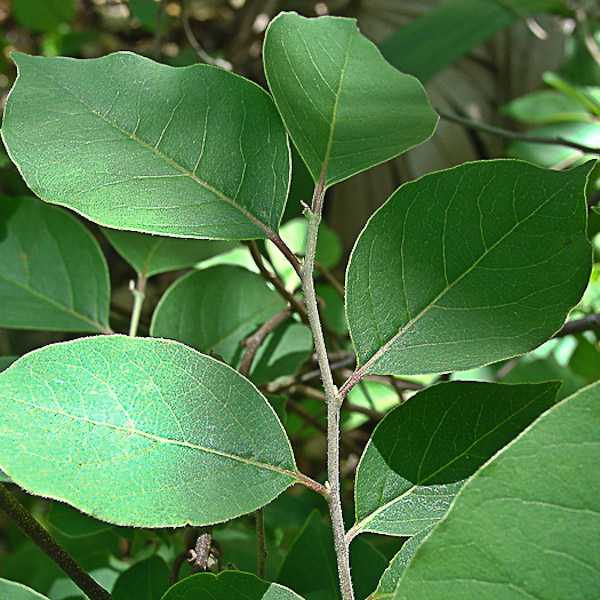
In the absence of bark, fruit, or flower, Persimmon can be challenging to recognize, but here is a handy hint…the twigs have no buds at their tips…they just fizzle out.   Good clue, and here’s more, the leaf stalk tends to be reddish or peach colored, at least when young.

Native Persimmon is one of the most delicious foods in the megaverse.   I’d trade a bushel of Chocolate Pudding fruits and Publix Persimmons for a half-dozen fresh ripe native Persimmons, but good luck finding any here.    Scarce they are, and the wildlife beats you out.   To be totally tasty, they need a frost, although there are frostless cultivated selections.  The trees are separately male or female, and they clone by root suckers, with the consequence that an entire “population” can be completely male, never making fruits.

Biting an unripe Persimmon fruit is memorable.  Pucker up Buttercup!    It is astringent on steroids, which explains the old-time use of the juice to relieve “piles.”    Astringents still help down south, and it all has to do with tannins.    Tannins are plant products with a super-power—to bind proteins.    That is how tannins tan hides…they tie the proteins to each other, helping to preserve the skin  presumably by rendering the proteins inaccessible to decomposers.  (This to be more my presumption than scientific fact.)   In your mouth, they “tan your hide” too, instantly interlinking the proteins there.   That is potent protection from unwelcome nibblers.    DO NOT even think about eating my fruit before it ripens! (The seeds are not yet good to go.)

Diospyros virginiana 3

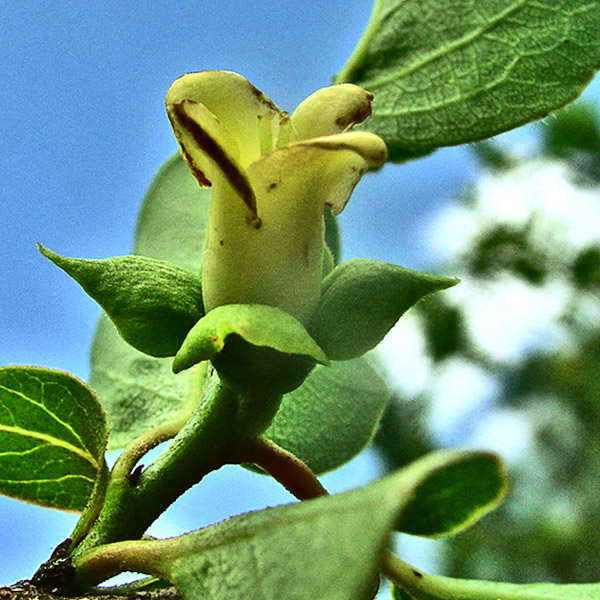
The flower, magnified

But how then does the fruit go from dreadful to delightful upon ripening? Early in development the tannins collect in special cells called, yep, tannin cells.  Little bags of trouble.   The toxic tannins sequester safely until they cross your lips.   You might think chewing breaks the nasty little bags to unleash the torment, but wrong.  Back in 1906 botanists showed the tannin trigger to be saliva entering tannin cells by osmosis.   No need for a biology lesson on osmosis here; suffice it to say dissolved tannins draw spit into the tannin cells to build pressure and burst the little poison balloons.

That explains the punishing pucker.  But we ask again impatiently, how do the fruits become harmless abruptly when the time is right?   Does the tannin go away?  No.   The tannins condense into harmless crunchy grains no longer having the ability to draw in water nor to bind proteins.  Has Persimmon served to tan leather?  Yes, although commercially there are better sources.

 
4 Comments

Posted by on March 17, 2017 in Persimmon, Uncategorized


What does the Leptospron flower have in common with 6 AM?

(It’s twirly) (too early)

Leptospron adenanthum

Fabaceae, pea family

Although John and I have an early field trip planned for tomorrow  (Friday), the rest of the day and evening will be unavailable for blog writing, so jumping the gun a day early..   A couple “new” non-native weeds, both  with a twist,  have popped up hereabouts in Jupiter, Florida.

Fourspike heliotrope (Euploca procumbens) invading from  the American Tropics is perhaps welcomed northward by Global Warming?   A  coiled inflorescence helps with recognition of this and other heliotropes.


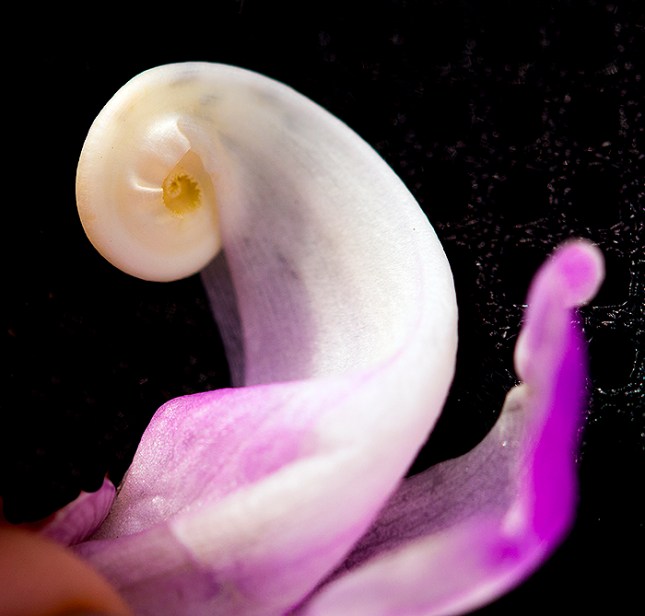
Twisted weed Euploca procumbens.  Compare its snail shell flower cluster on the left with the keel tip below.

Possessing its own much smaller coil, literally growing alongside the Heliotrope, is Leptospron adenanthum, which is one of several snail-flowered legumes.

Leptospron with foliage

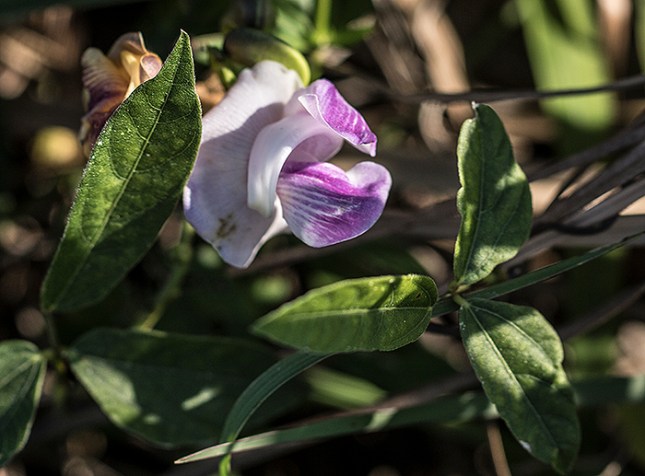
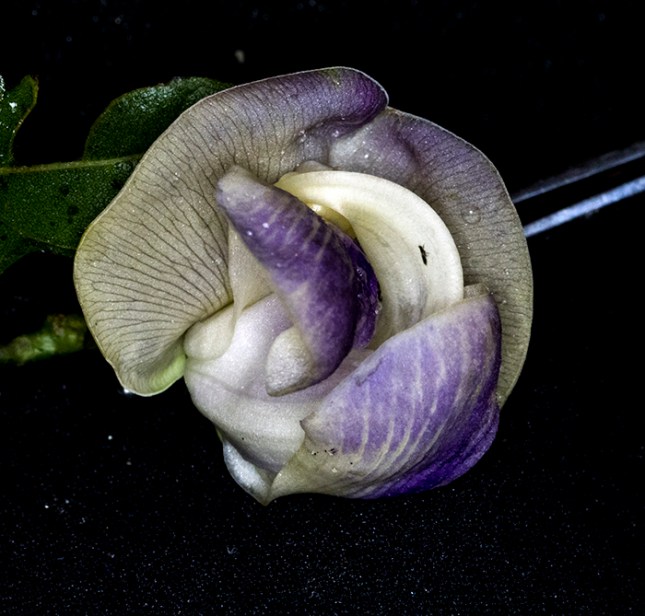
Leptospron flower and foliage,

We could call them “corkscrew vines” or “snail flower vines,” as we could some other legume species, because they have curling in the flower reminiscent of a snail shell.  Several not-closely-related members of the Pea and Bean Family  do  the twist,  three of them lookalike garden flowers distinguished in the notes below. Any of these “snail flower vines”  encountered in Florida are escapes from ornamental horticulture or conceivably from cultivation as fodder.   They are in different genera, which begs the question, “why do distantly related species all evolve independently the same weird contortions?”   There must be something useful to it, some common benefit.  Convergent evolution.

Dangling from tree branches in South Florida, including Cypress Creek Natural Area in Jupiter,  is Leptospron adenanthum, an example of how Mother Nature can take an old groundplan and give it a new twist.   We need to understand the straight basic structure of a pea-type flower as a staring point. Then we’ll put a new spin on it.

Legume Flower

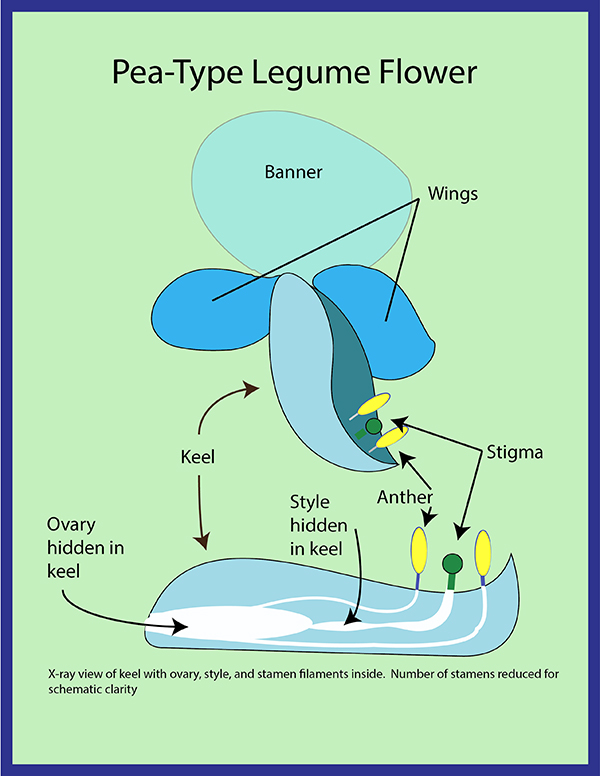
Standard untwisted pea or bean flower.  Be sure to find he banner, wings, and keel.

In most pea-type flowers there are 5 petals:  a banner petal behind the rest of the flower like a photographer’s backdrop;  two wing petals reaching out on either side like stubby arms; and a central keel made of two petals pressed face-to-face to form a single envelope.  The keel resembles a very narrow boat sealed on three sides and open or partly so at the top.    The pollen-making anthers and pollen-receiving stigma lie hidden within the keel where visiting insects land.  The visitor’s weight pushes the keel down, allowing the anthers and stigma to pop up via the open top and touch the underside of the insect.


Leptospron adenanthemum close in 1

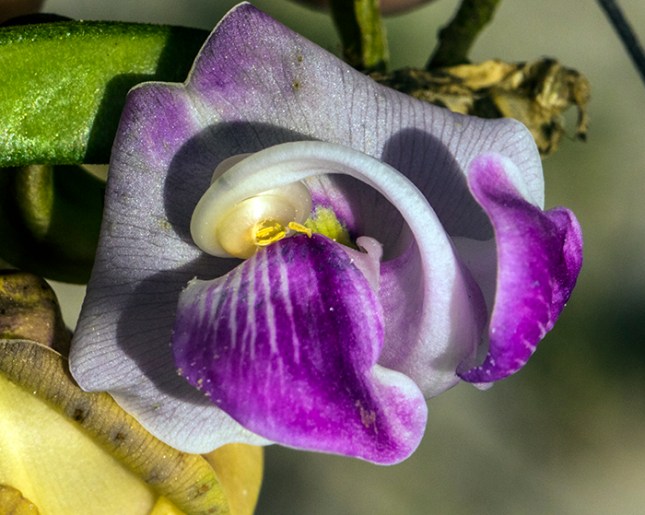
Leptospron.   The left (as we see it) wing is the landing platform with white lines pointing to the yellow  coiled keel tip.   Just to the right of the  coiled keel tip is additional yellow on the banner.   The large white arch is the lower region of the keel.   The righthand wing is out of the way.


Leptospron style

Keel isolated

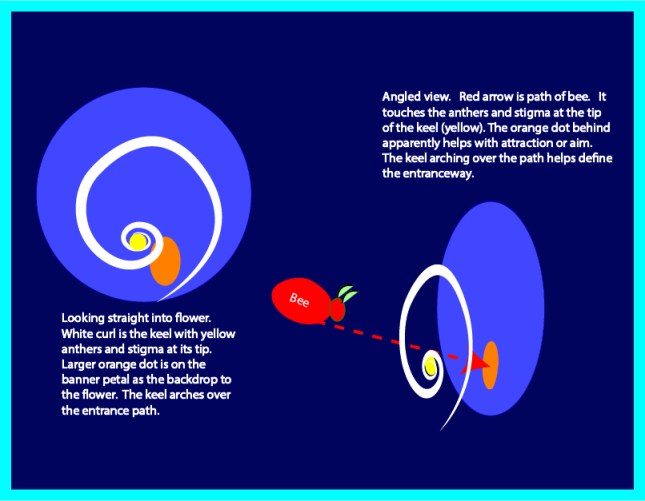
Leptospron turns the beat around  You have all these petals, but in  novel and complex arrangements with altered functions.  The biggest alteration is to the keel.  It becomes long,  tubular, curled, and coiled.  The keel curls in its lower half to form an arched doorway covering the passageway into the flower.  Then it goes through multiple corkscrew twists toward the tip, there resembling a small snail shell.  The coiled shell is positioned near the central base of the entranceway,  has a yellow tip presumably attractive to a bee, and has emerging from the tip the stigma and anthers, the sexual business parts of the flower.

leptopron diagram dark background lt border

The banner  has a yellowish spot near its base along the same line of sight as the all-critical yellow keel tip.  The two yellowish spots team up to make an emphatic double bull’s eye—bee aim here!

One wing petal takes over as landing platform, leading compellingly to the dual yellowish spots.    This all guides the right bee into receiving and delivering pollen with precision.

To be annoyingly redundant, the  odd modifications include:

  1. Having a wing become the landing platform with nectar guides into the flower
  2. Having the keel arch up over the top of the entrance giving rigidity and definition to the approach. (And maybe the bee’s contact with the arch helps with pollen placement or release.)
  3. Having the distal keel portion coiled to place and pick up pollen surgically at its tip.
  4. Having the banner offer yellowish reinforcement to the small yellow zone on the keel tip.

Night is odd too.   The entrance closes.   The wing petal not serving as the main landing platform (on our right viewing the flower)  folds upward and blocks the arch entranceway. The wing petal (on our left) serving by day as the landing platform seems to rise and push itself against the flat face of the coiled keel tip, hiding its yellow marking, and blocking access.   The flower is closed for business!


Leptospron night

Night.  The righthand wing has folded up to block the flower entrance.  The lefthand wing rests against the flat face of the keel  coil, blocking access to it.  

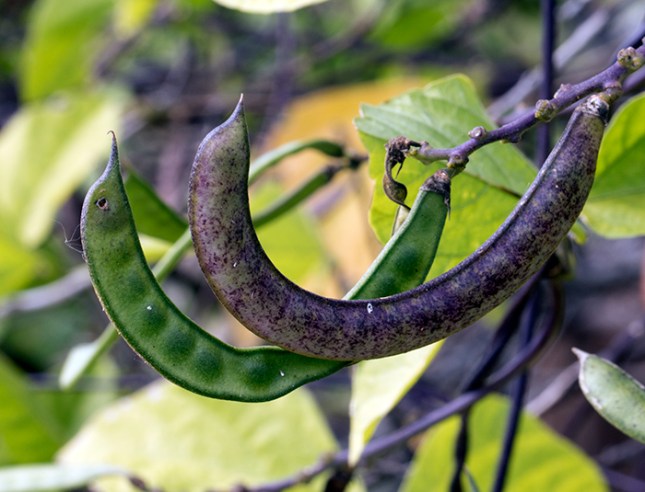
Leptospron pods

Sickle-shaped flat pods.


The End

————————————————————————

Notes for over-achievers.

A few  details beyond the main story.   Botanists have suggested the ultra-long keel may filter out “wrong” pollen.  To achieve sperm delivery a pollen grain on the stigma must produce a threadlike pollen tube that grows a microscopic thread, the pollen tube, down through the style to deliver sperm to the eggs in the immature seeds.  Pollen tube, style, and keel are all the same length. Only the correct pollen tubes can go the extra distance.  Those from other species come up short and thus fail to mis-fertilize the eggs..

Tthe anthers and stigma juxtaposed in that tight curling keel risk pollen transfer from anther to stigma within the keel.  But no worries.   Leptospron has a membrane protecting the stigma.    Probably an aggressive bee breaks the membrane.

*Three showy legumes with similar “snail” flowers.  These resemble each other and are mututally confused.  The guide below might help.   As far as I’m concerned, English names for any of them are almost worthless.

Cochlisanthus caracalla (Vigna caracalla, Phaseolus caracalla)

Whole flower twisted or wavy, and the buds twisted (vs. buds straight in the others)

Flowers numerous in dangling clusters (vs. flowers few or one)

Pod resembles green bean (vs. flat)

There is a detailed study of tis species in Ann Bot. 2008 102(3): 305–316.


Leptospron adenanthum (Vigna adenantha)

Buds not twisted (vs. twisted in Cochlisanthus)

Flowers few or just one per cluster (vs numerous in Cochlisanthus)

Keel with about 3 full twists (vs. merely looped into nearly a circle in Sigmoidotropis)

Fruit flat and uniquely C-shaped, much broader than that of Sigmoidotropis


Sigmoidotropis speciosa  (may be sold as Phaseolus giganteus)

(Often called “Giant Snail Bean)

Flowers few

Keel looped nearly into a circle (not with multiple corkscrew twists as in Leptospron and Cochlisanthus)

Fruit flat, long, narrow, straight, the halves twisting upon opening (much longer and narrower than in Leptospron)

 
Leave a comment

Posted by on March 9, 2017 in Leptospron, Uncategorized


Scrub Hickory and its Inner Phylloxerans

Carya floridana

Juglandaceae

carya-floridana-8

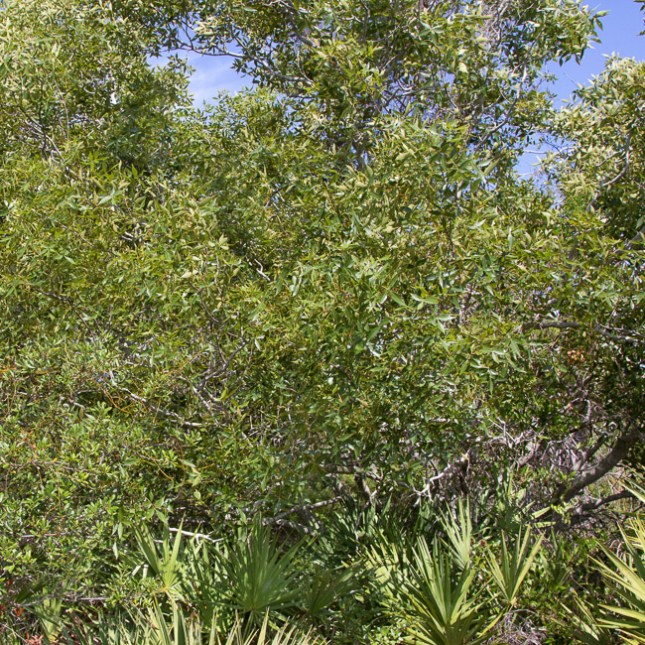
Small Scrub Hickory.  All photos today by John Bradford.

Today John and I botanized  a local coastal hammock remnant, Maggy’s Hammock (aka Rocky Point Hammock)  near Stuart, Florida,  species galore in a square mile.   As tempting as it is to start listing, we better pick one species and stick to it.    The alpha trees are Florida hickories, some with trunks, oh say, a yard in diameter.   Florida hickory is well named, being restricted to Florida, living in high dry  habitats.

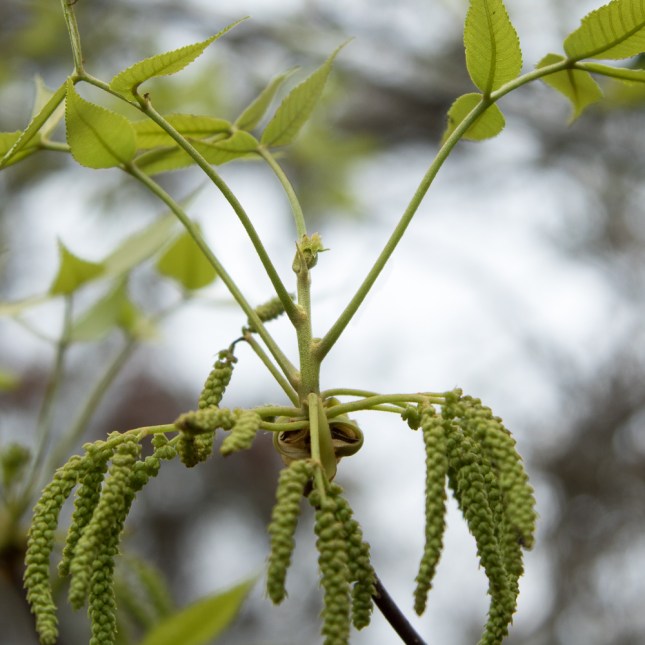
They are in full bloom today, although their wind-pollinated flowers are not showy.  The males dangle clustered in spikes called catkins.  The females stand solo.

carya-floridana-11

Flowering twig.  Male flowers in catkins.  One green female flower at the twig tip.

Hidden within, the trees have a secret, phylloxeran galls*.

Huh?

To explain the galls it is necessary to refer to another wonder of Florida nature:    Koreshans.    Phylloxerans  have much in common with Koreshsnas, just on a smaller scale:  they both lived on the inside of their globes.

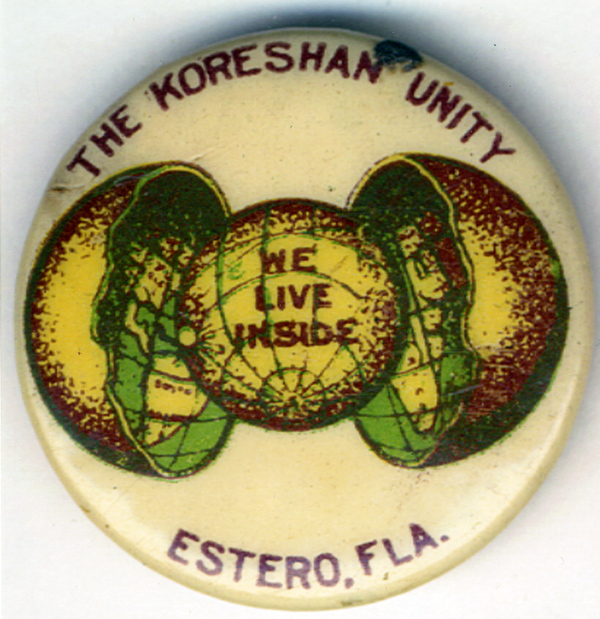
The Koreshans were a utopian community  a couple generations ago at Estero, Florida, near Ft. Myers.  Their village persists  as a state park.  There’s a ton to tell about them, but to stay on-topic, the important thing is that they lived  inside the globe.   Koreshans knew the rest of humanity had the world-wrongside-out.

:This button may help you see where they lived:

koreshan-button

Koreshan Unity button. 19–. Color photoprint. State Archives of Florida, Florida Memory. Accessed 3 Mar. 2017.

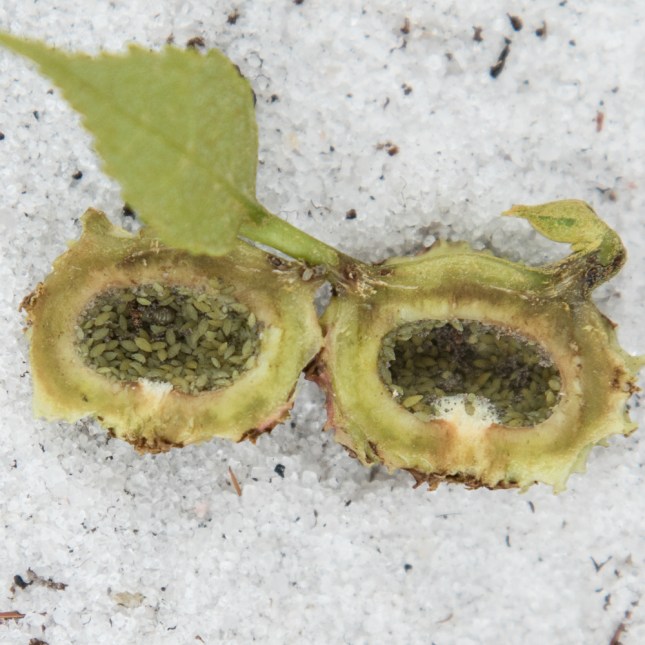
Today’s phylloxerans are the micro-Koreshans of Maggy’s Hammock.  They live on the inside of their little globose gall the diameter of a grape.    Slice it open…there’s a utopian world within.  Hundreds of tiny Koreshan phylloxerans.

carya-floridana-15

We live inside

OK, cut the crazy crap, what’s a phylloxeran?   They’re kin to aphids, with many species infesting many plants.   They get along famously with grapes and hickories, entailing economic consequences for both.    The most important cultivated hickories are pecans, bothered by phylloxerans.   The pests are more infamous in vineyards, where root-infesting phylloxerans from North America  brought the European wine industry into peril, forcing grafting vines onto imported pest-resistant rootstocks.

See the little rascals inside thei hickory hostel today on our microscopic phylloxeran-cam:

CLICK

They wiggle within a 100% enclosed chamber.  How bizarre.  How did they get in?  A  pregnant female founded the gall.  It formed around her.  She probably died full of viable eggs, populating the gall with siblings.   What’s so great about living in a bubble?    Protection, no doubt.   What is their exit strategy?   Somehow the bugs induce the gall to rupture.   Hold on there:  They can tell the gall to open sesame and make a portal to the infinite universe?  Apparently so.  And it gets weirder:

Phylloxerans can throttle down the plant’s protective chemicals just as the HIV Virus hobbles our human immune system.  Way back the 1890s biologists found phylloxerans to force the host (grapes) to develop extra stomates.  Stomates are little gas exchange valves essential  for photosynthesis.   More stomates = more photosynthesis = more sugar for the tiny lodgers.  We all know it is silly for a parasite to kill its host.   These wise little parasites understand and go a step beyond, helping the  host to help themselves.

———————————————–

*Galls are growths on plants caused by insects, mites, or fungi.  They are usually larval homes for the arthropod that induced them.

 
5 Comments

Posted by on March 3, 2017 in Uncategorized


Canada Toadflax, seeds it through to the end

Linaria canadensis

(Linaria comes from Linum, for flax, with similar leaves.  Canadensis means lives in Canada)

Plantaginaceae (traditionally Scrophulariaceae)

Blue skys and  fragrant breeze like paradise today,   so John and I tackled new swampland with a disapproving Osprey complaining from a branch above.    There’s a babbling brook (cynics might say “drainage canal”) leading through the jungle to the St. Lucie River, and on its shore waving in the breeze is a svelte blue wildflower, Canada Toadflax.  Pretty as a picture.

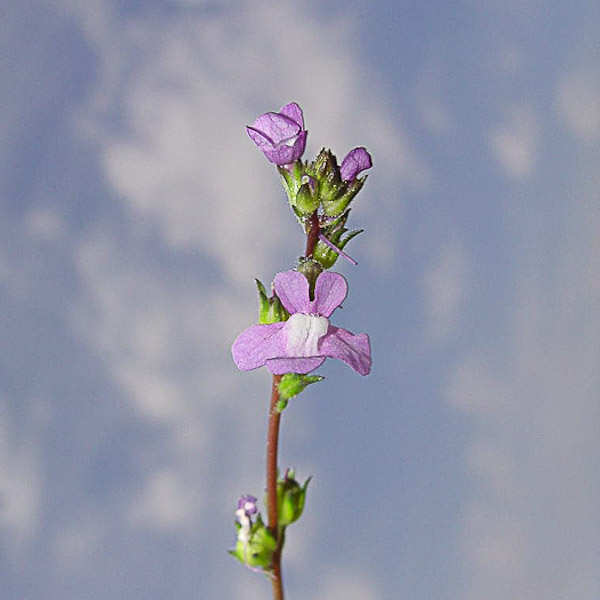
linaria-canadensis-1

Canada Toadflax by John Bradford

This short-lived annual or biennial native likes open sandy habitats across the eastern and central North America and Canada.  One of its habitats is lakeside dunes around Lake Michigan.    Looking farther west, the flower is absent or nearly so from the Great Plains and  desert regions, and then oddly reappears toward the West Coast, either naturally or by the hand of humans.

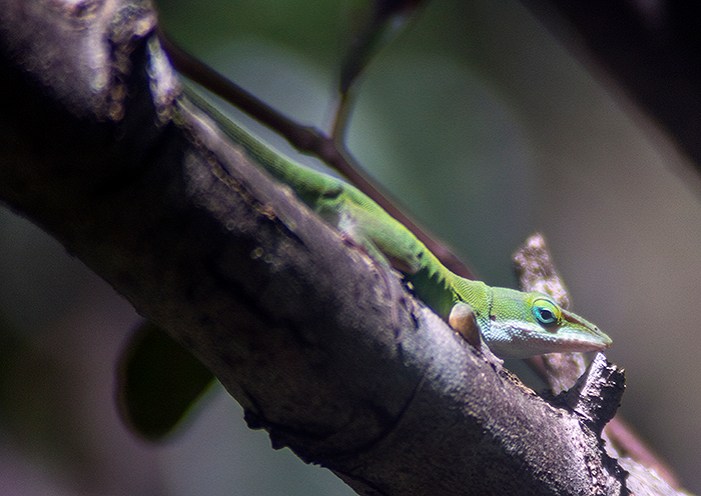
linaria-lizard

Lounge Lizard

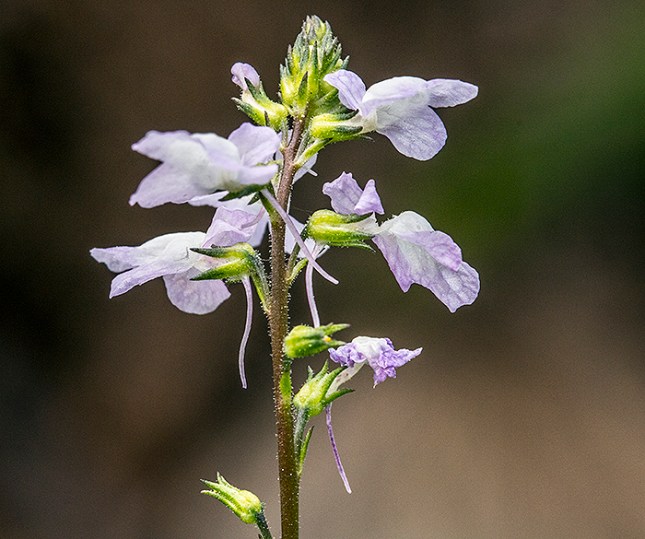
The Toadflax blossom sports a long skinny tube (spur) dangling behind like a ponytail.   The spur is longer than the rest of the flower, and has the diameter of a needle.   Somehow the flower sequesters its nectar deep in the spur.  It is lock and key:  only the insect with the right “drinking straw” can reach down to the secret nectar cache.  Others—scram!

linaria-spurs

Who’s “straw”  reaches deep into those spurs?

We all cry out in curiosity, find the foot that fits the glass slipper!   Who get’s the sweet reward?

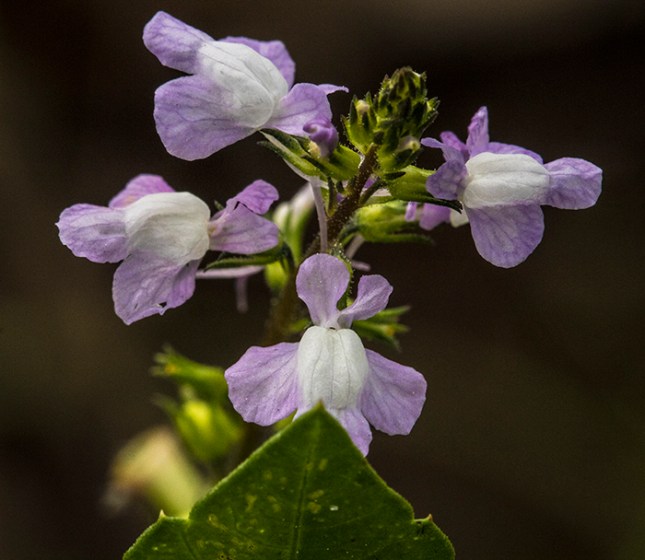
Like my safe deposit box, there are layers of security before inserting the key.  The front door to the flower is  closed, so not only must the customer have the right long skinny key, access to the spur requires  pushing the outer door open.   The floral portal resembles a snapdragon…snapped shut.

linaria-face

You gotta get the door open in order to probe the spur.

The flower “wants” the door opened by the correct  visitor because the well  guarded route to the nectar passes by the pollen-making anthers and the pollen-receiving stigma.     The authorized pollinator must be able to get in the door, and then drop off and pick up pollen, and then nail the tasty treat in the spur.

The native insect with the tongue long enough for the spur, and muscular enough for the door is the bumblebee.

However….butterflies participate too.   They can plumb the nectar slipping their needlelike proboscis under the door.  If the probing proboscis effects pollen exchange is anybody’s guess.   They seem to cheat a bit.

Not every flower needs a buggy helper.  Botanists long ago realized that Canada Toadflax makes some perpetually closed flowers never to say hello to bee nor butterfly, yet able to form seeds and fruits.   Why possess such non-conformist flowers?

To counter a conundrum.  On one hand, the showy blue “normal” bug-visited flowers are delicate yet costly.  On the other hand, the nasty sandy habitats dry out in hot weather, cutting the resources to make normal flowers, and resulting in decline to death.

linaria-far

Living on the streamside sand…getting dry.

No problem.

Declining branches during drought,  smaller than those made in good times,  continue flower-making.   But they go to cheap  quick  tough little non-opening  colorless flowers.  These back-up blooms pollinate themselves, short-circuiting the time,  expense, and growth required to attract bees and butterflies.   (They are called cleistogamous, kliste-OG-ah-muss flowers, closed, as in “cloistered.”)

linaria-cleistogamous-spike

Cleistogamous flowers.   On this stunted spike note the decadent progression from the buds at the tip (lower right) to maturing fruits (upper left) bypassing the blue “normal” flower phase, thus skipping insect pollination.

Cleistogamy is not an either-or situation.  As  conditions dry out and as stems decline, the flowers diminish progressively through what one botanist called “decadent” stages, with pure insect-pollination at one end of a spectrum and pure cleistogamy at the other.  There are tweeners.   It would be interesting to alter the balance by adjusting growth conditions.

Such a back-up system when times get tough is handy for an annual or biennial living on borrowed time,  dreading the drought.

——————————————————-

 
5 Comments

Posted by on February 24, 2017 in Canada Toadflax, Uncategorized


Poison Ivy

Toxicodendron radicans

(The misnomer “Poison-Oak” is applied sometimes to this species, although in Florida that name is probably best reserved for the close relative Toxicodendron pubescens and relatives in the Western U.S.)

Anacardiaceae, the Cashew Family, many of which can cause dermatitis


Continuing our month-of-Fridays probe into the botany of the Kiplinger Nature Preserve today in perfect weather, John and I found the plant most interestingly in bloom to be poison ivy.    Too bad it is nasty, because the species has a certain charm and fascinating natural history otherwise.

toxicodendron-radicans-2

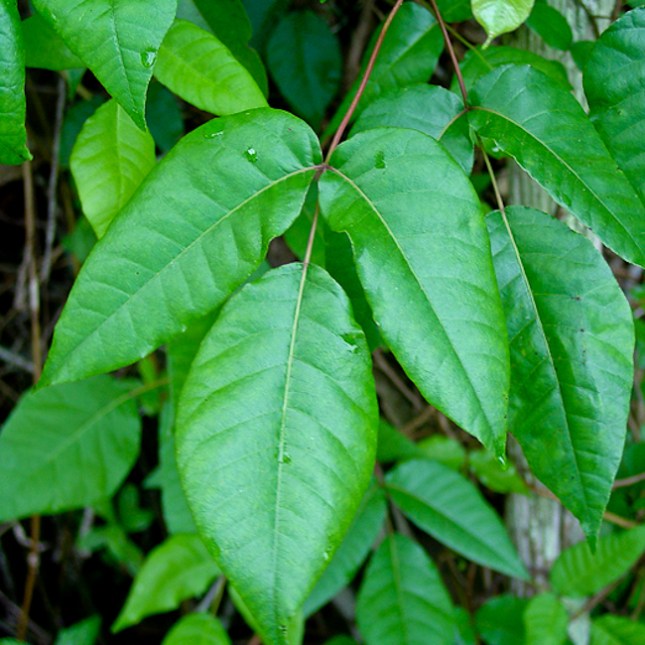
Leaflets 3 let it be.   All photos by brave John Bradford.

Poison Ivy is not “a” species, but rather the most mind-boggling complex of Mother Nature’s messy handiwork you can find.   Anyone who wants to reduce botany to simplistic species and easy rules better first look at this perplexing tangle of variation ranging across much of Asia, North America, and parts of Tropical America, but neither Europe nor Africa.      Different people can look into the complex and see different species, subspecies, varieties, and even different genera,  with our well known eastern Poison Ivy more similar to the same species in Japan than it is to all the numerous variants in the rest of the U.S. and Mexico.   The big ol’ mess was sorted out painstakingly by Michigan State University botanist William Gillis on the shoulders of predecessors.  The late Dr. Gillis and I shared the distinction of our careers intersecting with the only botanist convicted of booking  a hitman to murder his wife.

A good segue into Poison Ivy.  The writing on P.I. as a poison are infinite, so to pick the weirdest aspect of that history  I know of, as documented by Gillis, hereyago:  indigenous men in California used the irritating plants to oppress women.  When the men wanted to meet and keep the women apart, one guy would strip naked, be body painted, and run around all crazy threatening the women with wet poison ivy branches suspended around his head.   Who would volunteer for that job?  The hazards are numerous.  A better use of the plant, despite the itch, was in the Netherlands to reinforce dikes. Worked better than a little boy sticking his finger in the leak.

toxicodendron-radicans-1

Would you believe Poison Ivy has a role in ornamental horticulture?    It develops red fall color and contributes to the subtle autumn hues in South Florida.     It has served in that capacity cultivated in gardens in climates where fall color is otherwise deficient.

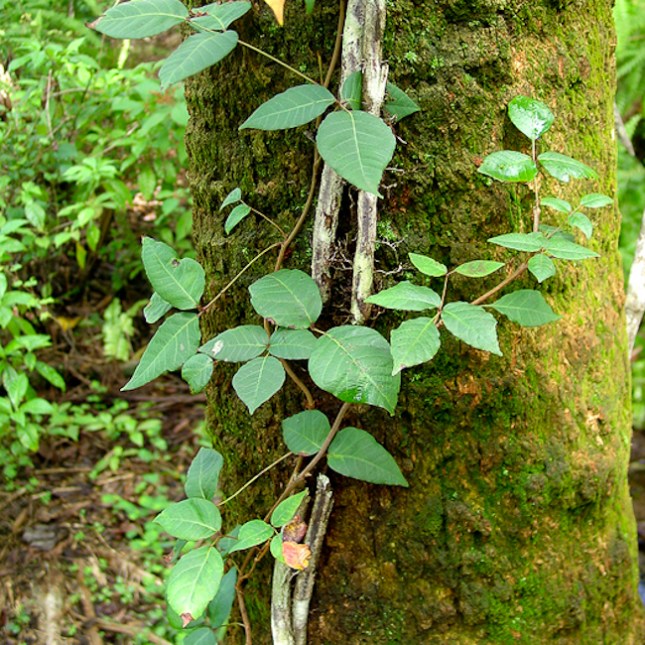
Poison Ivy has the ability to resurrect dead trees.   The vine climbs hugging the defunct trunk, and way up high decides to branch out like the original limbs on the tree.   From the distance such a tree looks like a very odd species. Here is the vine covering a dead tree in flames. CLICK

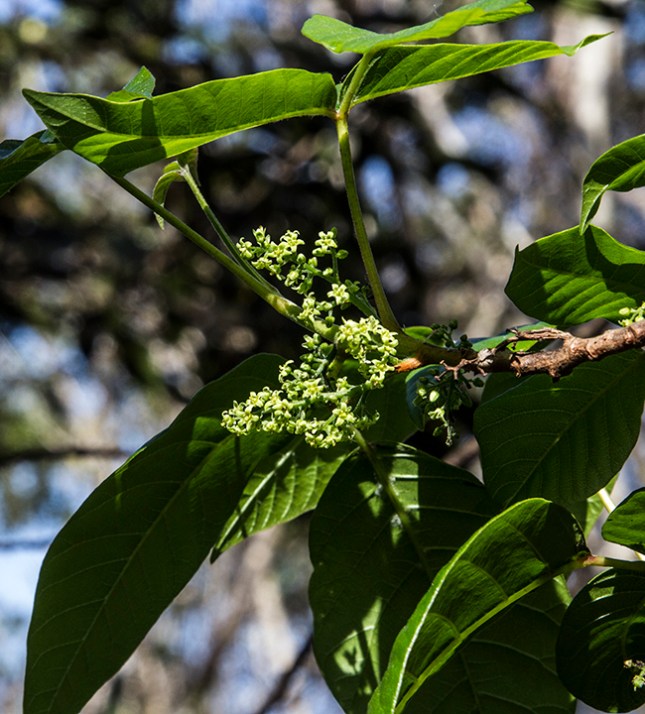
We’ve been trying to catch it in bloom, so today was a minor triumph.   The flowers are separately male or female, on distinct plants.    In some locales, the male plants have foliage differing from the females, a weird occurrence.  Why?

toxicodendron-radicans-flowers

Blooming P.I. today 2/17/17

The flowers draw bees, and Poison Ivy honey is not unheard of.   No thank you. The blossoms mature into little “berries” which are not berries; they are related to and resemble mini-mangoes: lopsided, flattened, and with a “stone.”  As the fruits age, the outer layer separates from the stone leaving a hollow space, and the outer layer can crack open along lines.

To wrap up, one more oddity.  Commonly allergic reactions come from proteins.    Poison Ivy causes a horrid allergic reaction yet its toxin is not a protein.   Oh however can that be?  Apparently the plant’s poison, urushiol, binds and alters proteins in human skin, and then those altered self-protein complexes kick off an allergy, sort of a vine-mediated auto-immune disorder.    The itchy oil is almost a varnish.   It can collect in sufficient quantities on the leaves to dry into a black spotty paintjob, a skull and crossbones reminder.   Fact is, the Chinese Lacquer Tree is itself likewise a species of Toxicodendron.

toxicodendron-radicans-4

 
9 Comments

Posted by on February 17, 2017 in Uncategorized