Morella cerifera (cerifera means “has wax”)
Today’s project in broad form was suggested by John Lampkin, who contributed the fruit photos. The goal is an ecological profile for Wax Myrtle (Morella cerifera). It’s a shrub we know so well, yet then again, not so much.
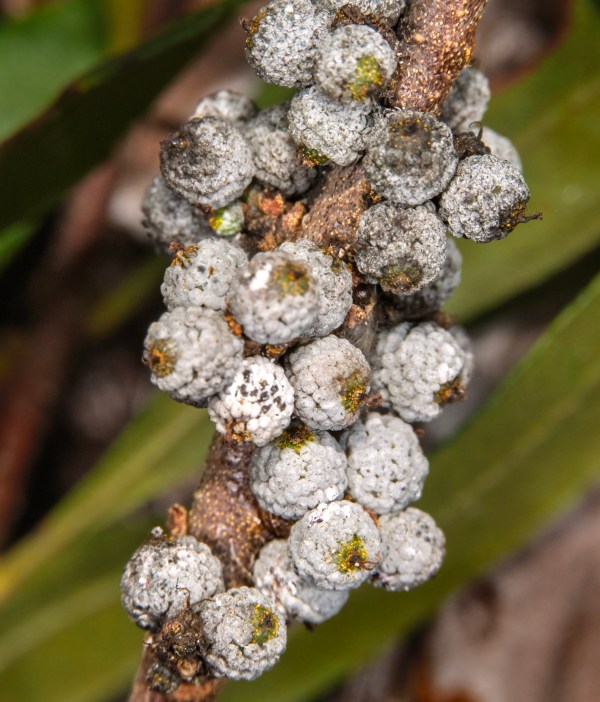
Wax Myrtle fruits, by John Lampkin
Let’s start with where this weird and wonderful shrub grows. What’s its favorite habitat? I might think, hmmmm, mostly moist, and sunny or shaded places. But here is where it reveals its first secret. Go beyond memory to and ask AI to examine all 197 specimens in the USF Herbarium. And what it found is, yes sun, yes shade, and mostly in between. Mostly in between. More interesting is the relationship with moisture, not a mere preference for moist, but more subtly, for borderlines (ecotones) between wet places and dryish places. So it likes semi shaded wet spots alongside dry.
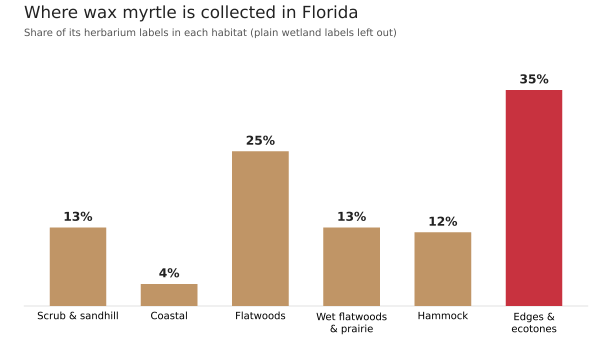
Thirty-five percent of 197 Wax Myrtle collections come from ecotones.
With the help of AI, I calculated an “Ecotone Preference” index for Florida’s woody plants from the herbarium data[1] The index rests on two things herbarium labels record. One is the share of each species’ specimens from shade, partial sun, or full sun. The other is how often a species grows at the border where wet meets dry, compared with wet ground or dry ground alone. A high score means a species favors the in-between, partial sun and wet–dry borders. The results were tidy. Species that stick to one end scored lowest: scrub plants such as Florida rosemary at the dry end, and swamp dwellers such as pop ash at the wet end. Wax myrtle came in second of 121 species, behind St. Andrew’s cross, which is more herb than shrub. Among true shrubs, wax myrtle is about as much an eco-borderline case as Florida plants get.
Like legumes, wax myrtle has nitrogen-fixing bacterial root nodules but with very different bacteria. Associated with several variants of the bacterium Frankia, it makes its own nitrogen fertilizer where nitrogen is scarce or hard to take up, such as in wet soils. Frankia needs moist soil but not suffocating. It seems to ride out the wet–dry swings of the wetland-dryland edge by surviving dry spells and inundation partially dormant, probably as spores.
The “wax” is not true wax but mostly saturated fats, rich in energy, “jet fuel” for the few birds that can handle them. Those birds are few, led by Yellow-Rumped Warblers. Most animals absorb less than half of such fats, whereas the warblers absorb over 80%. They push the meal back from the intestine into the gizzard for another round, flood it with bile to emulsify the fats, and pass it through slowly.
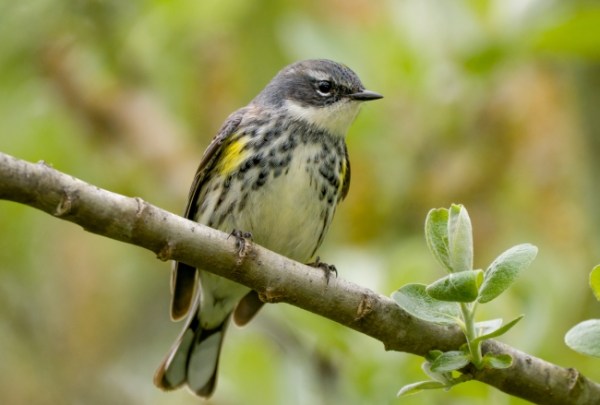
Yellow-rumped Warbler. Photo by Jake Bonello, USFWS (public domain)
Although Yellow-Rumped Warblers eat insects and several fruits, the link between the birds and wax myrtles is underscored by the similar distribution maps below. Moreover, warbler’s winter range and the wax myrtle’s range both extend to Panama.
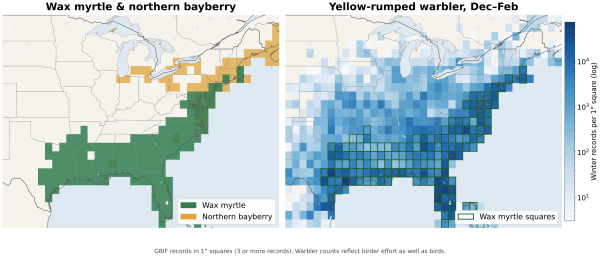
Where wax myrtle grows (left) and where Yellow-rumped Warblers spend the winter (right). Map by George Rogers from GBIF records; base map Natural Earth.
Flowering in late winter, then slow fruit growth through the moist summer, ends with fruit presented on the shrub in large quantities over a long stretch of winter, just in time for the hungry flocks. Did I say flocks?
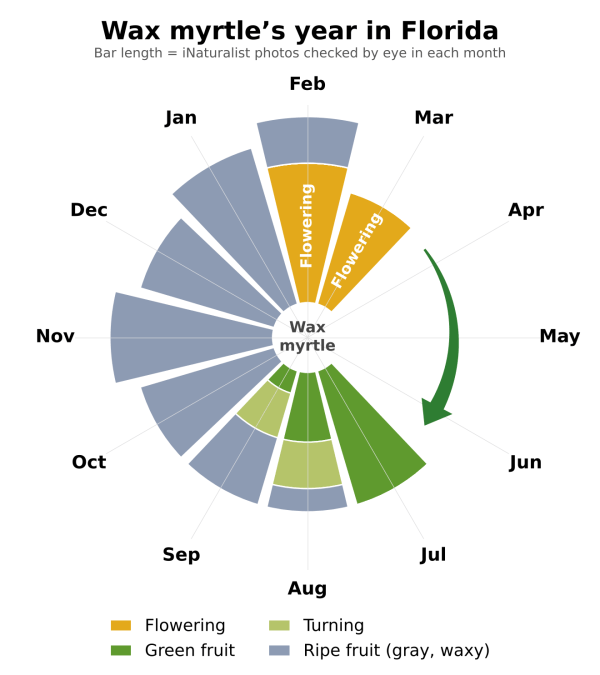
The way to attract and feed a crowd is a smorgasbord, which is what the massed, persistent fruits are, displayed abundantly on the branches all together in good shape through the winter. Then suddenly a flock of warblers can spot the feast, strip a bush, be on its way, and spread the “seeds.” Making the energy-laden fats is costly to the plant, but only in a one-time sense. Look at how long it is from flowering to the winter feast. On a per-day basis—built gradually and displayed for a long time—it’s an affordable installment plan. And the fruits don’t just feed the birds: the pit has to make it through the bird, then persist in the soil until sprouting time, holding hands with Frankia.
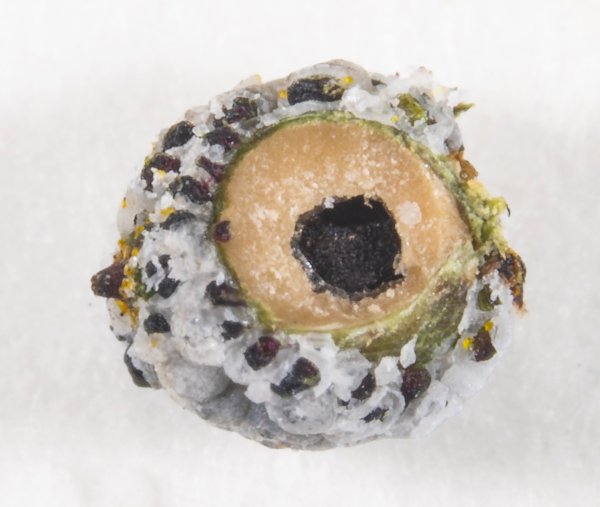
A wax myrtle fruit cut open: waxy coat, hard pit, dead contents. The black knobs secrete the white fatty bird reward, a natural “suet” feeder. Photo by John Lampkin
Bacteria associated with roots raise the question of how a relocated fruit pit upon sprouting can hook up with a new bacterial partner. Wax Myrtle seems to need one, or nearly so. One possibility is “plenty of Frankia in the soil,” but that’s probably not always adequate. Could the bacterium somehow ride on the pit? In a 2008 master’s thesis, Spencer Bissett from Virginia Commonwealth University suggested this. Makes sense. The waxy coating and the many bumps and crevices could be good places to catch bacterial spores from the wind. The spores can endure drying, and the fruits hang on the shrub for months gathering windblown dust. There is more. Frankia spores fed to captive parakeets passed through able to start nodules. Songbirds on Virginia’s barrier islands carry live Frankia in their droppings. And in Patagonia, plant-eating animals spread Frankia in their dung.
Now the two halves of the story, the birds and the habitats, meet. Wax myrtle is a plant of edges, and edges are scattered and inconstant: a raised tussock in a marsh, a wet depression in a scrub, a temporary flatwoods minipond. The plants need delivery to those spotty “islands.” Flocks of warblers moving from shrub to shrub can do that, dropping pits as they go, perhaps with Frankia aboard. Because the plants are separately male and female, conceivably carpet bombing by squadrons of birds increases the chance of male and female wax myrtles winding up intermixed.
[1] For the full calculation, contact George R.
 John Bradford
 George Rogers
 George Rogers
 Dee Staley

