In the pre WWII era botanist John Kunkel Small (1869-1938) documented the daylights out of South Florida when you had to get muddy, thorn-pricked, and heat-exhausted to earn your creds. Not bad for a flautist in the NYC Philharmonic.
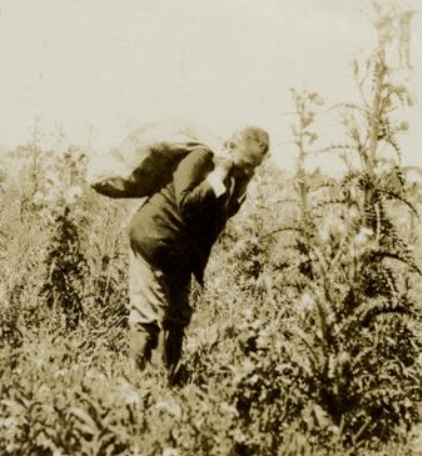
Today, for reasons unrelated to the blog, I looked up Coreopsis leavenworthii (Leavenworth’s Tickseed) in JK Small’s 1933 plant manual and bumped into an odd little comment tacked onto the species description:
“A hot infusion of this plant is used externally by the Seminoles in cases of heat prostration.”
Generally “out there” are many reports on historical plant uses, many of them derived, hearsay, and third-hand. And truth is, the ratio of modern confirmed benefits to reported historical uses has turned out to be sorely disappointing despite enthusiastic efforts by researchers to mine for gold. But Small’s non sequitur caused me a double-take, and his use of the present tense, “is used.” sounds like experience rather than something he read. He took an interest in the Seminole People of his era, which no doubt underpinned his observation. Small did say “externally,” but let’s cheat a teensie and stretch that plausibly to “internally,” because Native Americans beyond Florida reportedly used Coreopsis tea internally for many ailments.
As an aging botanist myself who has experienced “heat prostration” in a nasty way, I also wondered if Small had his own personal interest in that Florida occupational hazard. After all, he was basically a city-dweller whose scrambling through brush lugging plant press and camera under the Florida sun was an acquired taste. Could there be anything to sipping Coreopsis tea against heat illness? Happily and sadly, contemporary computer-based research sure is easy. So here is what online sources say on the possibility of Coreopsis against heat illness (which does not make it all necessarily true, effective, or harmless!). Reportedly:
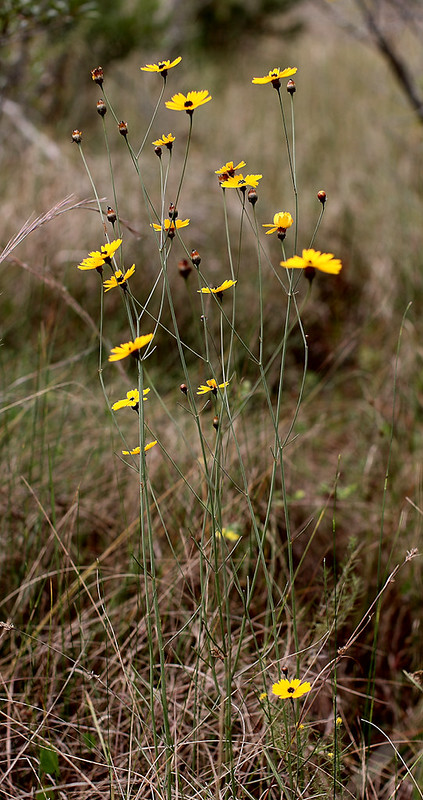
- Coreopsis produces antioxidants, including that sunshine yellow flower pigment. Heat illness causes excessive immune responses and vascular inflammation tamped down by antioxidants. Additional Coreopsis (phenolic) compounds likely reduce intestinal damage and consequent self-poisoning associated with heat illness.
- Tea made from Coreopsis causes sweating, with evaporative cooling, although it is a reasonable bet (?) that the patient was placed in cool water.
- Heat stress disrupts sugar metabolism. Coreopsis extracts have been shown in modern research to resist blood sugar spikes.
So then, I’ll bet the Seminoles knew a thing or two about heat illness, and how to deal with it. I’ll bet JK Small knew a thing or two about heat illness too, and had interest in how to deal with it.
(Personally I’d like to try it but have an absolute ban on ingesting wild plants, which are not binary “safe” vs. “toxic” .)


Michael R Kohner
May 15, 2026 at 11:50 am
Are there folks at the Seminole or Miccosukee Tribes that have some additional hisory
George Rogers
May 15, 2026 at 12:34 pm
would love to know
Michael R Kohner
May 15, 2026 at 12:57 pm
Next month , Ill make inquires and let you know what I find
George Rogers
May 15, 2026 at 1:13 pm
terrific thanks