Proserpinaca pectinata
Haloragaceae
What Linnaeus had in mind in 1754 when he coined the name Proserpinaca is its first mystery. A leading possibility, not my original idea, is Proserpina, Roman goddess of springtime and of the underworld. The plant Proserpinaca does rise up from the underworld mud in the springtime like a little green goddess mermaid. Pectinata means roughly, “looks like a fish skeleton.”
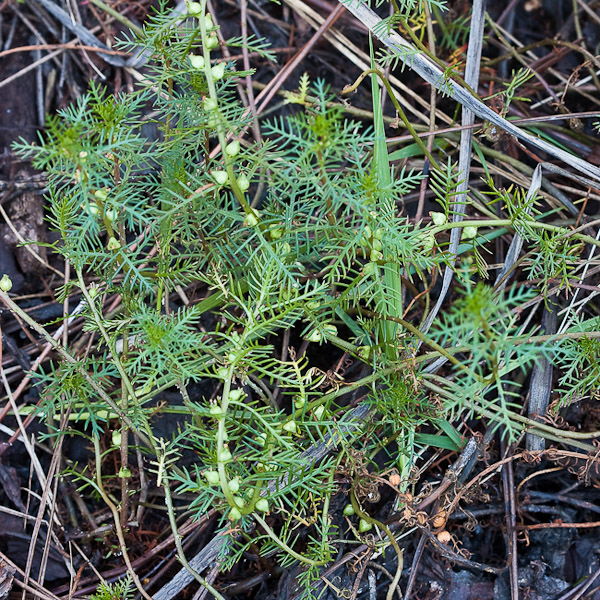
Proserpinaca pectinata with fruits by John Bradford.
You don’t have to work hard in dried out marshbottom mud to find Proserpinaca pectinata rising, creeping, flowering, and fruiting. We have two (+) species of Proserpinica around here, but let’s focus on just one. I have no particular point to make about P. pectinata, except that it is shy, odd, and poorly known.
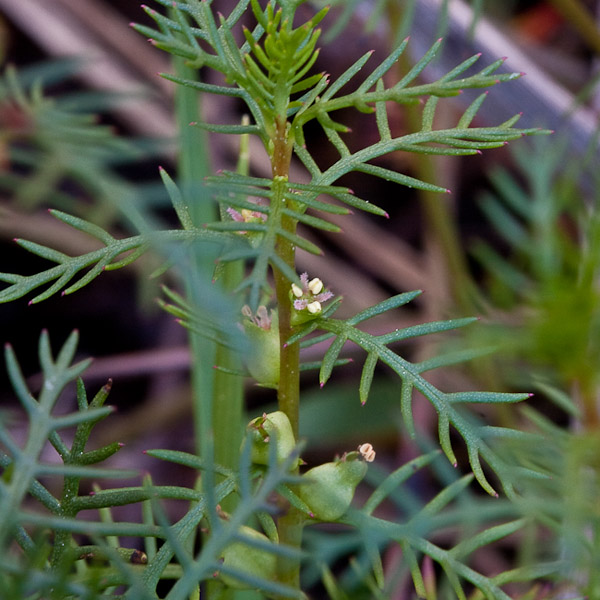
In flower, by JB. Pinkish stigmas between yellow anthers.
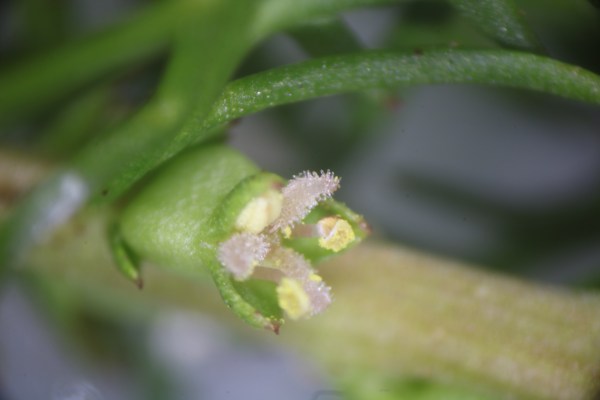
Looks like it is getting its own yellow pollen onto the pink stigmas.
Odd thing 1. The mermaid lives in two separate regions. The main region is semi-coastal from New England, across Florida and Cuba to Texas. The curious second region is central Tennessee. A skeptic might say, well, some bird probably dropped it there and it spread. Agreed! But birds probably drop its little fruits all over the place, so why “take hold” and spread just in the center of Tennessee? I dunno.

Map 1999 by botanist P. Catling. What’s going on in Tennessee?
Odd thing 2. When the marsh bottom dries Proserpinaca can explode into a green carpet of zillions of crowded individuals covering a lot of space. How does it do that? The fruits are hard, floaty little “nutlets,” and clearly get around. But at any given moment there don’t seem to be enough of them to take over, and you don’t see them sprouting on the mud anyhow. So where’s all that massive new mermaid coming from? Old fruits accumulating dormant in the mud? (probably) Stem and root fragments breaking apart and floating around? (probably, the stems root where they touch). Surviving plants that persisted during the last inundation? (probably). Stem-creep? (probably). That’s a lot of probablys. Wonder what the main source of the springtime mermaid explosion is. Maybe not even in my list.

Prolific!
Odd thing 3. Itty bitty flowers having no appreciable petals. The flowers have three pink fuzzy pollen-receiving stigmas and three yellowish anthers releasing pollen. The entire plant being short, the flowers are semi-hidden near the ground. Googling to discover the pollinators yields three (not necessarily exclusive) assertions by folks who obviously do not really know:
- Wind pollination (I doubt that, as the flowers are hidden down out of the wind; they tend to be relatively few, and they don’t seem well “designed” for putting pollen in the wind.) ((But never say never.))
- Unknown insect visitors. (Bet that occurs. Would be fun to catch visitors red-handed.)
- Self-pollination (I like that possibility: even in todays photo you can see self-pollen slopping onto the stigmas. Self-pollination would explain why the flowers reliably form fruits.)
Odd thing four: The leaves have tiny white doohickies directly in the angle where the leaflet joins the central leaf stalk. The little attachments are made of several cells, and under a microscope look like a cluster of grapes. These are a mystery. Water lilies have somewhat similar structures, called hydropotes (“water drinkers”), but those probably do not drink water, and they too are of unknown function. Many plants have water-release “valves” called hydathodes at the ends of veins. Could be, but the placement and appearance are very iffy. Anybody’s guess can be the function of the tiny appendages, if any. Something to do with water uptake and output, or dissolved material? Feeding tiny insects such as ants, and if so, why? Help draw visitors to the flowers? Make the leaves taste like $#@#@! to leaf eaters? Breaking free and micro-sprouting?

Thingamajigs at leaflet bases

Thingamajg highly magnified

 John Bradford
 George Rogers
 George Rogers
 Dee Staley
 Treasure Coast Natives
Virginia (Gini) Proulx
March 27, 2026 at 9:16 pm
Pleased to see one of “your” plants that I might come across here in Nova Scotia. When I saw your distribution map I immediately thought: “Coastal Plain Flora”. Sure enough, it’s known as far north as Newfoundland. (Love your entertaining posts!)
George Rogers
March 27, 2026 at 11:28 pm
Thanks! Not too many woody plants shared between Florida and Nova Scotia…but then again a surprising handful, like Cephalanthis occidentalis
Virginia (Gini) Proulx
March 28, 2026 at 8:02 am
Thanks for responding! I have found Cephalanthis occidentalis just once in NS. I am near it’s northern limit.
George Rogers
March 28, 2026 at 5:09 pm
I went on a (failed ) photo safari with my brother in Michigan looking for the Red Bellied Water Snake which is supposed to like to hide on Cephalanthus root masses.
WalterB
March 28, 2026 at 1:12 pm
Quite an interesting article. Just a thought, could the “thingamajigs” in the leaf base axils be embryonic stage axil buds? Maybe they sprout as branches if apical growth is damaged especially during drying periods.
George Rogers
March 28, 2026 at 5:07 pm
Walter, nice to hear from you. Good point—they sure are in exactly the right place. Although I haven’t seen branching coming from those points, that could merely mean not looking at the right time and place to catch the trigger in action. Maybe even submersion. If I had the right materials handy I’d clear and stain them to see if the little nubs tie in to tiny veins. Maybe weak laundry bleach and/or drugstore lactic acid. Anyhow, I agree you might be right, and thanks.
Virginia (Gini) Proulx
March 28, 2026 at 8:01 pm
Hi again, Sorry that you did not find your Red Bellied Water Snake in Michigan but I salute your adventurous spirit. Nothing beats seeking out the rare and unusual – great satisfaction when one “scores”!
Sabrina Carle
March 29, 2026 at 6:33 pm
I have seen this plant at Corbett and was so happy to read this article about its interesting characteristics that I had overlooked. One thing I love about your writing is that you talk about the unknowns, encouraging your readers to engage our thinking caps. You demonstrate how to be a scientist: first observe and then ask a question! Perhaps one of us will pursue the scientific process for future discovery. Always a pleasure to read. Thank you.
George Rogers
March 29, 2026 at 8:34 pm
Thanks Sabrina, We do live in a nature wonderland in SE Florida. Soooo diverse, so weird, and so much to see and explore!
mindfully0ca473f749
March 30, 2026 at 2:32 pm
Fun read! Thank you!
George Rogers
March 31, 2026 at 9:06 am
Thanks!!
David chaimowitz
April 1, 2026 at 1:30 pm
it would be interesting to watch it grow under a microscope and watch the small white filaments develop. They might not have a direct function and could be a byproduct of something else. It maybe just doesn’t cause a hindrance? Could plants have something equivalent to a modern appendix per se?