Urena lobata, and Apis mellifera too
Malvaceae (Hibiscus Family)
A botany class kinda truism is:
Question: Why do leaves of many species have nectar glands?
Answer: To attract nasty ants who quard the host in exchange for lunch.
But exceptions are fun. One exception appears to be plants that have ant food also on the seeds, so that the nectar on the leaves draws ants near enough to find the seeds with benefits, which the insects then disperse beneficially for all. See that here.
Today’s exception, extends beyond ants. Abundant locally is non-native Caesarweed (Urena lobata). They probably brought it here back when one of the many ideas of “how to make money in Florida” was growing fiber plants, before the more lucrative idea of opening an Assisted Living Facility. When I’m sitting in the garden of my Assisted Living Facility, I want them to have Caesarweed. Then I can watch the bees, and wonder why it is called “Caesarweed.”
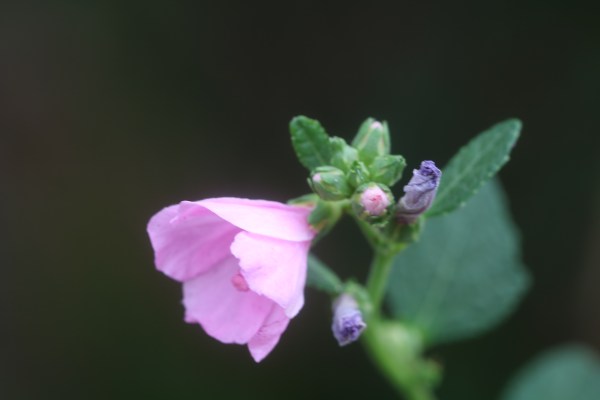
Let’s see if AI knows!
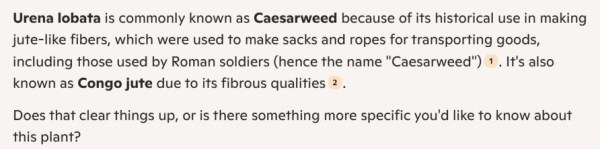
How’s that for instant expertise? Thank you Hal. And, yes, while watching the Caesarweed in the meditation garden, I’d like to know if its nectar glands under the leaves are good for anything?
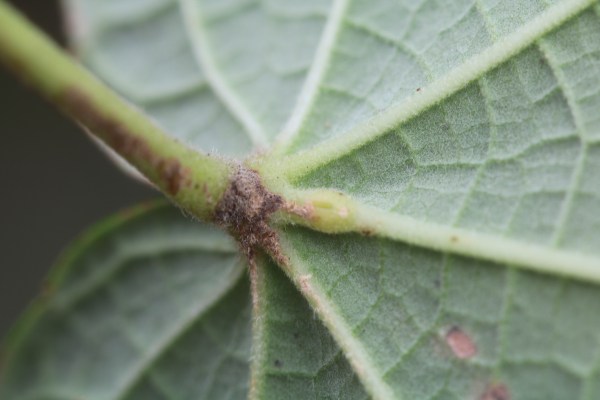
The gland is shiny green, on the leaf vein, to the right of the dark blotch.
That brings us to another invasive exotic: Honeybees. Hey, don’t we hate invasive exotics that out- compete native species? Don’t we love Honeybees! Cognitive dissonance strikes hard!
To get to the point, have you ever seen how bees tend to start at the bottom of an upright flower cluster then work upward? If not, take it on faith. Enjoy the video clip below. The bees work their way up the leafy Caesarweed as though the leaves were flowers in a spike. Then, at the top—well there IS a flower. I’ll bet a jar of honey that the leafy nectar glands help Caesarweed achieve pollination.
Bee in action on Caesarweed CLICK
 John Bradford
 George Rogers
 George Rogers
 Dee Staley
 Treasure Coast Natives