Carnivores suffer pests who swipe the kill or scrounge leftovers. Dolphins steal from Sperm Whales. Hyenas rob lions. Remoras clean up shark scraps. Food theft is called “kleptoparasitism,” and it is not that rare in the animal kingdom. A great example of abominable culinary larceny plays out in our local natural areas with a little big carnivore, the Banana Spider.
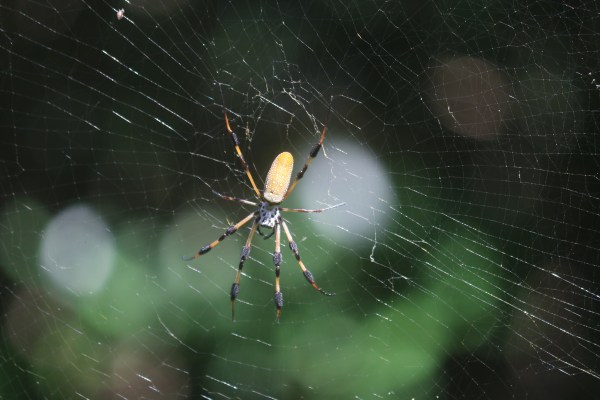
The Juno Dunes Natural Area adjacent to the Loggerhead Marine Life Center in Juno Beach is home to a village of ferocious-looking Banana Spiders on webs the size of tablecloths. Wonder why they like that site so much. Do ocean breezes bring victims to the killzone? No doubt mere coincidence, but the webs are associated often with an odd coastline semi-vine in the Coffee Family, “Redgal,” Morinda royoc, but back to arachnid true crime.
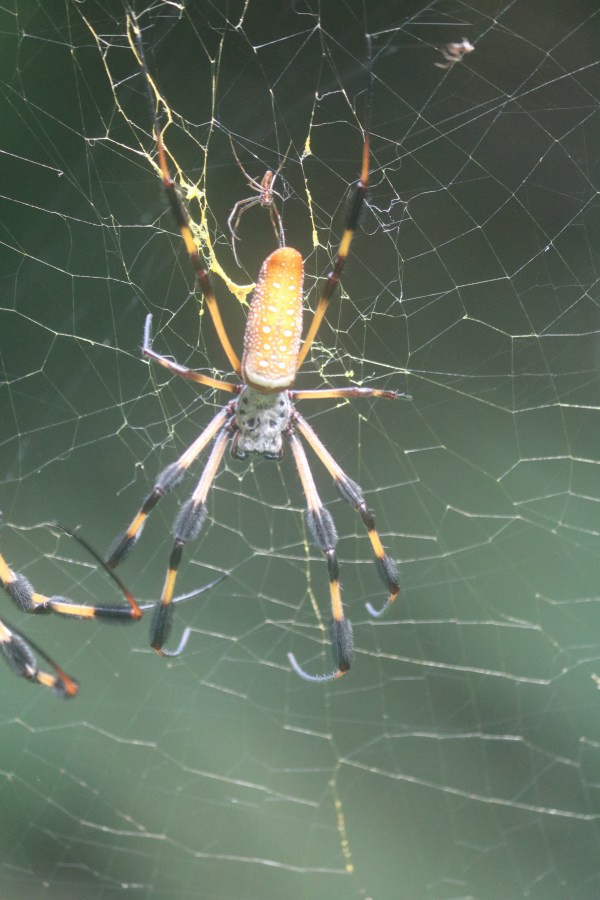
Female (big) and male (above his main squeeze). That’s a Dewdrop near the upper right corner.
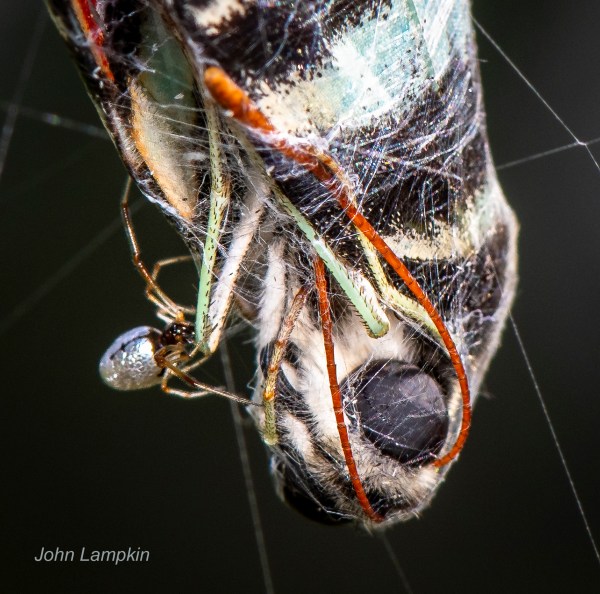
Look closely at a Banana Spider web, if you dare. In addition to the jumbo Queen of the Web, there are little spiders too. Some are pale males much smaller than the hunky yellow females. Some wee spidies are juveniles. But the truly interesting tiny ones are called Dewdrop Spiders (aka Robber Spiders). They are rip off artists.
They do look like dewdrops, especially the females. Varying in color, most around here are shiny white toward the rear. Some are so silvery you can see mirror images on their scales. Are the shiny Dewdrops disguised from birds as water drops on the web? Or does the reflective coloration make it difficult for PO’ed Bananas to nab them? Or do they look like Banana egg cases? Or is the glossy surface temperature regulation? (In ignorance, I vote for birdproofing.)
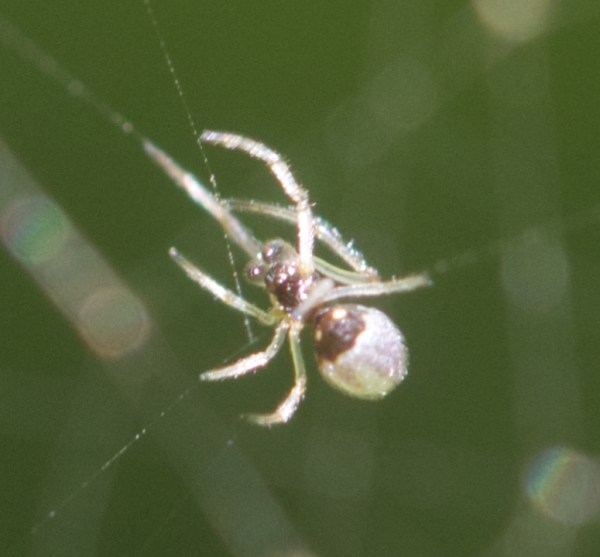
Dew Drop Inn. Highly magnified. Really less then 1/4 inch across.
In any event, they thievin’ little rascals are unpopular with the Banana Clan, although enforcing “get off of my lawn” may not be worth the Banana’s energy. The dynamics are not well studied, and are confounded by multiple species of Dewdrop Spiders. Fact is, so little is known, all I can do is list disjointed observations by various biologists. Some observations are on different Dewdrop species..
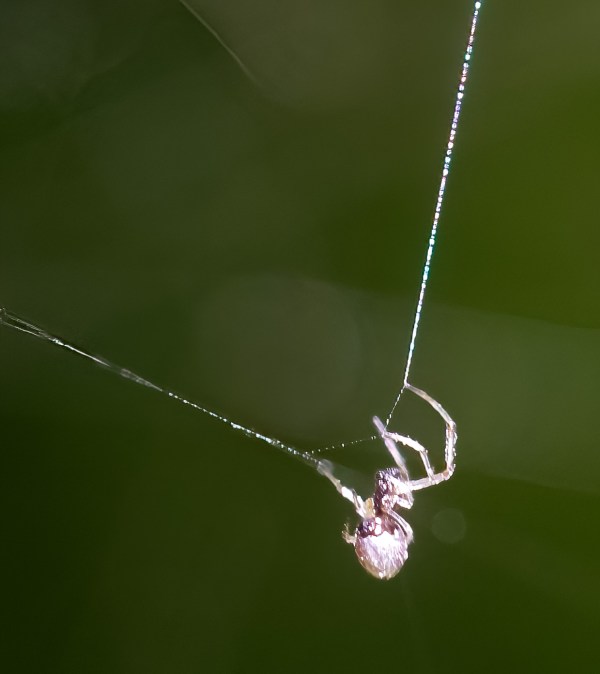
Dewdrop….on its own filament?
Kinda relevant stuff I kleptoparasitized from online articles:
Banana webs are toxic, obviously to subdue prey, but maybe also to discourage trespassing? Dewdrops can eat the web as a source of protein. Are they immune to the poisons?
Dewdrops loiter at the margin of the Banana Spider’s web, where the big spiders seldom go.
Dewdrops “know” when and where the Banana wraps prey by vibrations in the web.
Brave Dewdrops approach the Banana for a quick scoop and score. Cowards steal prey from the web with the guard is away.
Dewdrops can snip the stolen merch from the web allowing the morsel to swing free on a single filament the Banana can’t navigate but the tiny Dewdrop can.
I have not read this, but I suspect I’ve seen Dewdrops on “their own” filaments safely isolated from Big Bad Banana .
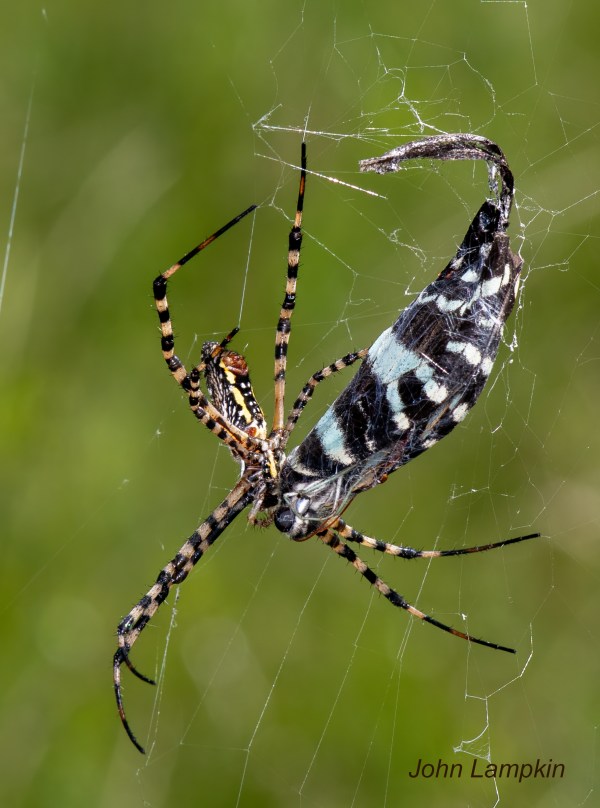
It gets better. John Lampkin contributed the two photos below of an Argiope Spider with a captured Zebra Longwing. Check out the mirror-surface Dewdrop in the 2nd photo. Thank you, John:
 John Bradford
 George Rogers
 George Rogers
 Dee Staley
 Treasure Coast Natives
theshrubqueen
September 28, 2024 at 4:48 pm
I have never seen any of these. Guess they are not scrub lovers.?
George Rogers
September 28, 2024 at 5:16 pm
Not completely sure. I do not recall seeing them in scrub as such, but sure can’t rule it out. Scrub probably does not have much prey, and those big spiders like pretty big vegetation to string their webs. The site mentioned in the blog is the immediate border between scrub and hammock.