For a minor medical reason I’ve been housebound for several days. So no fieldtrips, but, then again, plenty of “fieldtrips” on the bookshelf and file photos in the archives. A mystifying new book is titled, “Unsolved Problems in Ecology.*” One of the head-scratcher chapters in it is, “What Determines the Abundance of Lianas and Vines”?
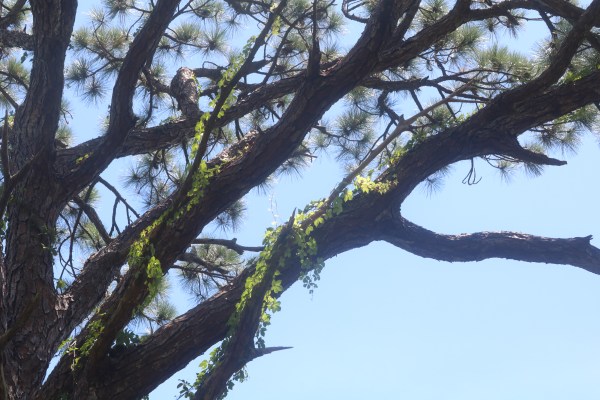
Oh yea, ha, ha, our little blog shall now answer answer one of the “Unsolved Problems in Ecology,” Not actually within our reach, but still fun to poke the conundrum here in vine-tangled South Florida.
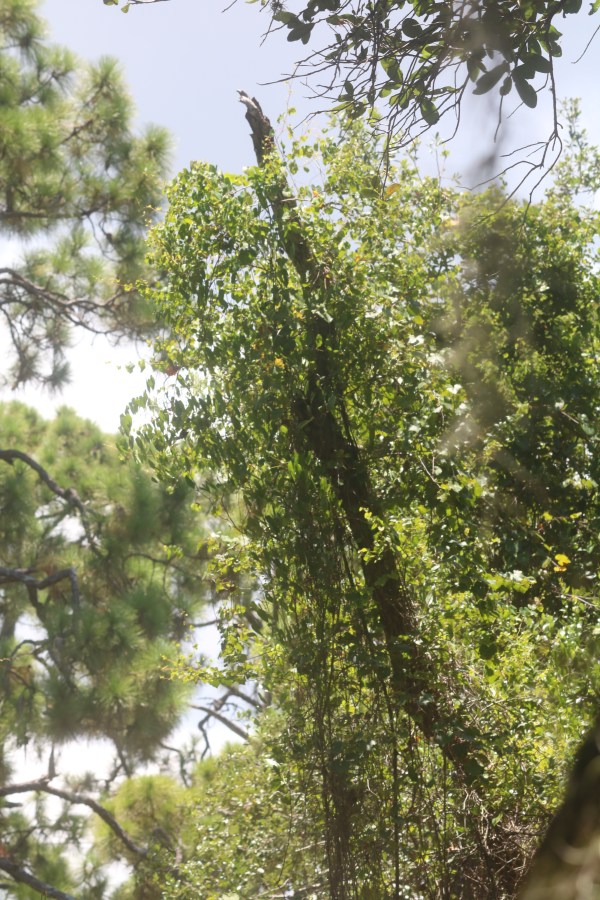
Being a vine** is a great deal. You get a free ride up a tree into the life-giving sunshine without all the blood, sweat, and sap invested in building a tree. Vines can adjust their growth to seize the best canopy real estate. The puzzler is, if being a vine is such a bully deal, why aren’t there even more of them? Why do only some trees have climbers. What limits their abundance. It’s not from failing to get around, given that most Florida climbers have seeds rained down from perched birds. How convenient is bird delivery for establishing around tree bases?
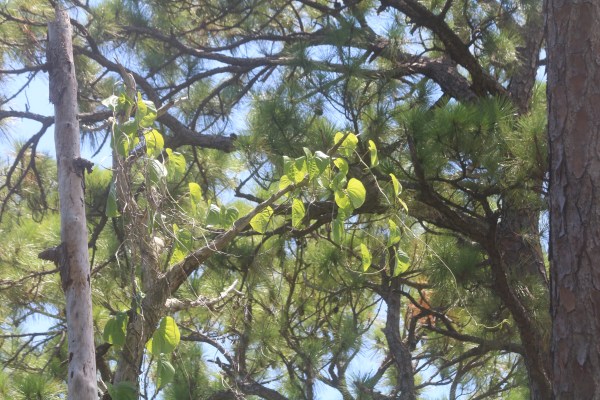
Do vines help trees? The general consensus is, not much. There are some conceivable minor benefits, but most observers believe the net effect is negative.
Do vines hurt their trees? Yes, by stealing light, by root competition, as physical burdens, as wind-catchers, as entanglements with other trees, and sometimes as fire conduits. From a tree’s standpoint vines are green tapeworms. In fact, people who study vine infestations borrow statistical methods from medical parasitology.
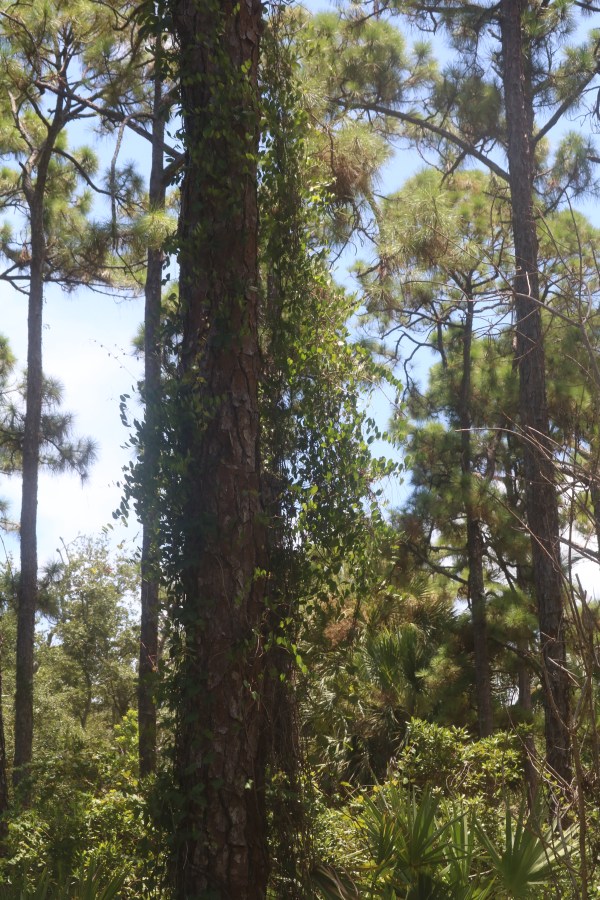
Do some trees have more than one type of vine? Yes, frequently and dramatically. Inter-vine competition has never been studied much though. Hard to measure!
In a forest, do different tree species have different hosting tendencies? Yes but long story short, perhaps not as much as we might think, and trunk diameter matters too. Even Gumbo Limbo gets vines.
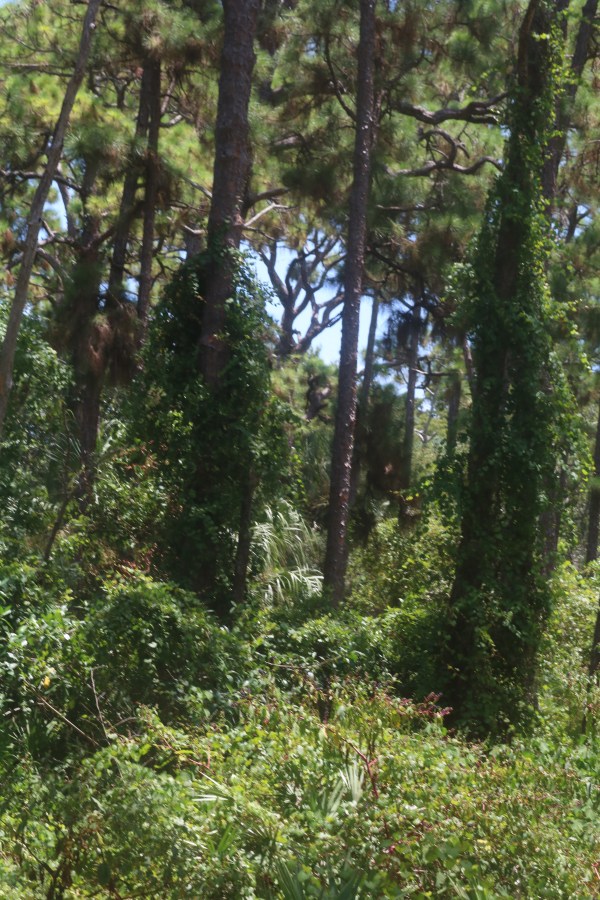
Do trees have defenses against vines? Yes, although not enough to answer today’s big question, especially because defenses can be bypassed by vine trickery. Examples of defensive measures please:
1. Death. When a tree dies it is no longer bothered by vines.
2. Fire. If you are a lucky tree, a passing fire may fry your vines but spare you. Even so, many vines can resprout from their bases, Smilax being a prominent example.
2. Bark that flakes off or sheds frequently, such as Gumbo Limbo, or Slash Pine. That’s a big help with vines that climb by clinging to bark, such as Poison Ivy or Virginia Creeper, less help with twining or scandent species such as Air-Potato or Cat’s Claw. Vines with tendrils, such as Grapes and Smilax, can defeat shedding bark by getting a “toehold” on branches or on neighboring trees and then spread all over, sometimes in great masses climbing their own older stems.
3. Shedding of low branches, and of old palm petiole bases. Dropping branches is not likely to help much in preventing vines altogether, but may reduce their volume.
4. Symbiosis. There are cases of useful ants snipping vines from trees.
NOW HERE WE ARE. NONE OF THE ABOVE IS ENOUGH TO ANSWER TODAY’S BIG QUESTION. THEREFORE WE HAVE NO CHOICE BUT TO VENTURE BRAVELY INTO THE SPECULATION ZONE. LET US GUESS:
If birds rain multiple species of vine seeds at the base of a tree, what might prevent those seeds from spawning an invasion of the trunk?
A. One partial answer is that life is tough for all young things (except rats) to establish, so maybe those baby vines often succumb to fire, to herbivores big and small, to flooding or drying, to competition from non-vine species, and to the many perils that allow only one seed in a zillion to mature.
B. Underground competition. Baby vines at the tree base need to compete with the massive established root systems of host the tree and its mycorrhizae. Additionally, most forest tree bases are sheathed with moss. Vines don’t seem to like that.
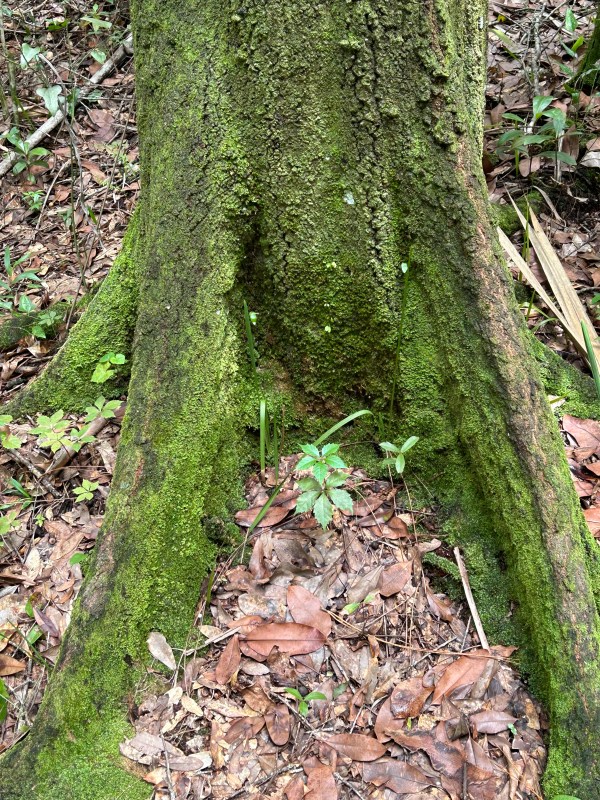
Hmmmm…moss vs. baby Virginia Creeper.
C. Shade. Tree bases are shady. Although variably shade-tolerant, vines do ultimately need light. A sign that shade matters is that you see more vines on dead trees than on living ones, and more vines on trees out in the open. I think shade is important.
D. Chemical warfare. You have “allelopathy” when one plant poisons competitors. I am aware of no studies testing trees poisoning vines, but why not? Those little baby vines are positioned directly where stemwash and fallen bark collect.
D. Basic life history. A big fundamental difference between trees and climbing vines is their plumbing. In relation to stem diameter, vines move vastly more water upward than trees. Fire hose vs. waterpik. For a rapidly climbing vine spreading hither and thither, making flowers, feeding berries to birds, taking over a tree, it must be great to have a high-volume pipeline in that skinny vine stem. But when the vine is young is that greedy tendency a liability? Maybe the immature roots, competing with the tree, can’t satisfy the demanding stem pipes.
E. Carbon dioxide? Temperature? Disturbance? Here is the actual major mystery for today. It is that climbing vines are increasing in prevalence around the tropical world. We can guess but nobody knows what was keeping them in check, and now isn’t. If we automatically say, “climate change,” we’re still left with the question of why that would favor vines over trees. There is one possible answer to that we already know—that special big-pipe plumbing. Without getting into boring details, vines store water and other resources better than trees, and also can repair drought damage. They tolerate drought and disturbance. Could the explanation be as simple as increasing drought and disturbance?
That was fun. If you have any new ideas of your own, chime in! I’ll tell the editors of “Unsolved Problems in Ecology” they can omit the vine chapter in the next edition.
*Dobson, A., R. Holt, D. Tilman. 2020. Unsolved Problems in Ecology. Princeton University Press.
Chapter: Muller-Landau, S. Pacala. What determines the abundance of lianas and vines. P 239-264.
**I’m using the term “vine” for any of what we think of locally as climbers, most of them woody: Air Potato (not native), Cats Claw, Cissus, Coinvine (can be a climbing vine), Old World Climbing Fern (not native), Grapes, Peppervine, Poison Ivy, Smilax, Snowberry (can be a climbing vine), Trumpet-Creeper, Virginia Creeper
 John Bradford
 George Rogers
 George Rogers
 Dee Staley
 Treasure Coast Natives
Flower Roberts
August 5, 2024 at 12:19 pm
This was a great ” brain-storming” post. I could envision this exercise with a botany class and writing all possibilities on the board.
I have always been fascinated by vines.
GREAT job here. Thanks
George Rogers
August 5, 2024 at 7:32 pm
Yea, kinda miss those board-writing days sometimes!