Been thinking backwards this week, starting with a visit from a face-to-face with a native long-tailed skipper butterfly sipping nectar from a non-native Pentas. Longtail skippers use legumes as larval hosts, thus the name “bean leaf rollers” for the caterpillars. An abundant host legume is the non-native Beggarweed, Desmodium inacanum. Although hard data are scarce, one seemingly well informed on-line writer attributes the abundance of the LT Skippers around Tampa to the plentitude of the urban-happy Beggarweed. Seems likely that the invasive exotic weed aids the lovely native butterfly. That all got me thinking about other cases where invasive exotic species may benefit native species. An invasive exotic we (almost) all love is the honeybee, although even beloved honeybees are not great for native pollinators. Buzz here
Can non-native plants in their unwelcome abundance help make up for their invasion by feeding native pollinators? That is a meaningful question, knowing that some native bee species are in decline, perhaps thanks in part to honeybees (and much more). Delving into that big complex question is more a topic for a major research project than a paragraph in a blog. Yet even so, the answer seems to be a qualified yes, at times, with the devil in the poorly studied details.
Don’t get me wrong. I’m not defending or advocating invasive exotics, which of course on balance are an environmental disaster. But they are here in spades, and I spend a lot of time out in the swamps and fields, finding it all interesting, including the good, the bad, and the ugly. Even when an invasive exotic boosts the population or range of a native species, that alteration in the balance of nature is not necessarily “good.” Even so, if hundreds of non-native species are out there impacting the native flora and fauna, let’s sniff out some positivity.
We all know that invasive predators crunching native prey is a terrible thing, such as invasive Cuban Tree Frogs eating native frogs, or pythons eating me. But do native predators leverage invasive exotic prey? Yes, speaking of pythons, there was an well-publicized case recently of native bobcats breakfasting on python eggs. CLICK And speaking also of Cuban treefrogs, several native snakes and birds, including owls, eat Cuban treefrogs.
Around local wetlands a conspicuous invasion is by the island apple snail, Pomacea maculata among additional non-native snails. The native Florida apple snail, Pomacea paludosa, feeds snail kites and limpkins. As the invasive snails have increased, limpkins have likewise increased, probably also true for snail kites. Little Blue Herons studied in 2017 in the Everglades had slightly over half their diet comprised of non-native fish.
What is the most despised invasive exotic tree in Florida? Cast your vote. Brazilian Pepper has over-run vast ecosystems, thanks in part to birds dispersing its red berries (drupes). Those helpful birds are feeding happily on those billions of exotic berries, although there are documented downsides to the indulgence. Beyond feeding (and sometimes intoxicating) native birds, Brazilian Pepper trees serve as rookeries, not to mention supporting pollinating insects, probably true also of Melaleuca.
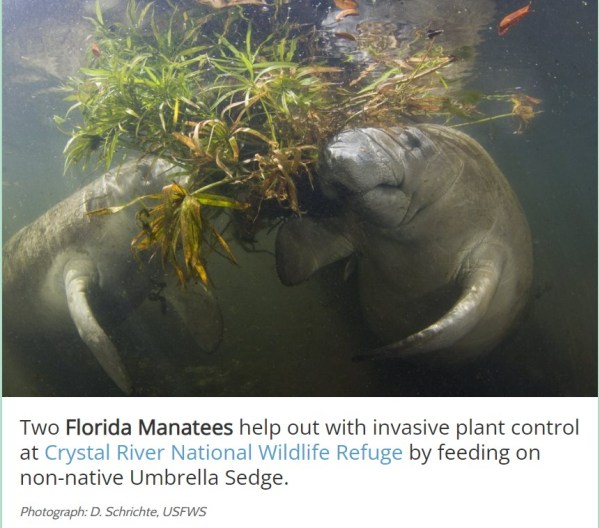
I’m not sure about much in today’s blog, but I’m darn sure I love manatees and fret about the decline of native seagrasses they eat. I just looked it up, manatees eat almost my weight in aquatic veggies per day. Fortunately they are not fussy about native vegetation, because manatees munch pesky invasive exotic water weeds such as hydrilla and water hyacinth.
Take home lesson, except for mosquitoes and covid, nothing is completely evil.
 John Bradford
 George Rogers
 George Rogers
 Dee Staley
 Treasure Coast Natives
Suzanne Koptur
October 7, 2022 at 6:12 pm
I am a great fan of manatees too, and I think the invasive plants are probably more nutritious than lettuce!
George Rogers
October 8, 2022 at 9:24 am
Yea…the one time I saw manatees getting fed, they even didn’t seem to like it. Thousand Island helps.
theshrubqueen
October 7, 2022 at 9:54 pm
Yes, I agree…I think Florida Snow supports a lot of butterflies..this is an interesting take and I did not know about the manatees.
George Rogers
October 8, 2022 at 9:25 am
Good point about the FL Snow. It is my backyard “lawn” in places, and the Peacock Butterfliess appreciate it.
theshrubqueen
October 8, 2022 at 11:14 am
I see many butterflies nectaring on the FL snow and have more Peacocks since the St Augustine passed away.
Diane Goldberg
October 8, 2022 at 10:44 am
Sorry, but clicking the comment button did not bring me to your website.
I disagree that exotics and invasive plants & wildlife might help our native species. They crowd out and even some hybridize with our natives species. We lose more than we gain. If we didn’t have so many of them there would be more native plants for the long-tailed skippers, native bees, and manatees. We would have more native snails and frogs instead for our native wildlife to eat. I get long-tailed skipper. Their larva eat cannas, cowpeas, & pigeonwings, while the adults nectar on most of my native plants. Our food web would work better without them.
Diane Goldberg
George Rogers
October 8, 2022 at 2:13 pm
Thanks Diane, All points well taken!
Steve Woodmansee
October 8, 2022 at 12:19 pm
Bald eagles and native hawks are making a come back in the Miami area thanks to the overabundance of exotic lizards. I am not a big fan of all the iguanas, red headed agamas, Basilisks, curly tailed lizards, and tegus. But many have replaced the already gone rabbits and small mammals that those raptors used to depend on. I’d much rather have eastern cottontails and marsh rabbits, native hispid cotton rats, and the snakes that eat them, however they are poorly suited to the crisscross of roads in the suburban world I live in. Dead iguanas make great compost too!
George Rogers
October 8, 2022 at 2:12 pm
Hey Steve, Thanks! Interesting. There was a bald eagle occupying the same tree overlooking the Jupiter wastewater treatment facility near my home for multiple months, although have not seen it recently. Wonder if that eagle was eating lizards….certainly plenty of them. Had never occurred to me…nice contribution.
Steve Woodmansee
October 8, 2022 at 4:55 pm
Yeah. I’ve gotten into birding in the past few years. There is a pair of nesting red tail hawks a few miles from my house, but on occasion, I see them overhead. Three times I’ve seen some kind of lizard in their talons.
Another animal which may be introduced to the Miami area (depending on who you talk to) is the White winged dove, we already have a sizable population of Eurasian collard doves. Both those species, along with our mourning doves, are favorite prey items for Cooper’s hawks. Cooper’s hawk, only a for a time, was only a winter resident in Miami, but now resides year ’round. Most birders I’ve talked with attribute this to those doves, there is sufficient food here for it to nest and rear its young.
George Rogers
October 9, 2022 at 9:08 am
Your new interests are sure great stuff. All I knew about the white winged dove I learned from Stevie Nicks. Had no idea it was here or the range extension, or its “relationship” with Cooper’s Hawks. Way cool! thanks.