Hydrocotyle varied species (Dollarweeds)
Apiaceae (Carrot Family)
Marsh plants are fascinating because their sprawling patches can be single clones, one big individual all laced together by rhizomes, one gigantic plant, and that breeds interesting questions, such as when patches collide…is it individual plant vs. individual plant, planto-a-planto? (Not for today.) When a patch of Dollarweed, and this is not hypothetical, differs genetically from a different patch of Dollarweed when the two are in different places with different conditions, what is the basis for that genetic difference? Quick localized genetic adaptation, instant evolution, causing differentiation of originally identical starts? Or did two genetically different seeds each wind up thriving where their own unique genetic palette was optimal? Or neither? (Not for today.) What is for today is botanical braniac behavior by Dollarweed, a prospect raised most saliently by ecologists J. Evans and M. Cain in 1995.
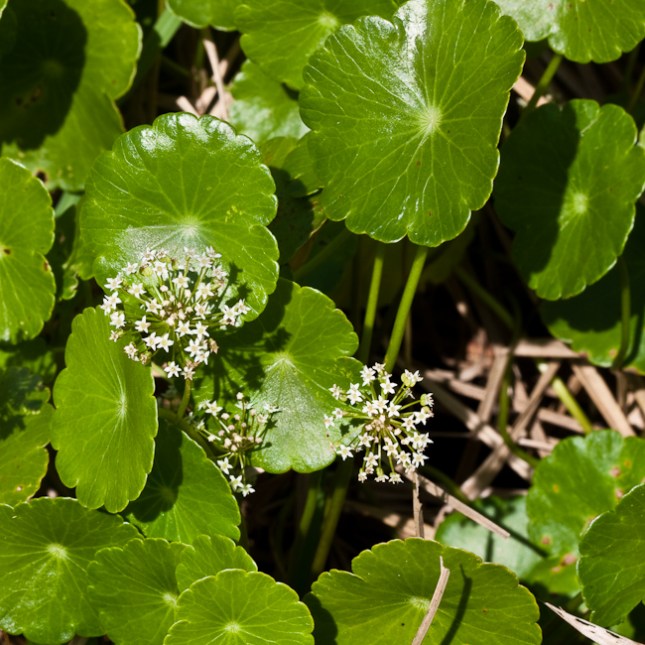
Today’s photos by John Bradford.
A clonal patch resembles a giant amoeba…it can expand this way and that depending on circumstances; some portions stumble into bad areas and fizzle, while other portions expand into favorable zones and thrive, branch, and expand. Nothing amazing there. Anyone who has faced tree roots in a sewer pipe may now bow to the Roto-Rooter Representative.
Now back to amoeba business. A slime mold is much like an amoeba as big as your hand. The “plants have intelligence” enthusiasts tout the mold’s ability to “solve” a maze with food at the end. SLITHER HERE Well sorta…it slithers hither and thither and then dies out wherever there is no food, thus producing ultimately one surviving strand leading to the oatmeal…biologically amazing and complex, but not “solving” the maze like a slimy little Hercule Poirot.
Hydrcotyle has its own smart trick. Remember the concern above about expanding wastefully into unfavorable places? Wouldn’t it be nice to avoid evil before stepping into it? Yes! A clone of Hydrocotyle can steer its rhizome growth clear of competing grass clumps. A skeptic might ask, “is it merely that the grass roots block the Hydrocotyle rhizome?” Naw, they checked on that. The rhizome veers off safely before contact like I alter course (usually) before blundering into a stinky crocodile-infested malarial miasma on my explorer map.
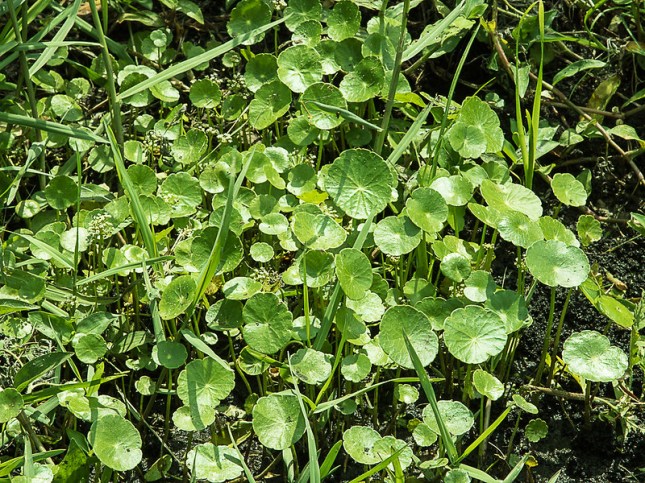
Now we all agree prescient side-stepping is fancy for a lawn weed. Complex and responsive yes, but “woo-woo OMG! don’t hurt the sentient plants,” no. Although the behavior is not explained, it is easy to suggest mundane ways the Dollarweed avoids trouble. Evans and Cain suggested perhaps it senses the area of nutrient-depletion surrounding the grass roots, or maybe root secretions are the no trespassing signs. Experimenters will nail it down if that has not occurred already. What makes me more curious is, what additional marshland green amoebas have radar, or engage in other cool behaviors?
 John Bradford
 George Rogers
 George Rogers
 Dee Staley
 Treasure Coast Natives
Linda Grashoff
April 24, 2020 at 12:55 pm
Thanks for clarifying the slime-mold issue. (I was duped.)
George Rogers
April 24, 2020 at 1:31 pm
i live duped.
Pat Bowman
April 24, 2020 at 3:32 pm
I can’t explain why certain plants just “speak to me” (like lichens, slime molds, mushrooms, lichen, fungus) but do add dollar weed to my list— quintessentially Florida and to me the NC Outer Banks.
theshrubqueen
April 24, 2020 at 4:18 pm
I keep seeing Dollarweed likes acid and alkaline (baking soda and lime) get rid of it?? My St Augustine usually grows a lovely stand of Dollarweed over the septic tank – then it goes away with droughty weather. Haven’t tried the lime theory. I live duped as well.
George Rogers
April 24, 2020 at 4:39 pm
Strong rhizome…don’t know abut killing it with kitchen products but doubt it…except maybe temporary topkill
theshrubqueen
April 24, 2020 at 5:15 pm
i’ve seen the rhizome and it is interesting how it infills in my non toxic St. Augustine. Opportunisitic with the Florida Snow as the summer inhabitant. The lime and baking soda may just make it wait til later.