Chromolaena odorata
Asteraceae
Across vast areas around the warm-climate world, including Florida, lives Jack in the Bush, a huge, raggedy, hairy, smelly, weak-stemmed weed up to 10 feet tall, often leaning on other plants. The leaves often look bedraggled, and they suffer often from leaf miners.
The flower heads start out white and wind up borderline pretty and pinkish, fuzzy, with long protruding stigmas. They attract several species of butterflies as well as additional insects. Notice I did not say insect “pollinators,” because the bug visits are pointless to the flower…there is almost no pollen.
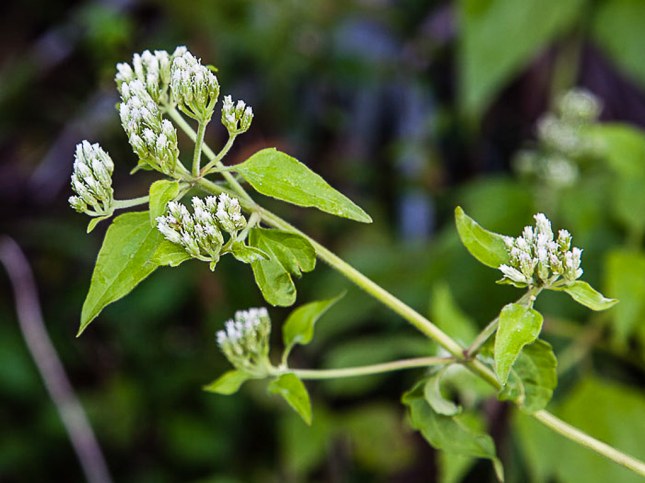
Jack in the Bush, white phase. Both photos today by John Bradford.
Members of the Aster Family generally share a common basic pollination plan. The flowers have 5 male pollen-making anthers joined edge-to-edge into a tube with pollen released into the hollow inside of the tube. The female style then rises up through that tube and either pushes pollen out like a plunger ahead of its two pollen-receptive stigmas, or the style drags pollen out of the tube using a “bottle brush” below the stigmas. Jack belong to the bottlebrush type. Its long style rises dramatically from the anther tube exposing two big long stigmas just asking to be pollinated. Below the stigmas on the style is the bottle-brush where there ought to be pollen. Only problem is, there’s almost none. What’s up with that?
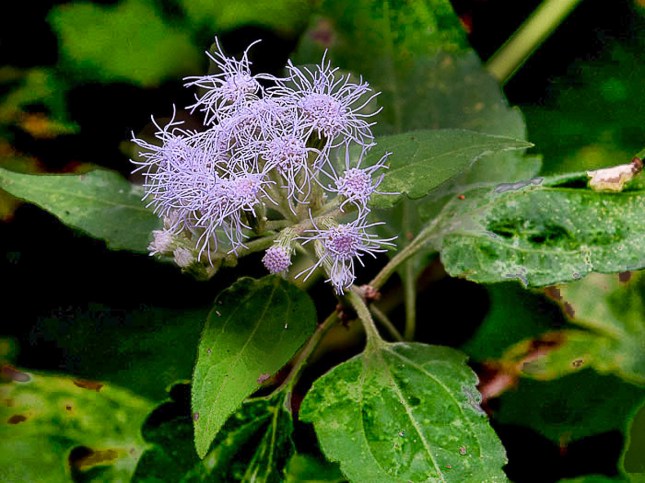
Mature flowers. The long threads are stigmas on the styles.
Knowing a plant to be a worldwide weed is a red flag to look for some ability to reproduce rampantly without benefit of separate individuals of the same species. That is, for a pioneer to be able to make seeds all alone. There are many such mechanisms, and one is to make eggs that do not require sperm, or in more botanical terms, viable seeds bypassing pollination.
True of today’s species. Jack in the Bush has six sets of chromosomes instead of the usual paired chromosomes we think of as normal. Extra chromosome sets are not rare in plants, and have different consequences in different species. Normal paired chromosomes matter during formation of eggs and sperms. Our chromosomally abnormal weed cannot make pollen, at least not much of it. So how does it spread like a weed? No problem, the extra chromosome sets do not prevent egg formation, In fact, just the opposite, eggs form needing no pollination. The embryos are clones of the mother plant.
Probably all the Jack in the Bush in Florida is probably one big genetic clone. The butterflies love it nonetheless.
 John Bradford
 George Rogers
 George Rogers
 Dee Staley
 Treasure Coast Natives
Flower Roberts
December 16, 2019 at 8:39 am
Fascinating as usual George.
theshrubqueen
December 16, 2019 at 3:29 pm
Hmm, for the non pollinator garden, How interesting there is little pollen and the plant is so incredibly prolific. These frighten me and are pulled out whenever I see one. Did they change the botanical name?
Melissa
December 16, 2019 at 10:56 pm
Fascinating revelation, but is Chromolaena still a high nectar source for pollinators?