Panicum repens
Poaceae, The Grass Family
The names:
Panicum refers to the panicle, a branched, flower cluster.
Repens means creeping.
Torpedo grass is the perfect name. Not only does the sunken rhizome look like a torpedo, it behaves like one too.
The essentially tropical species torpedo grass is of unknown origin, generally but not unanimously regarded as indigenous to the Old World, and invading the Americas at least as far back as the 19th Century. The grass once served as a forage grass, although it has some livestock toxicity. I wonder if it is experiencing a northward range extension via global warming. Nowadays torpedo grass is one of the premier weed pests in southern states, and around the tropical world.
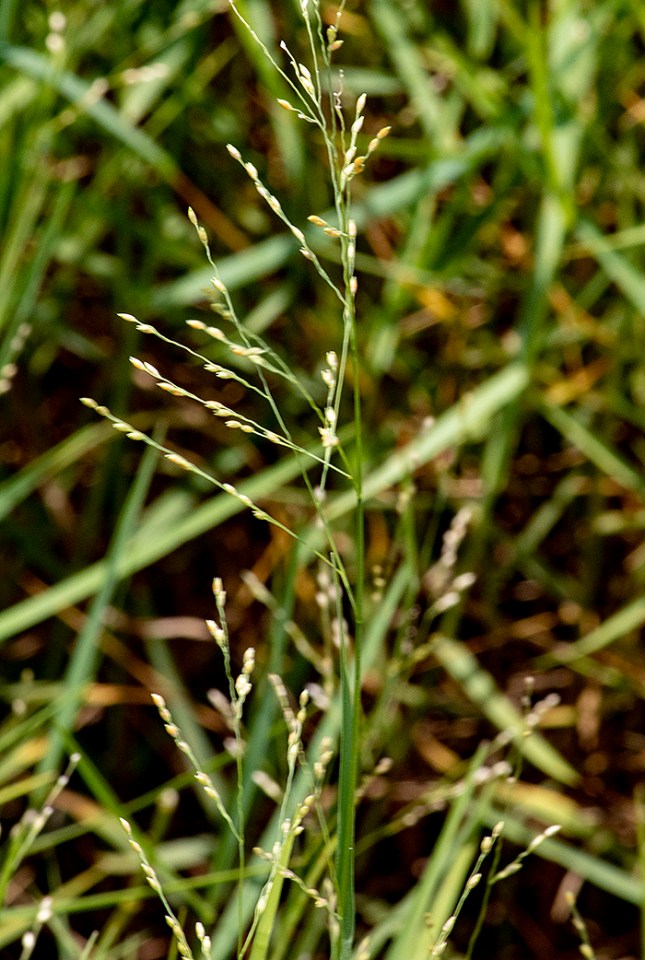
The grass is OUTRAGEOUS! Here are some TG OMGs:
Rhizome pieces can grow to the surface after burial of over 12 inches.
They survive at least 60 days buried.
Living rhizomes have reportedly turned up under soil about 20 feet deep (huh!?) and under 5 feet of water.
Rhizome segments remain viable after at least 10 weeks of floating.
They can dry out and then later sprout.
The torpedo can penetrate wood and asphalt.
Growth can exceed half an inch per day.
A single rhizome node can make 20,000 buds in a year.
Torpedo Grass covers over 16,000 acres around Lake Okeechobee.
Usually associated with wet habitats, the grass can occupy dry sites, even in scrub.
Salty habitats are just fine.
The species is allelopathic, that is, it poisons competitors.
What a grass!, despite herbicide, fire, and plowing attacks, it blankets countless acres. In some places, especially those under shallow water, much of the year, TG can form acres of “lawn,” yet I can’t maintain a healthy St. Augustine front yard to keep the HOA golf cart spies content. Proud homeowners keep their lawns lush with fertilizer. So how can today’s species make a big happy carpet without added fertilizer? Well, maybe it has some, not counting whatever nutritional pollutants are in its wet habitat. Let’s look into TG and nitrogen:
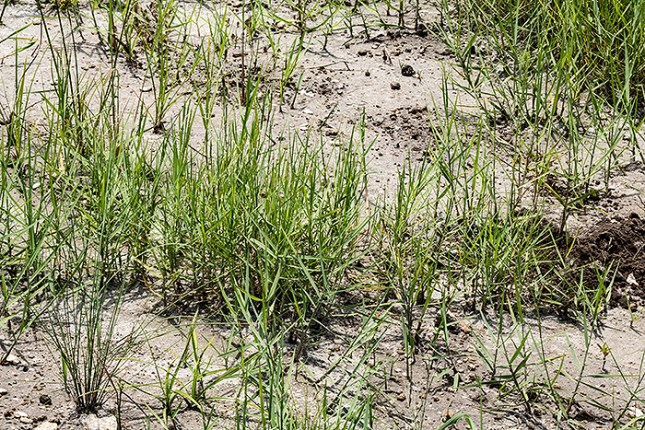
Over the last few days I’ve botanized a multiacre torpedo grass invasion on a severely disturbed wet meadow. The surface is essentially bare wet sand. How sand can “fertilize” tons of torpedo grass might seem a mystery, but here’s the thing: Mixed grass-legume pastures feed livestock sustainably because the legumes “fix” nitrogen by transforming atmospheric nitrogen gas to ammonium, which plants can use directly. Fixed nitrogen is the fertilizer nutrient needed in by far the highest volumes. A legume-heavy field is largely self-fertilizing. The field west of Jupiter is not a monoculture of torpedo grass, but instead is a mix of the grass and a substantial component of legumes: Indian shyleaf by the ton, thousands of wild bushbeans, and additional legumes scattered in small quantities, such as sensitive-pea, alyce-clover, cowpea, and danglepod. Grass plus legumes, almost nothing else.
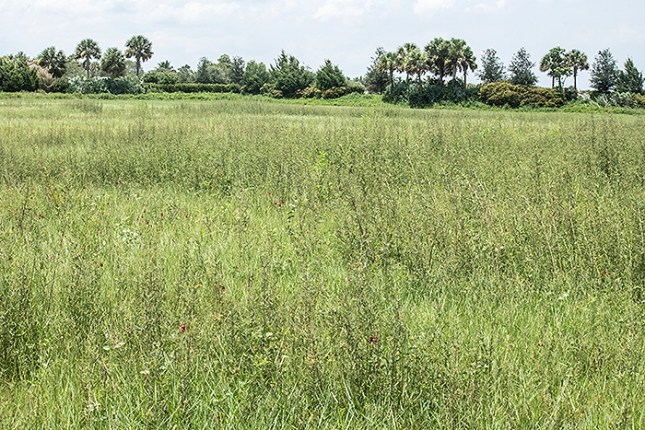
Torpedo grass stretchin’ out so far and wide. But wait a moment—all those taller plants are Indian Shyleaf, a nitrogen-fixing legume
That t-grass responds to added nitrogen is demonstrated in published experiments. You can deduce the same from one clump in my study area…taller than the rest of the torpedo grass, and darker green. Why? The happy grass sits atop a big scary ant nest, and no doubt the anty debris and waste is a nitrogen boost.
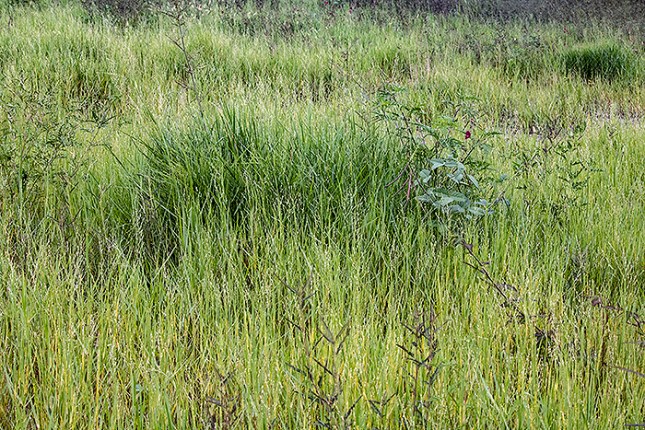
Clump of torpedo grass taller and greener than its neighbors. Go look…well, it is on an ant mound. The non-grass plants visible are legumes bushbean and shyleaf.
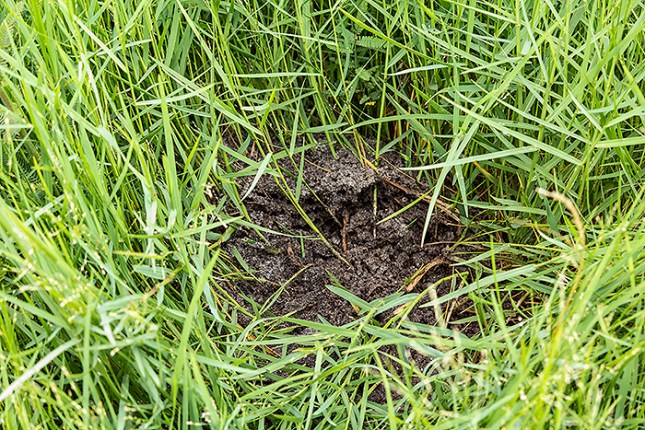
If you don’t believe me about the ants, stick your hand in there for ten seconds.
It isn’t all about legumes and ants. The ability of grasses to thrive in vast quantities without human-added fertilizer is becoming increasingly attributable to symbiotic nitrogen-fixing bacteria, not in nodules, as in legumes. Instead, nitrogen-fixing bacteria live in the grass’s root zone, or sometimes housed within leaf bases around rhizomes, or even within the grass tissues. This area needs a lot of study. Nitrogen-fixing bacteria have been reported a couple times associated with torpedo grass.
More astounding are additional bacteria associated with the grass and able to neutralize nasty acid soils, extending the already super powers of the torpedo grass into acid environments.
Weirdly, TG seems to be taking over the world despite poor seed production, at least in places. The species is reportedly unable to make viable seed in large parts of is range, including much of Florida. A study at Lake Okeechobee where the grass is out of control failed to find viable seeds in the soil seedbank. Thus most of the Florida reproduction is clonal, such as by floating rhizome fragments, also by axillary buds produced along the rhizomes. Just think, in a genetic sense a clone is one individual. That would mean South Florida is being devoured by an immense immortal botanical amoeba. Talk about going green!
The rhizome-buds are generally immune to herbicide applications, making torpedo grass hard to control chemically. Tilling encourages it. Fire can’t touch it. Weed-killing fungi have been tried but can’t do the job. We may be SOL.
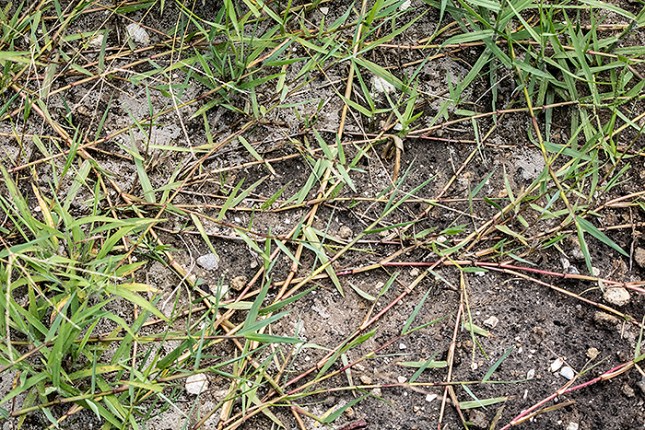
Long thin rhizomes running hither and thither.
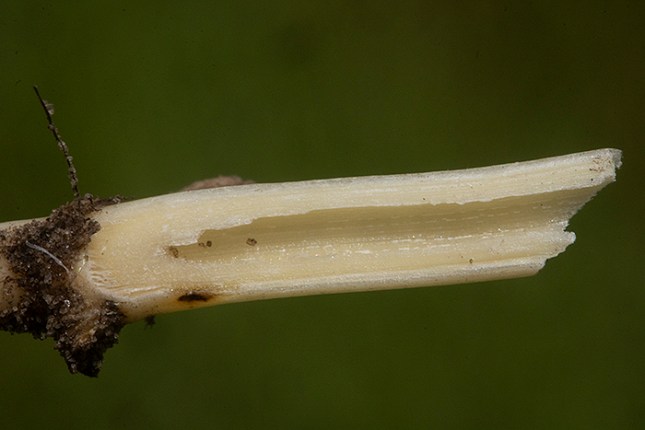
They are hollow gas pipes.
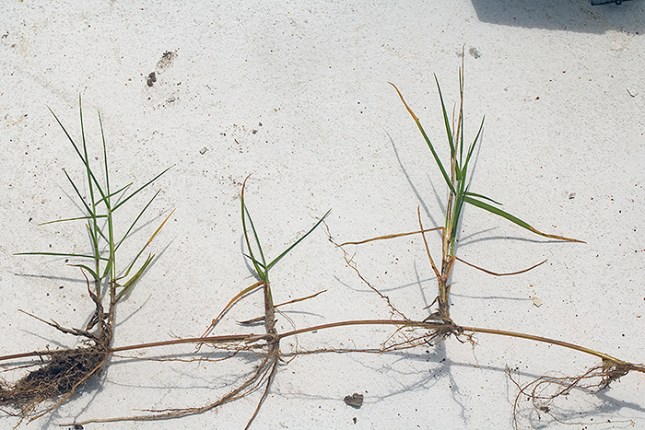
To add to the immorality, the rhizomes come in two different forms, sometimes totaling to over 85% of the plant’s biomass. One form is long, narrow, and able to penetrate the earth submerged, or to run across the surface of the ground. The long narrow rhizomes have a hollow center, clearly allowing gas exchange deep in the ground or submerged in water. These rhizomes put the torpedo in torpedo grass, helping it spread and invade like wildfire. The thin rhizomes can be so abundant to form mats 6 inches thick.
The second rhizome type is thick and gnarly, looking like a ginger “root.” Those who study the species actually call them “ginger root” rhizomes. These seem to let the species hunker down, store starch, and maybe sit tight until conditions become right for sending out a new infestation of the long thin rhizomes. Torpedo grass has been documented to “go dormant” under seasonal floodwaters, then resume spreading as water recede. Alternatively, the rhizomes can make a floating mat.
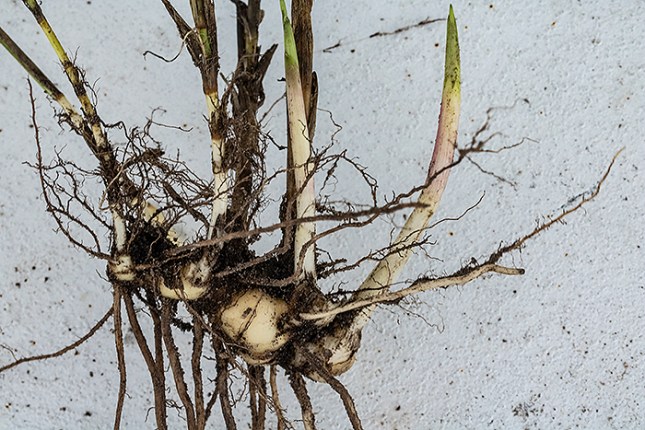
Ginger root style rhizome on torpedo grass
To sum it all up, torpedo grass is a species you can’t kill, eager to colonize wet places, standing water, scrub, acid soils, and probably the surface of Mars. It is armed and dangerous with aggressive imperial rhizomes and with resting food-storing rhizomes. You can curse it, and sometimes all we’ve got is resignation. But then again, a super-weed with crazy growpower ought to be good for something. Does all’s green make a little contribution to carbon dioxide reduction? Isn’t it good for some biomass purpose? Maybe as a bioweapon…dice the rhizomes and spew the pieces on the enemy?
 John Bradford
 George Rogers
 George Rogers
 Dee Staley
 Treasure Coast Natives
Linda Grashoff
July 12, 2019 at 2:29 pm
That’s just plain scary.
George Rogers
July 12, 2019 at 3:01 pm
Linda, I’ve got a question for David, who would be he world’s authority on the topic. Southern needleleaf, Tillandsia setacea, an airplant, catches masses of decaying debris among its leaf bases…and is it my imagination (maybe), or do roots get into the debris? I wonder if it would be fair to suspect the plant is a trashbasket feeder like some orchids with their vertical roots.
David Benzing
July 13, 2019 at 1:32 pm
George,
Numerous bromeliads, but less so Tillandsia setacea compared to those species equipped with better developed leafy “tanks” such as T. utriculata, frequently produce scattered roots that penetrate the debris that accumulates in their inflated leaf bases. So it’s likely that some uptake of moisture and nutrients originating from that impounded organic stuff often enters the shoot via this route. However, the more advanced members of the family, and especially members of subfamily Tillandsioideae, rely primarily on their foliar trichomes to acquire moisture and mineral nutrients their root systems being relegated primarily to roles as mechanical holdfasts. So they qualify in a sense as trash basket plants except that unlike the qualifying orchids, aroids, etc. the bromeliad tank or phytotelm is a much more elaborate device that in fact supports a complex microcosm inhabited by all sorts of microbes, invertebrates and more that through their activities as symbionts process debris, releasing nutrients that the bromeliad absorbs via its foliar trichomes. Also, the microflora can include nitrogen fixers. It’s a system that’s only now receiving the attention it warrants given the prominence of the tank bromeliads as bioengineers in many Neotropical ecosystems. By the way, the bromeliad foliar trichome has reached a state of functional refinement that has allowed near complete elimination of the root system in Spanish moss, for example. Why and how all of this has occurred makes for interesting speculation, but it’s too elaborate to add here.
David
George Rogers
July 13, 2019 at 9:41 pm
David, Thank you so much for such a thorough answer to my question. Much appreciated, especially as we see all the local Tillandsia species on class fieldtrips, and now can discuss them with greater insigh. Thanks for the needed helping hand, not to mention for all your research that enriches botanizing in Florida…..George
David Benzing
July 14, 2019 at 1:44 pm
Glad to help George. I enjoy and learn from your blog!
theshrubqueen
July 12, 2019 at 2:46 pm
I have been having a long term discussion with torpedo grass in my vegetable garden, I actually prefer it to Bidens and Richardia. The size of the root/rootlets never fails to amaze me.
George Rogers
July 12, 2019 at 3:10 pm
interesting set of preferences priorities…you growing any summer vegetables?
theshrubqueen
July 12, 2019 at 3:52 pm
Summers are for the pollinators! Food grown in the summer – basil, bay, rosemary and papayas and mangoes.I sit on the sofa and watch the butterflies.
George Rogers
July 12, 2019 at 3:57 pm
Yes, so do I…then run out with camera ready to shoot just as the butterfly decides to relocate.
Kim Smelt
July 12, 2019 at 5:20 pm
Take out all the enemies with TG! Mars is worth a try. Thank you for making Botany fun!
George Rogers
July 12, 2019 at 5:50 pm
Hi Kim!
Chris Lockhart
August 12, 2019 at 10:17 am
Hi George,
Thanks for your insightful blog on TG. Quite the headache for sure. If you keep at it long enough, sometimes you can get lucky and reduce it, even if you cant totally kill it. It’s interesting that you mention bushbean. We’re trying to control an invasion of TG in a planted landscape along a formal ADA paved nature trail in municipality. The second worst headache is the bushbean, which is currently listed as a Category II invasive plant. I now see why. After reading your blog, is seems like a feedback loop or perhaps a symbiotic relationship between TG and the legumes. Only the hardy need apply to claim a space in the garden. The poor muhly grass, wild coffee and even spider lily!