Leptothrix discophora
(Leptothrix means fine hair, referring to thin filamentous bacterial colonies. Discophora, means “has a disc.” A disc helps attach the bacteria to aquatic substrates.)
John and I today poked into the ecology of a couple aquatic plants, the results not quite ready for prime time. In the meantime, here is another aquatic.
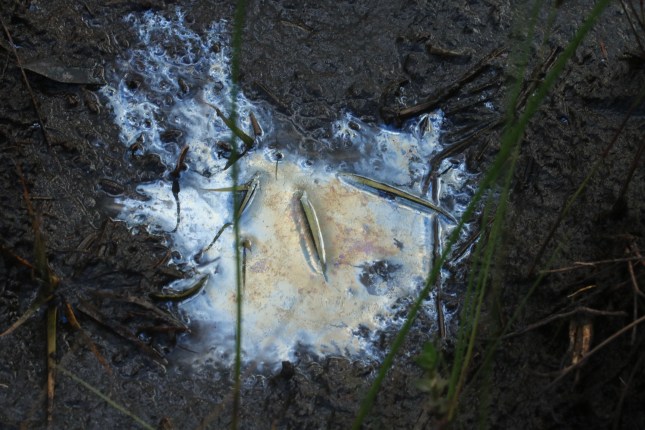
Sometimes slow shallow waters have a “rainbow” or silvery film on the surface, often resembling a subtle oil slick. Could be oil. Poke the slick with a stick. If it fragments like shattered glass it is probably a colony of Leptothrix bacteria. A genuine oil slick merges back with itself unshattered.
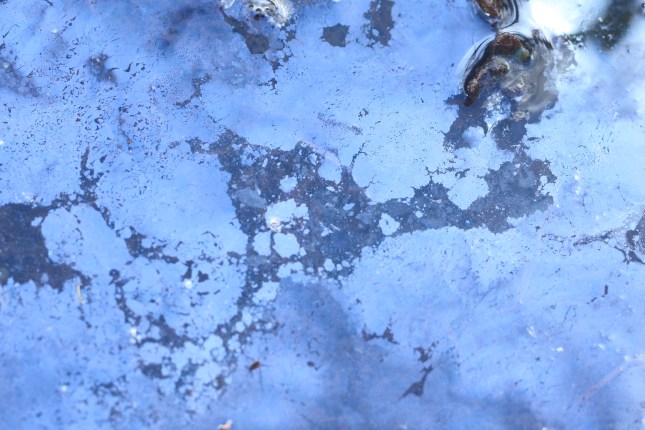
The film
Now I’m no microbial expert, and can’t 100 percent guarantee my facts. I just enjoy knowing these ultra-microscopic life forms, a taste acquired from Linda Grashoff who lifted bacterial rainbows into the world of art in her book, “They Breathe Iron.” She sent tips helpful in today’s item. CLICK to see a great book. https://scienceandartpress.com/
Leptothrix bacteria form tiny hairlike branched chains enclosed in a sticky sheath. Think of a translucent garden hose holding a string of beans so minute as to be challenging to examine with a good microscope.
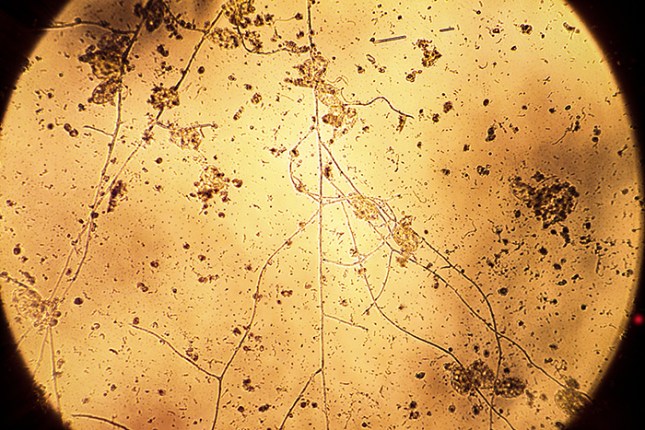
Under the microscope. The hairs are Leptothrix colonies in their sheath.
The sheath-bound chains can accumulate as a film on the water surface, or may stick to submerged sticks or stones. The bacteria have a complex nutritional cycle involving organic matter, and iron and manganese. The bacteria oxidize (you might say “rust”) these metals and adorn their sheath with metal nanoparticles. The resulting colors vary with the thickness of the bacterial film and with the relative amounts of iron, multicolored, and manganese, silvery.
Leptothrix is similar to the more famous and useful Sphaerotilus bacteria that contribute to the stringy “floc” during secondary sewage treatment, where they help the organic components in sewage. Somebody’s got to do it.
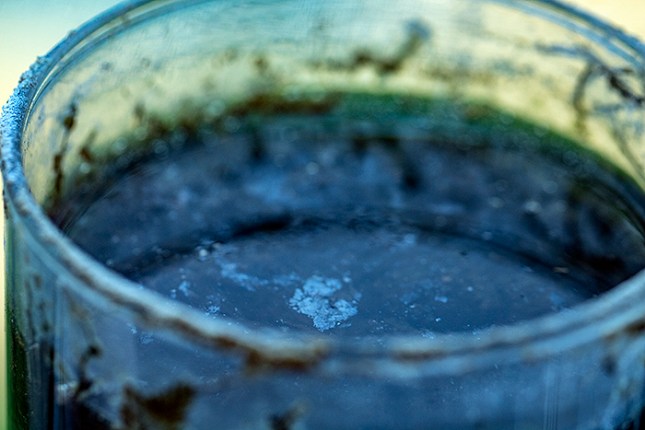
Given that Leptothrix thrives on organically enriched water and iron, it possible to “cultivate” the bacteria in a cylindric glass vase called a Winogradsky column, filling the column with waterlogged pond mud covered with pond water. For iron I used Feosol iron dietary supplement pills. The vase came from Dollartree, the world’s greatest source of inexpensive botanical “labware.”
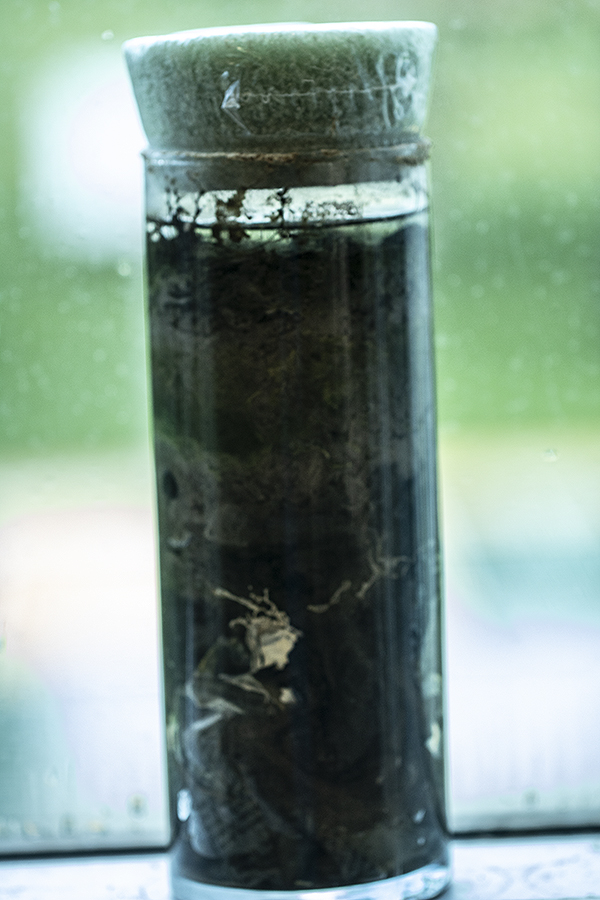
Winogradsky column, with Leptothrix (not visible in this photo) afloat on top.
Dig in deeper: Dyer, Betsey D. A Field Guide to Bacteria. Ix + 355 p. Cornell University Press, Ithaca, NY. 2003.
Linda’s Blog CLICK https://lindagrashoff.wordpress.com/
 John Bradford
 George Rogers
 George Rogers
 Dee Staley
 Treasure Coast Natives
theshrubqueen
June 23, 2019 at 3:35 pm
In A Vase on Friday! It is pretty, looks like a painting.
Linda Grashoff
June 23, 2019 at 7:07 pm
What fun! Welcome to my world, George. Can’t wait to start my own Winogradsky column. Thanks for the links and plugs.