Rhizophora mangle
(Rhizophora means root-bearing. Mangle means mangrove in Caribbean Spanish.)
Rhizophoraceae
Continued play in the Peck Lake mangroves near Hobe Sound, Florida, this morning kept John and me as happy as dogs with two tails. We’re trying to figure out what makes mangroves tick.
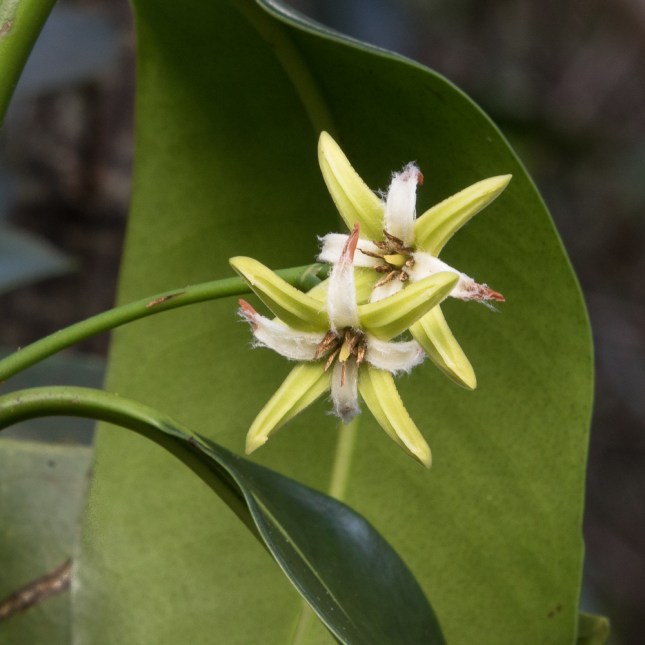
Red Mangrove y John Bradford
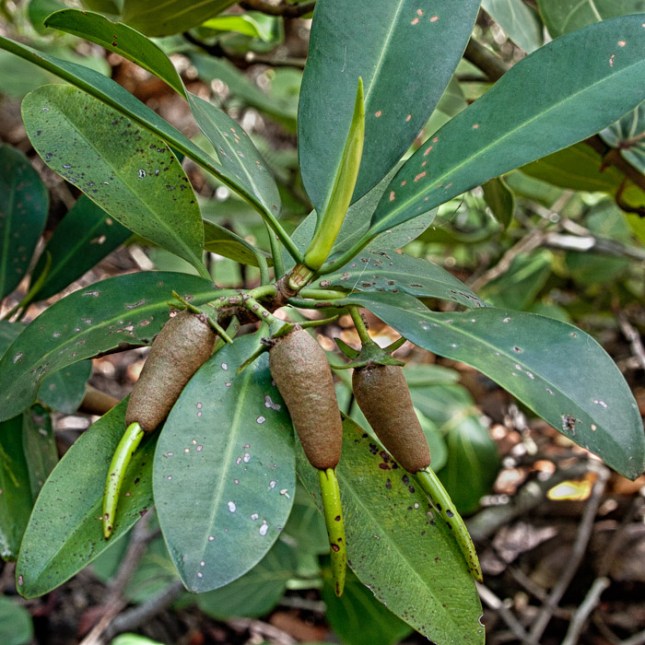
Start with the embryos. All our local mangrove embryos germinate precociously, with those of White Mangrove sprouting within the fruit, those of Black Mangrove dropping from the fruit. CLICK for Black Mangrove. In Red Mangrove the embryo grows several inches before dropping, leaving its top parts behind.
By JB
How the mangroves handle salt varies. Black Mangrove secretes it abundantly from leaf pores. White Mangrove has such pores, but seems more prone to stash salt in expendable foliage. Red Mangrove emphasizes blocking salt at the roots, leaving the leaves free to specialize on air circulation. On that topic, White Mangrove tends to have the least-oxygen-starved roots, and can send specialized snorkel pegs upward as needed to get above suffocation. Black Mangrove extends its little “dead man’s fingers” vertically above the anoxic ooze. These need more attention but not now.
Red Mangrove is the star today, and its aeration system is extreme. Of our three local contenders Red is most tolerant of tidal submersion and thus may need the most aggressive air circulation. Sources like to say the species services its sunken roots by allowing air into its big prop roots arching above the water level. Makes sense…the submerged roots need air and the prop roots rise into the air just above. Any defense attorney can tell us not everything that makes sense is true. Research by a couple generations of physiologists reveals a more complex system.
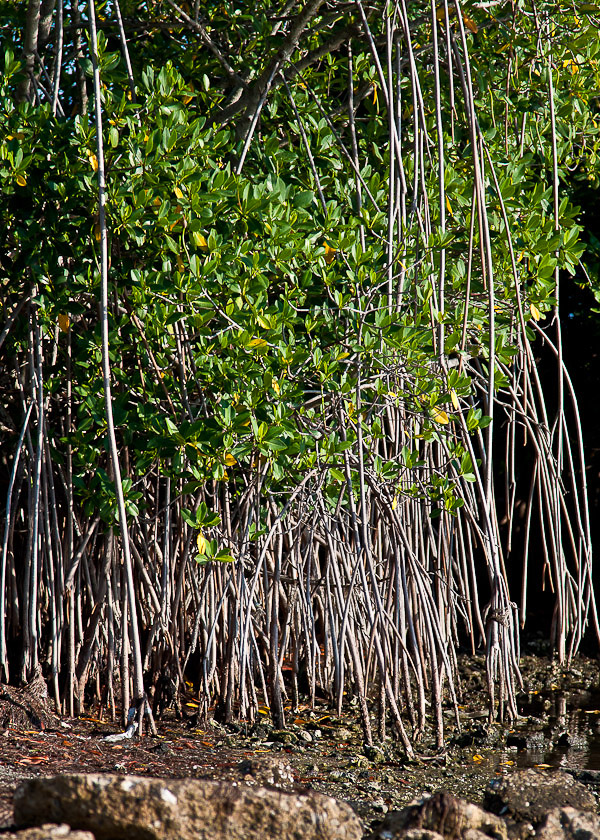
Stilt roots, by JB
A Red Mangrove recognition tip I mention in my native plants class is freckles on the undersides of the leaves, dozens of dark pinpricks. They are not salt glands. Instead, they are air-intake valves called cork warts. The cork warts penetrate into the leaf like little thimbles, broad at the leaf undersurface and narrowed upward far into the leaf, ending adjacent to open air-conducting tissue near the top leaf surface.
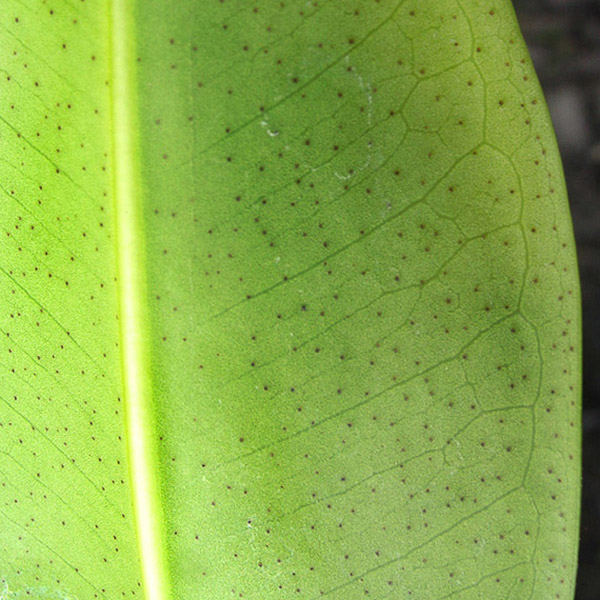
Cork wart freckles by JB
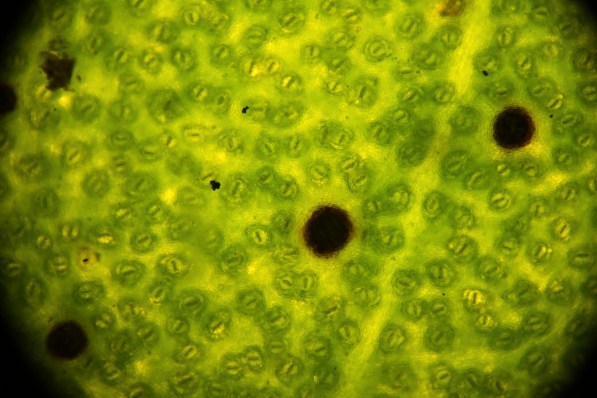
Dark cork warts mixed with countless green stomates. When the stomates inflate and open does that impinge on the cork warts? Just a hunch!
That leaf airspace is connected to ductwork leading all the way down from leaf tip to submerged root tip. That long-distance HVAC system must need pressure. Pressurized air is known in wetland plants, and has surfaced previously in the blog. The solar-powered air-blower resides in the leaf blade’s air spaces, the sun-generated heat pushing the air out of the leaf and down down down through a system of air-conducting tissues. The old air escapes from the roots, either below the waterline or above, the exit strategy needing research. Some botanists think the released air helps oxygenate the stinky mangrove mud.
You might ask why the pressurized air flows cooperatively down though the ductwork rather than leaking back out the cork wart entry points. That can happen, as shown experimentally with hyper-pressured leaves held underwater bubbling from the cork warts. Even if there is some naughty backflow, air goes down the plant too. Rising pressure may alter the shape and structure of the cork warts to impede backflow. Additionally, the air can enter the leaf 24/7 and seep deep into air spaces getting far from the potential exits before sunny times generate pressure. Conceivably millions of stomates open and turgid during the sunny day may force the cork wart valves closed. On top of all else, warmer air flows toward cooler air in Knudsen Pressure. Most of this paragraph is speculative, but in any case forced air starts in the leaves and exits the roots.
For a pressure test John and I connected a delicate pressure gauge to a couple leafy Red Mangrove twigs, and to non-mangrove leaves and leafy twigs, and monitored pressure changes over time during changing light conditions. In non-mangroves the leaves generated a negative pressure, suction, as water is pulled up and out via evaporation from the leaf blades. The pressure decreases over time. Non-mangrove leaves are suckers.
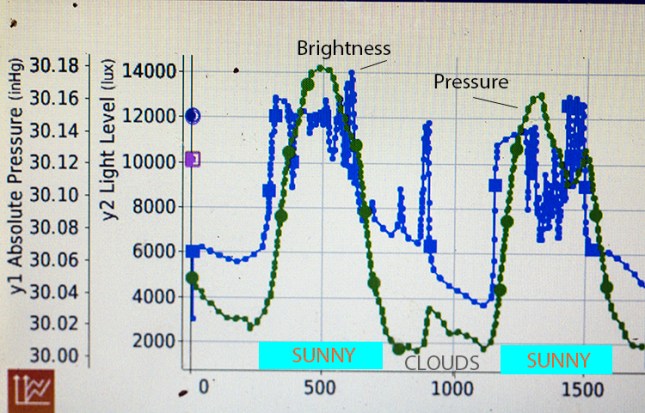
Blue line = solar radiation at the leaves. Dark green line = air pressure coming down twig from leaf cluster. As the sunshine increases so does the pressure. When sunshine dips, so does pressure. The two are tightly linked.
Here is another—different branch, later in day, same pattern:
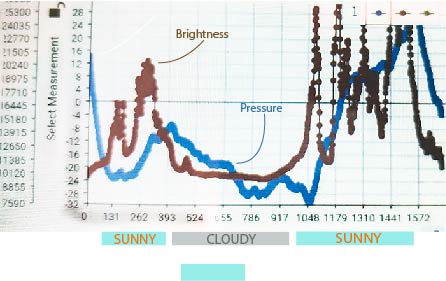
The jagged brightness line is due to passing clouds.
In Red Mangrove, by contrast, when and only when the sun is bright the net effect is positive pressure. Sunny Red Mangrove leaves are blowers. But, as the graphs above show, only when the sun is bright, the pressures being highly attuned to sunbeams vs. cloudy skies.
More speculation. If bright sun on the leaf surface pumps air to the roots, does the parabolic arrangement of the leaves at the branch tips help absorb the air-pumping solar radiation like a parabolic antenna collects radio waves?
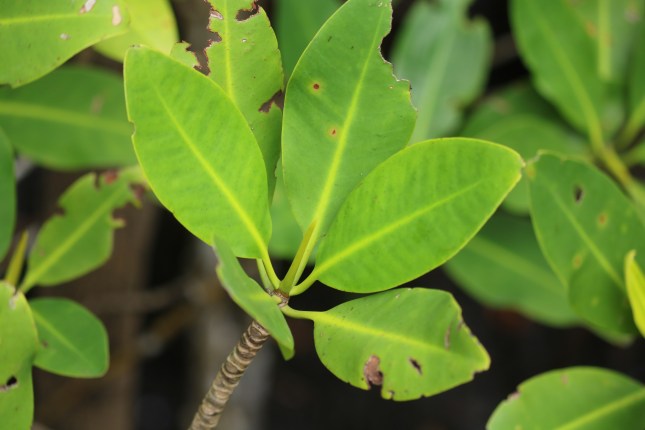
Parabolic solar-ray catcher? The pressure readings in the graphs above came from a point essentially identical to where the twig crosses the bottom edge of the photo left of center.
 John Bradford
 George Rogers
 George Rogers
 Dee Staley
 Treasure Coast Natives
Flower Roberts
March 30, 2019 at 12:37 pm
This was fascinating. Thanks
George Rogers
March 31, 2019 at 8:15 am
thanks!
Linda Cooper
March 30, 2019 at 5:08 pm
Cork warts – I learned something today. Actually a lot of good info that I won’t retain but cork warts I might. Will be sharing this on Facebook.
George Rogers
March 31, 2019 at 8:16 am
Weird little structures for sure, not completely limited to red mangroves. They sure need more study.by those with the appropriate equipment.
theshrubqueen
March 30, 2019 at 6:56 pm
Wow, my head is reeling from the pressure. HVAC for Mangroves, makes sense.
George Rogers
March 31, 2019 at 8:18 am
Forced air is becoming “better known” in plants of root-suffocating places. I’d like to see more study of what happens after the pressure leaves the leaves. The beginning gets the attention, but the rest of the path is a little murky.
David Chaimowitz
April 1, 2019 at 3:28 pm
Cork warts, there’s a new term. This is absolutely fascinating, and may also help a long running investigation into leaf anomalies in ficus going around our local south Florida nurseries.
George Rogers
April 1, 2019 at 7:43 pm
Yo David…whereya been, what’s up with you?