Tillandsia setacea
Bromeliaceae (Pineapple Family)
Tree of Tears
Live Oak – Quercus virginiana
Fagaceae
Today John had obligations so I did something botanical I enjoy near my home, perpetual exploration of Riverbend Park on the Loxahatchee River west of Jupiter, Florida, living proof you do not need to go far for good times with Mother Nature.
Riverbend Park and the contiguous Loxahatchee River Battlefield Park, in these paragraphs jointly called “the park,” is the site of the two-phased 1838 Battle of the Loxahatchee where 1500 U.S. troops killed an unknown number of indigenous people to make room for St. Augustine grass lawns.
A park icon is the “Tree of Tears,” an old Live Oak in poor condition, where the Seminoles allegedly sheltered their battle dead and dying. The historical connection between that specific tree and the battle history might be a little tenuous in a “scientific sense,” and it seems tacky for a modern author selling a book to dub the tree the “Tree of Tears.” Apparently the Seminoles did not bestow the name on their tree.
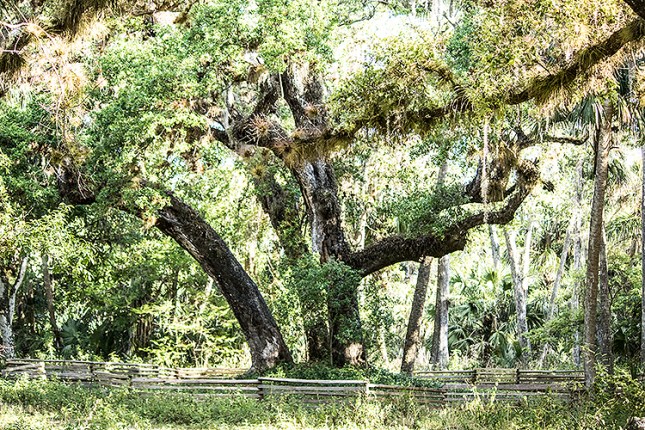
Tree of Tears
Whatever its true history, the tree is a big gnarly old Oak among similar old gnarly Oak neighbors in the close company of likewise large Bald Cypresses and Water Hickories. A magical, and noisy, place with a drumline of three woodpecker species.
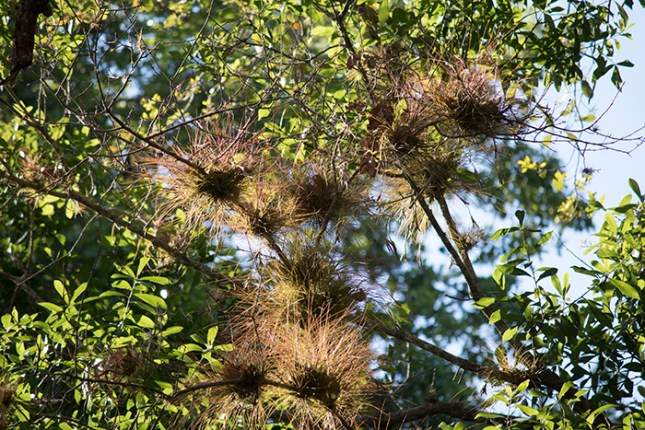
Southern Needleleaf on or near Tree of Tears
The massive Oaks are home to literally thousands of epiphytes representing numerous species, with by far the dominant one being Southern Needleleaf, Tillandsia setacea, a Bromeliad relative of Spanish-Moss, Ball-Moss, Cardinal-Airplant, and several others. The Southern Needleleaf clusters can occupy the old (and sometimes young) Live Oaks lined up along the branches so numerously the tree looks like a Pine, since the epiphyte’s leaves are the size and shape of pine needles, although usually with a reddish cast. This species has entered the blog before, and I feel moved to a redo.
Southern Needleleaf can occupy different host species, but in my experience around here it has a powerful predilection for Live Oaks. Vigorously growing Live Oaks can sustain countess Southern Needleleafs which seem to shun the adjacent Bald Cypress and have little love for the Water Hickories. Interesting pattern—Why?
Could it be the Oak leaves? Let me explain. Epiphytes share a problem: they are rooted high, dry, and nutritionally deprived up on tree branches. No roots in the earth. They each have their own fascinating special tricks for coping within treetop living. Tillandsias in general, including today’s species, have a covering of umbrella-shaped scales on the leaves able to absorb water and nutrients in the water.
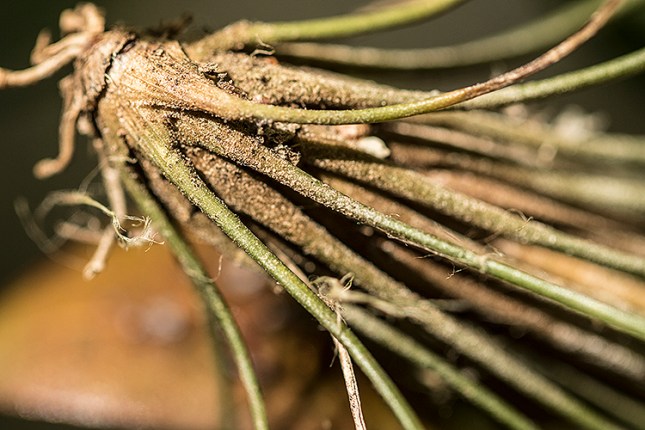
Southern Needleleaf basal covering of absorptive scales.
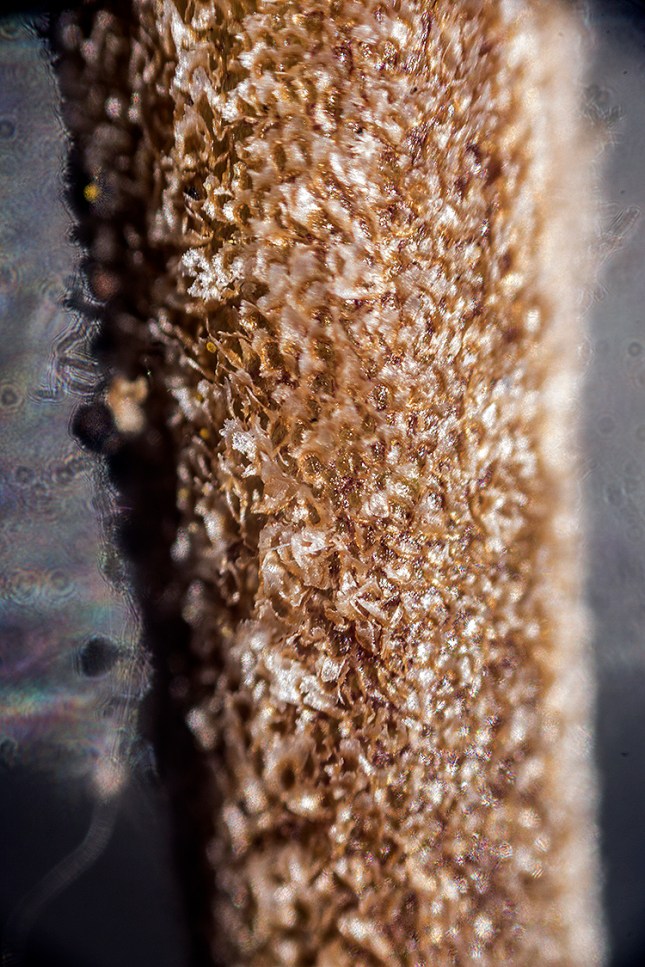
The scales magnified.
Southern Needleleaf has its umbrella-shaped scales concentrated at the bases of the long spindly leaves. That is exactly the same place the leaf cluster functions as a trashbasket capturing fallen Oak leaves and other debris, including possibly insect frass. (Frass from insects…suggesting symbiosis? Ohhhh, that’s pushing things a little too far for the moment.)
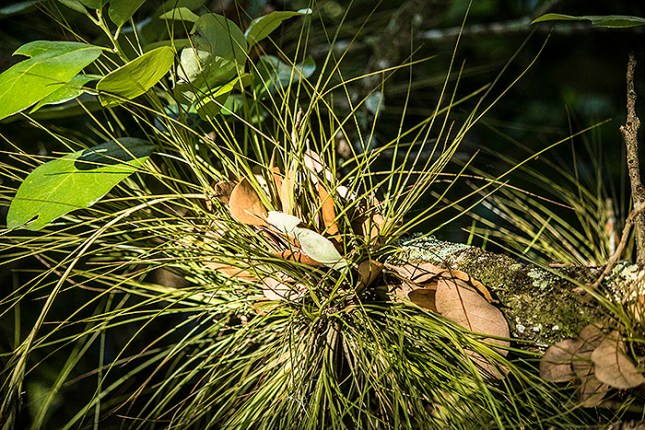
Southern Needleleaf catches debris in its trashbasket at the same level as the heavy covering of scales.
The leaf blades have the upper-inner edges rolled into a vertical groove, especially at the leaf base trashbasket zone. Picture a drinking straw slit along one edge. The grove is perfect for catching water and organic debris, which is present and sometimes stuck to the scales inside the groove.
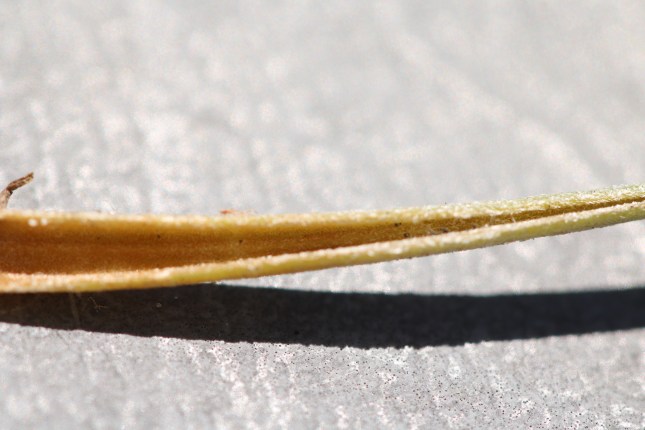
The groove at the inner-upper side of the leaf base.
Now, of course there are no data, no proof, but those scales and that groove at the debris-catching level look to me like this plant’s pantry.
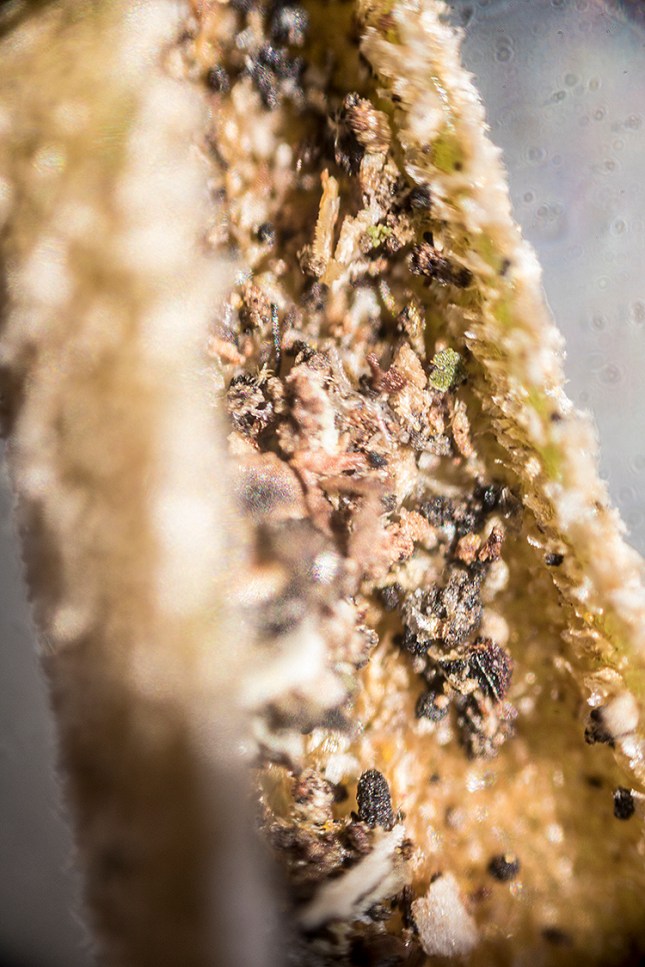
Microscope view inside the groove, with trapped compost stuck to the scales.
 John Bradford
 George Rogers
 George Rogers
 Dee Staley
 Treasure Coast Natives
Uncle Tree
March 17, 2018 at 7:29 am
Lovely sheltering tree of beauty — very charming, George.
HaPPy St. Patrick’s Day! 🙂 Cheerz, UT
George Rogers
March 17, 2018 at 8:57 am
A wee bit of resemblance to the Uncle Tree tree…same age I reckon.
Uncle Tree
March 17, 2018 at 5:07 pm
Oh, yes. I reckon with the ancients all the time. 😉 They reckon with me like a li’l sap bro.
Debbie Dixon
March 17, 2018 at 9:03 am
Enjoyed reading this, as I always have enjoyed your articles. I also like thinking of you and John traipsing about. Years ago I took a grass class you (and John) gave. I loved it!
Debbie Dixon
George Rogers
March 17, 2018 at 10:32 am
Hey Debbie….thanks and howya doin! Might run that grass class…probably for a total of four students…once more before I retire. Thanks for the happy note!!! -George
theshrubqueen
March 17, 2018 at 9:00 am
Happy St Patrick’s Day, time to seach for some four leaf Oxalis? Having read one too many English gardening blogs, I decided to create a stumpery – using Tillandsia and a non Oak stump. Did not work, stumpery is gone!
George Rogers
March 17, 2018 at 10:19 am
Had to Google stumpery. That sounds like a fun project…of which you will of course post photos. Irma left a stump in my yard in case you need one.
theshrubqueen
March 17, 2018 at 2:53 pm
Would need your stump mine was felled by Irma
leonorealaniz
March 17, 2018 at 9:37 am
Thank you again! Does it have different stages of hardness, depending on colimatic changes? It looks like I could print the Southern Needle Leaf and record its anatomy in 2D. I’d ink it and print it with a hydraulic press. Possibly even the curled “needle” would reproduce, depending on paper, wetness of it and ther variables I’d have to control. Of course I have never seen this plant, but would surely like to record it, Roger, would you mail me a few samples? I would reimburse you for postage and send you an original print. Thanks for considering! Oh, and since it looks bulky, I may slice it in half and expose the “inside” of the tuft. Leonore.
George Rogers
March 17, 2018 at 10:24 am
Hi Leonore, So pleased to hear you are still printing. It drives me nuts that our large college art program has no classes to speak of on relief print making, intaglio, monoprinting, lithography etc. So I feel doubly motivated to send you material. My pleasure. Certainly you do not want to put your address on FB, so send me a message and I’ll send you a plant or two. Can hardly wait to see your prints.
leonorealaniz
March 17, 2018 at 12:34 pm
Roger, got your reply with 🙂 and appreciation. Only this page comes up to send the info: LEt me know when you sent it, so I retrieve it in god time. You help make something special happen, I sense. I must come to FL and print these special creatures. Leonore
LA…I redacted out your actual address..no need for goofy mail sent by who knows who.
leonorealaniz
March 17, 2018 at 12:36 pm
George, why on Earth do I call you (always?) Roger?!? I like that name a lot, true, but my grandfathers name was also George. Germans pronounce it “Schorsch”. I apologize, George! :-)….
George Rogers
March 17, 2018 at 7:04 pm
Seems George and Roger have pretty similar letters. I get called Rogers frequently, so there is a reason. All good!
George Rogers
March 19, 2018 at 8:57 am
Plants sent today…
Jenifer Mina
March 19, 2018 at 10:18 am
The plants prefer oaks because their attachment fibers get the best purchase on the rough bark
leonorealaniz
March 24, 2018 at 10:43 am
The envelope arrived! Thank you, Amazing growth, ad the blossom! I have a grass growing in a pot that has smaler but same flowering grass just smaller. Does that little flower branch belong to Quercus virginiana Fagaceae ? Now they all soak in shallow water,am lokking forward to printing with it. ! 😉 soon. Leonore
On Mon, Mar 19, 2018 at 10:24 AM, Treasure Coast Natives wrote:
> Jenifer Mina commented: “The plants prefer oaks because their attachment > fibers get the best purchase on the rough bark” >