This afternoon was hot! John and I sweated 90 degrees to sink to our ankles in warm stink-mud near Jensen Beach, Florida to behold a zillion Bladderworts. The site is about half overpowered with invasive exotic species and about half restored to an intriguing dried pond carpeted with carnivorous yellow Bladderworts.
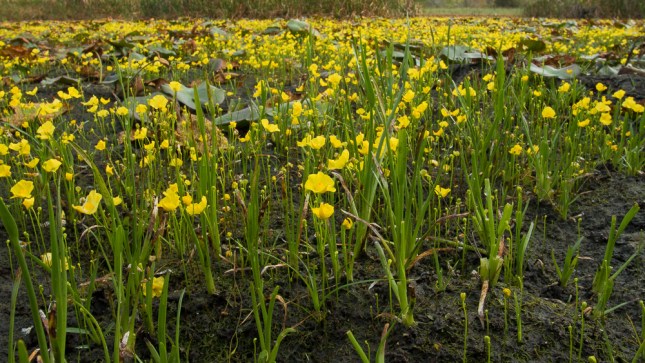
Bladderworts in the mud. Photo by John Bradford.
Because we’ve covered these greedy meat eaters previously, let’s turn to the invasive exotic species. For most of the hundreds of unwelcome escaped plants in Florida it is easy to surmise how they got here: running away from gardens, or feeding livestock, or hitchhiking as seeds or spores. Some pests have have more-interesting histories.
Let’s take a shot at the novel cases, with a disclaimer that just because somebody introduced a species once does not mean nobody else did before or after. That is impossible to pin down, and records are murky.
Sisal Agave
Sisal is a Category II invasive exotic species looming large in hot dry habitats locally. It dates back to Florida’s first well documented horticulturist, Dr. Henry Perrine.(1797-1840). Dr. Perrine had an eventful life, first as “The Little Hard Riding Doctor” in Illinois, where, oops, he accidentally drank a bottle of arsenic. That mishap drove him to Mexico, the toxic damage causing a craving for a warm climate. In Mexico Perrine doctored a cholera epidemic, which he caught of course, and yet survived as his second brush with death.
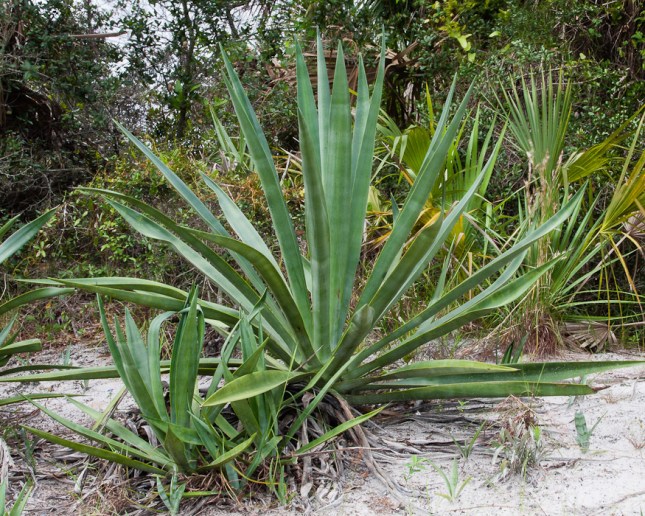
Sisal in Jensen Beach, by JB
In addition to doctoring, Perrine served as U.S Consul to Mexico, coming under a presidential executive order to ship Mexican crop plants back to the U.S. He sent them to Indian Key in the Florida Keys, and took a special interest in Agaves, including Sisal, writing a book on the plants. Sisal was and remains a commercial source of fibers. To this day Indian Key houses Sisal Agaves, as does much of South Florida. Perrine retired from Mexico moved to Indian Key to tend his introduction garden, and to be a doctor where one was needed, but never lived to see the literal fruits of his labor, as he suffered “strike three,” death at the hands of angry Indigenous People in 1840, and thus ended Florida’s first botanical garden.
Water Hyacinth
Water Hyacinths are lovely floating plants with spikes of attractive purple flowers.
All well and good if under control, but Water Hyacinth broke out and conquered Florida waters and beyond, sometimes smothering watery acres with millions of itself, clogging waterways and interfering with ecology. Maybe it should become a biofuel.
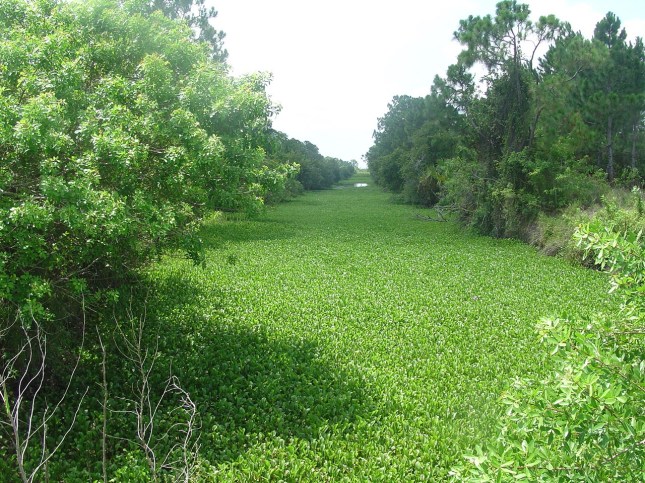
Hyacinth to the horizon
How did a bad deed like that get started? A careless lily pool owner? No. Hyacinth Hell traces back to the 1884 New Orleans Cotton Exposition (World’s Fair), where they had a mammoth greenhouse with mind-blowing horticultural exhibits. Not bad for 1884! But that is not exactly where the Hyacinth originated. Each Fair visitor received one as a keepsake, only to go home all over the South and unleash the scourge. CLICK for cinematic documentation.
Showy Rattlebox
Mirror mirror on the wall, who was the biggest plant introducer of them all? That is easy, David Fairchild (1869-1954), namesake of Fairchild Tropical Garden in Miami. No space here for a long biography, so suffice it to say Fairchild had a penchant for cultivating the rich and famous, and for marrying their daughter. He was Alexander Graham Bell’s Son in Law, and hob-nobbed with luminaries of the era, oh say Orville Wright for instance. The opportunities and funding from his VIP connections put Fairchild and his team in a position to travel the world and introduce, via the USDA maybe 200,000 different plants into the U.S.
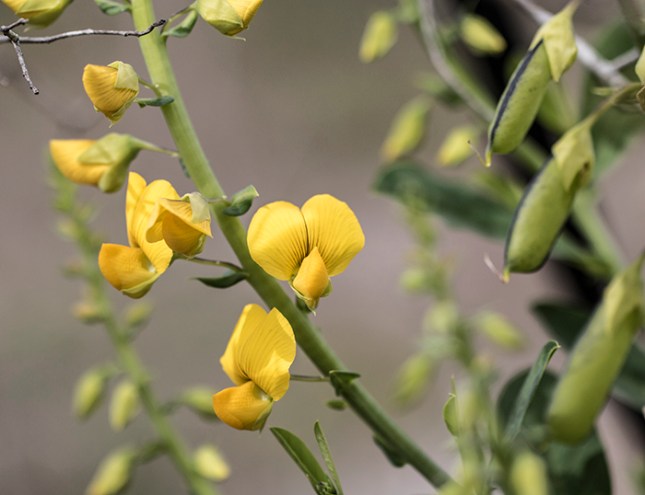
Showy Rattlebox, by JB
Included in his voluminous records are species of Crotalaria, beautiful yellow-flowered Rattleboxes, species now scattered abundantly in every disturbed site locally. Some gardeners know Sunn Hemp (yes with double-n) as one example, although it is not commonly escaped in Florida. A similar, gorgeous species is all over our area, well named “Showy Rattlebox.” It is so colorful this species must have come as a garden ornamental. Wrong.
Fairchild and his crew cultivated Showy Rattlebox and related species as companion crops for citrus and other fruit species. Fairchild thought C. spectabilis dated to around 1920 in his Miami experimental gardens.
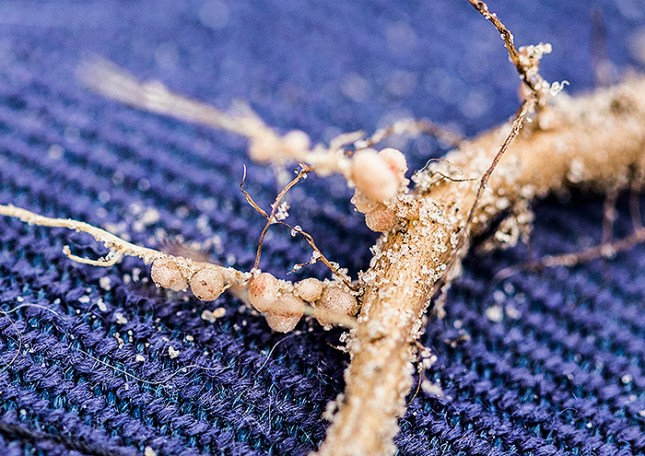
Showy Rattlebox nitrogen fixing nodules
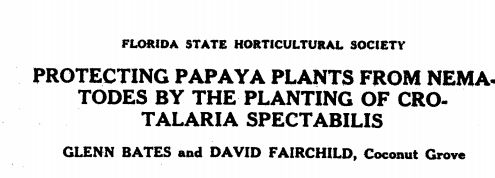
Beyond good looks, the species has nitrogen-fixing nodules, as a good legume should. And willing to prosper unwatered on terrible soil in brutal sun. Maybe that ability should have been a red flag, but trouble took time to appear. In the meantime, Fairchild and others waxed eloquent on the virtues of Showy Rattlebox, not only for nitrogenating fruit crop soils, but also for fighting soil parasitic nematodes attacking Papayas.
 John Bradford
 George Rogers
 George Rogers
 Dee Staley
 Treasure Coast Natives
Suellen Granberry-Hager
April 22, 2017 at 12:57 am
Fascinating background on these good intentions with unintended consequences!
George Rogers
April 22, 2017 at 11:07 am
What would be interesting, and is not conspicuously documented, is the feelings and reactions of the wholesale plant introducers….Fairchild, Simpson, Nehrling, Reasoner Brothers, and others…when the consequences became manifest. Nehrling wrote about becoming aware of the emerging problem. All I ever saw from Fairchild was comments in sort of amused way about kudzu overrunning a place in Georgia. Fairchild and Nehrling and certainly others were brought up short by the USDA awakening to the problem blocking plant imports in the 20s, amazing, given that Fairchild ranked pretty high in the USDA…gotta be a story there.
Martin
April 22, 2017 at 6:34 am
I always theorized that Trapper was responsible for bringing the lovely Lygodium to our shores…
George Rogers
April 22, 2017 at 11:10 am
Plausible theory. The Jupiter area is Ground Zero for OWCF, isn’t it? And Trapper seemed to like his jungle-ish ambiance. So nice to hear from You Martin. Went to JD about a week ago, and those low wet areas were crazy with flowers, like a postcard.
Martin
April 22, 2017 at 11:55 am
Were the low wet areas wet?
Almost bone dry with scattered moist muddy spots.
theshrubqueen
April 22, 2017 at 1:07 pm
Hi George, thanks for a very enjoyable read. Are the top pictures from the Exotic removal near the Roosevelt bridge? I have been watching that with great fascination. I have saved some natives from land development and am trying to grow them in a perennial garden. Kind of maddening.
Mary White
April 24, 2017 at 8:30 am
Savannas Preserve State Park is inundated with Crotalaria.
Where was it’s habitat of origin prior to introduction and has the purpose it was introduced for been proven successful?
George Rogers
April 24, 2017 at 10:09 am
Well, let’s see. Crotalaria spectabilis, warm climate Asia. Crotaliaria pallida and C. lanceolata from Africa. But at least Rabbit Bells (C. rotundifolia) native. Sunn Hemp I think originated in India.