Polanisia tenuifolia
Cleomeaceae (Capparaceae, Brassicaceae)
July showers bring the flowers. Not to mention mushrooms in fashionable colors. Today the scrubby woods pleased John and George botanically, with erect dayflower (one clump sporting 100 blossoms), prairie clover, froelichia starting to get busy, bright yellow partridge pea, and clammy weed.
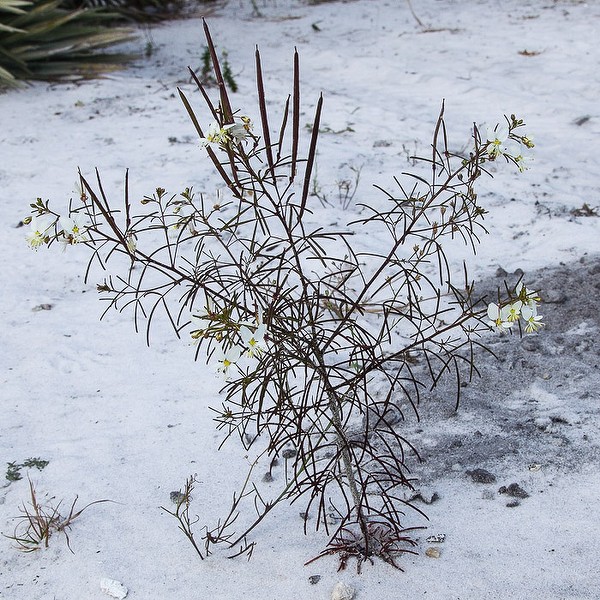
Clammy weed on the sand (by John Bradford)
Clammy weed is a pretty little curiosity, it’s clamminess coming from sticky hairs which give it the alternate name catchfly, a name applied to additional clingy plants. Clammy weed will look familiar to some northern gardeners familiar with its close relative spider flower, Cleome hassleriana.
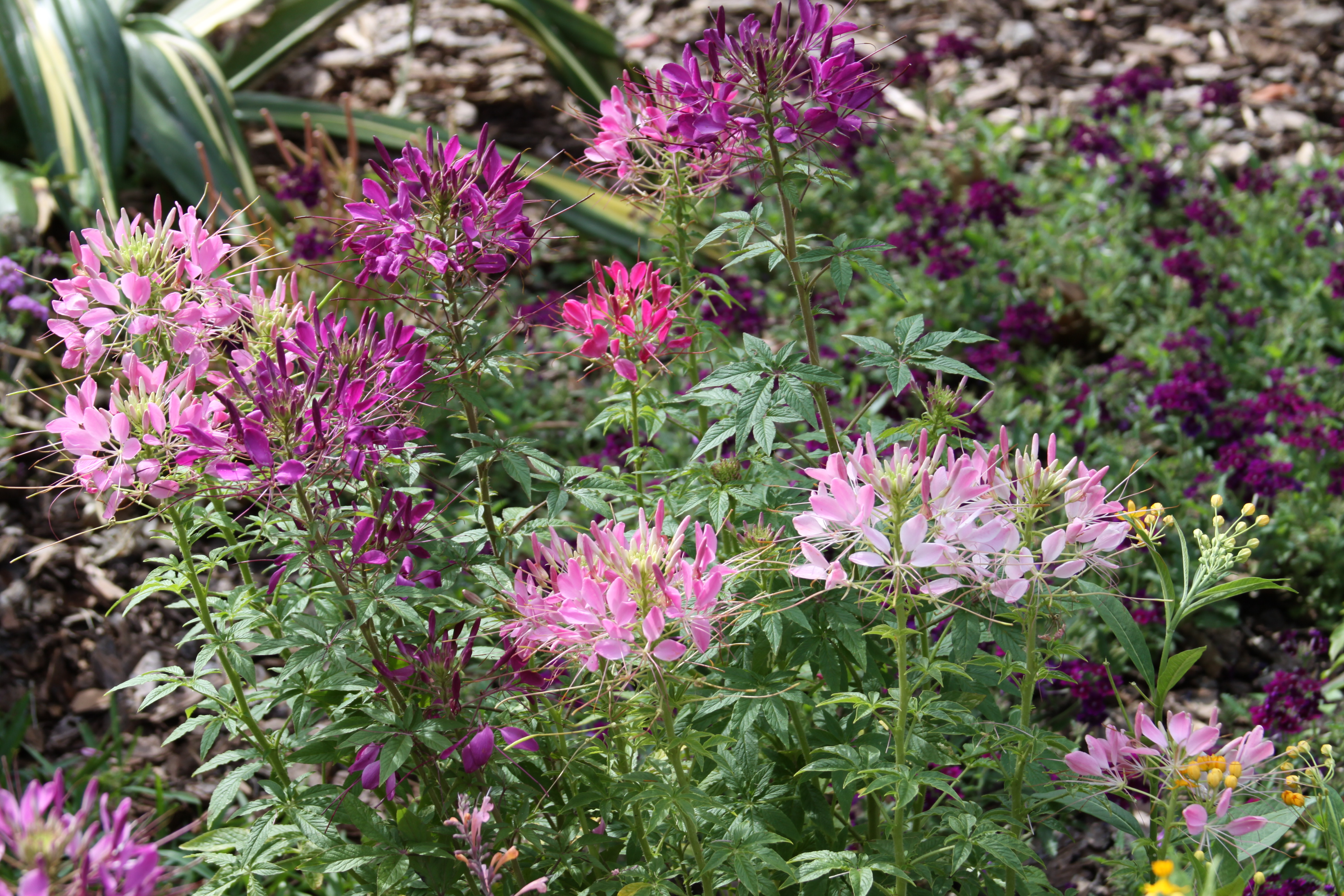
Cleome in the garden
Some botanists have included Polanisia within a broadly defined Cleome. Polanisia differs by having vertical vs. horizontal or dangling pods. The long skinny pod, called a silique (sill-EEK) opens gradually dispensing minute pill-shaped seeds. (A silique is long and sleek.)
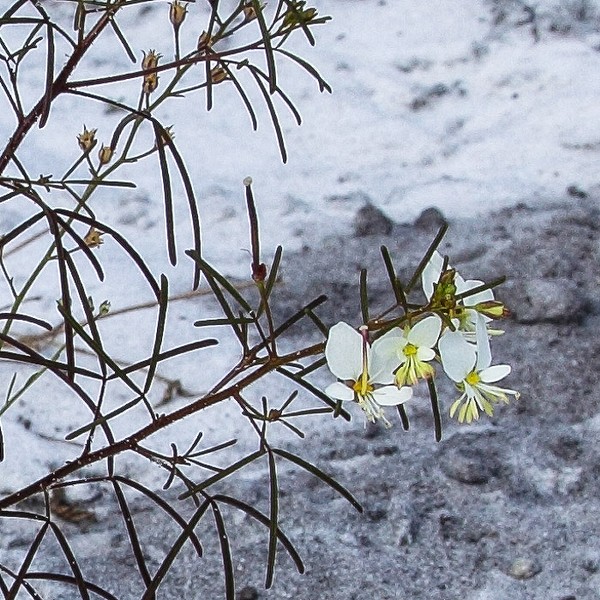
Closer (by John Bradford)
The little white clammy weed blossom is delicate with a surprise in the center, a great big sticky green gland, apparently there to attract pollinators.
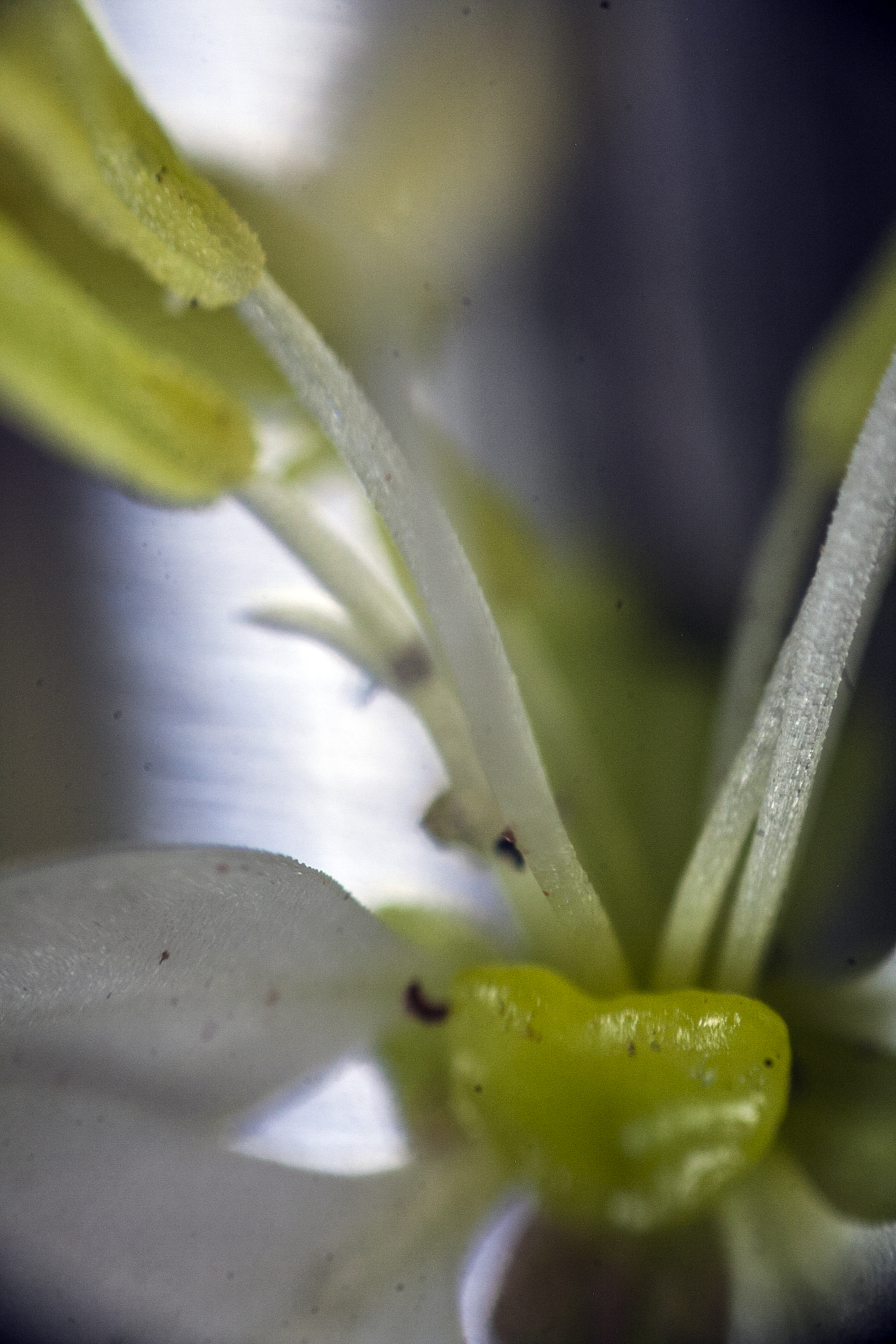
The gland at the center of the flower (microscope view)
The flower gland is not the only gland. Glandular hairs are generally believed to deter insect feeding and creeping, and that’s undoubted. Beyond that botanists have sometimes interpreted secretions from glandular hairs in part as “sunscreen.” The sun melts the coppertone, which spread out over the exposed surface. A hint of this speculative possibility is that in Polanisia species studied biochemically the secretions contain an array of flavonoid pigments. Flavonoids are known to provide UV screening in addition to additional benefits.
One chemist described species of Polanisia as smelling like “perm solution.” I’m not sure I’d recognize that smell but looked it up. Let’s see, there are a few ways to melt human hair, including ammonium thioglycolate, a sulfur compound which breaks the sulfur-to-sulfur bonds in hair protein. That actually makes some sense, as some members of the caper family and mustard family have protective compounds called glucosinolates that separate into sulfur compounds when the plant is wounded. I’m sniffing some mashed clammy weed right now and don’t smell the beauty parlor, although there is something with some “bite” that registers way up in the sinuses.
The flowers have an unusual feature that is a challenge to explain. Some are bisexual, like most flowers. Others are male-only. The term for this condition is “andromonoecious.” The usual explanation is that making fruits is “expensive,” so that there is a limit on the optimal number of fruit-making female flowers. The extra male flowers are “cheap,” and make sure the valuable female flowers are fully pollinated. In a scrub plant growing in horrible conditions, the females are probably especially costly, and the fruits are quite large, with a large number of seeds (each seed requiring a separate pollination event).
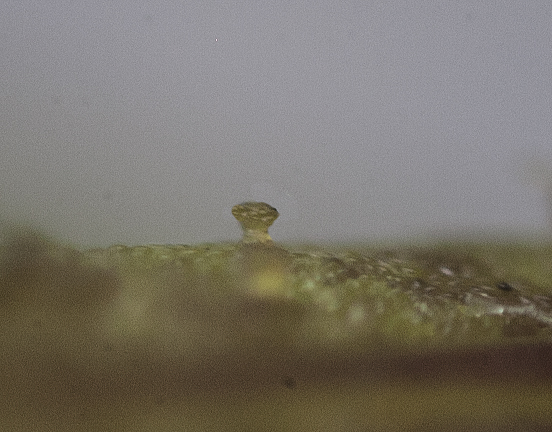
A glandular hair on the stem (microscope view)
Polanisia species have histories in human affairs as eats and meds in the usual ways, ho hum, but what caught my attention were records at the University of Michigan of Polanisia “ceremonial cigarettes” at Pueblo Isleta, New Nexico. I wanted to whip out my zig zags today and roll some up, but John just said no.
 Treasure Coast Natives
Suellen Granberry-Hager
July 31, 2015 at 8:42 pm
Plants are such neat little chemical factories. I love the pictures of those beautiful white flowers with the sugar sand below.
George Rogers
July 31, 2015 at 10:34 pm
Hi Suellen, As you well know, plant physiology has evolved into plant molecular chemistry…progress! But rough on old fashioned botanists. How are all your many projects going this summer?
Suellen Granberry-Hager
August 1, 2015 at 2:40 pm
This summer has been really busy but mostly has involved family matters. We’ll catch up when the semester starts.
Chris Lockhart
July 31, 2015 at 9:21 pm
One of my favorite little scrub plants. Thanks for covering it. Nice photos, too!
George Rogers
July 31, 2015 at 10:36 pm
Thanks Chris, it’s a cutie…
uma Bhatti
August 17, 2015 at 8:50 pm
beautiful weeds
George Rogers
August 17, 2015 at 10:04 pm
Hi Uma! See you soon…George