Everybody…get in your niche!
Today John and George visited the wading birds in Savannas Preserve State Park. What a photo op! John took the Snowy Egret action photos, and I took the others under John’s photo master supervision enjoying the use of my ancient and just-repaired 1970s reflector lens adapted happily to a modern camera.
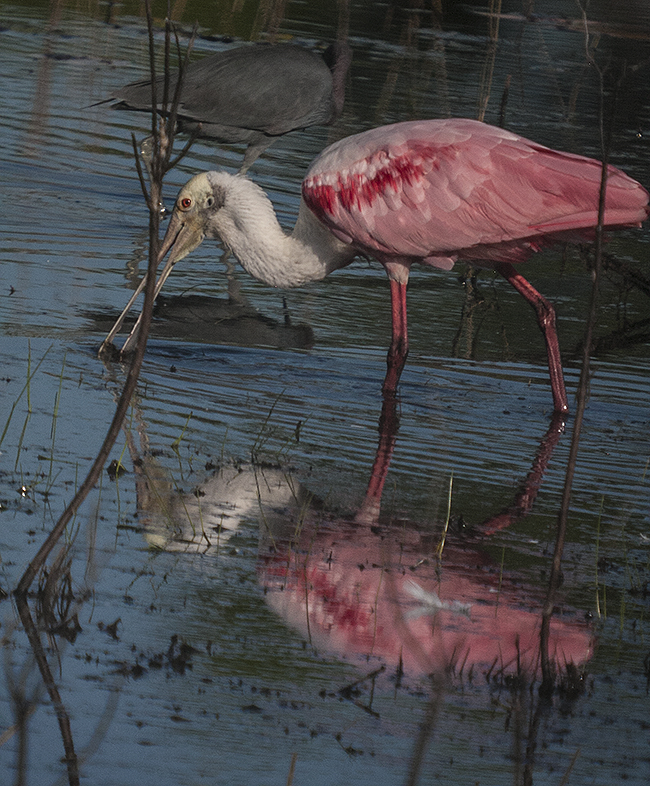
I’m pink and I dabble.
There’s something about a marsh to make you think of the big picture, maybe because you see so much at once: the open primitive diorama underscoring those big wading birds as the modern-day dinosaurs they are. Bird diversity helped Darwin envision evolution, so today John and George were 2015 Darwins. If Darwin hadn’t figured it all out back in the 1830s, we should have today because Darwin’s Finches having nothing on the Savannas Egrets.
A Spoonbill goes around with a shovel on its face, walking along…sometimes rapidly…dabbling and swinging its bill from side to side like an elephant’s trunk. The beak looks like one of those wooden ice cream paddles in the little paper lunchroom tubs. Spoonbills eat anything from vegan to squirmy. When the bird senses food the spoon snaps shut, and water drains out the sides leaving a tasty treat for Mr. Pinky to eat.
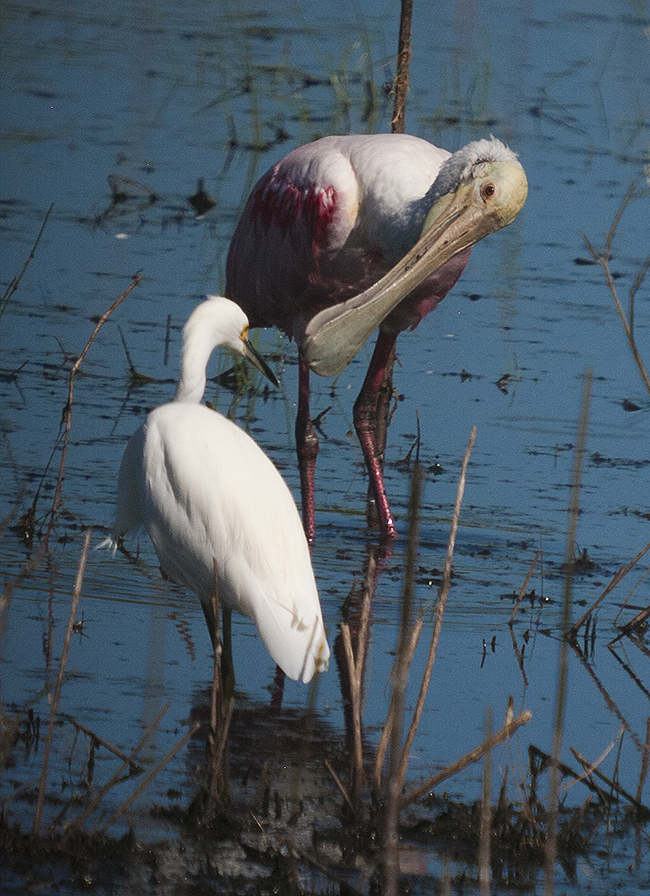
Yo buddy, you stick to your niche, I’ll stick to mine, and there won’t be no trouble.
Mixed in today’s flock were Great Egrets and Snowy Egrets. There could be a competitive situation here. But Mother Nature is on top of that. She wrote the “Competitive Exclusion Principle,” decreeing that no two species occupy the same niche. The big wading birds may seem to have similar competing needs, but competition breeds specialization, like the ecosystem of diversified shoe stores in the Treasure Coast Mall. Today’s Egrets have détente with Spoonbills. While Spoonbills eat with spoons, Egrets prefer harpoons.
Great Egrets are easy to photograph because they hold still until they spot a tasty fish, then snap, the sharp yellow dagger stabs like lightning.
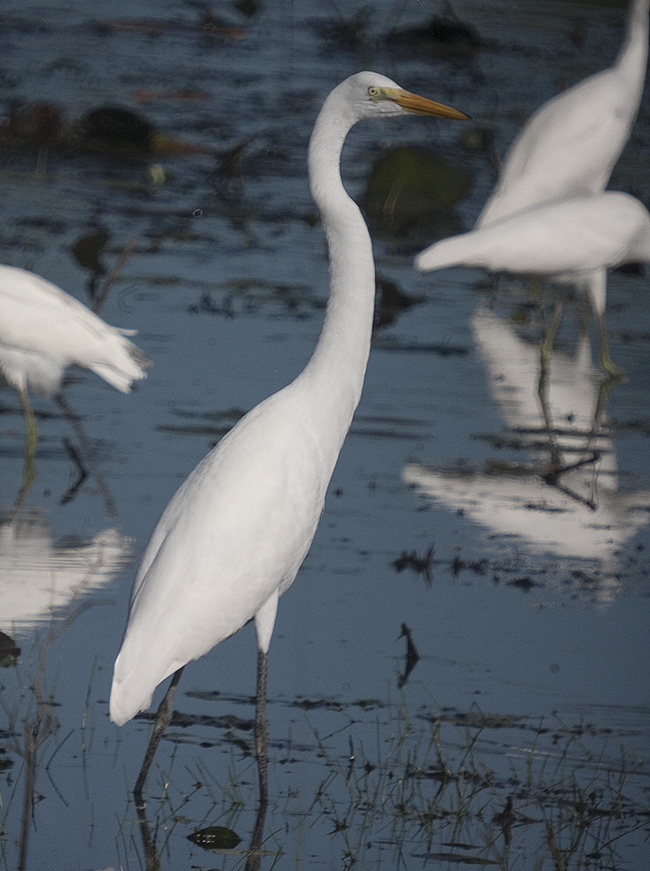
Great Egret waiting patiently and posing for portrait.
The similar Snowy Egret, with rakish hair-do and a black beak has its own non-compete clause. Rather than ambush large prey, it does the “stingray shuffle” or flaps around stirring up such lunchables as amphibians, insects, worms, crustaceans, or small fish. Snowy Egrets can hunt in groups and “round up” the menu as the birds dance around. Below those black legs are yellow tootsies. According to some accounts, the birds while flying dangle those yellow rakes down into the water to frighten the fish upward for an easy catch.
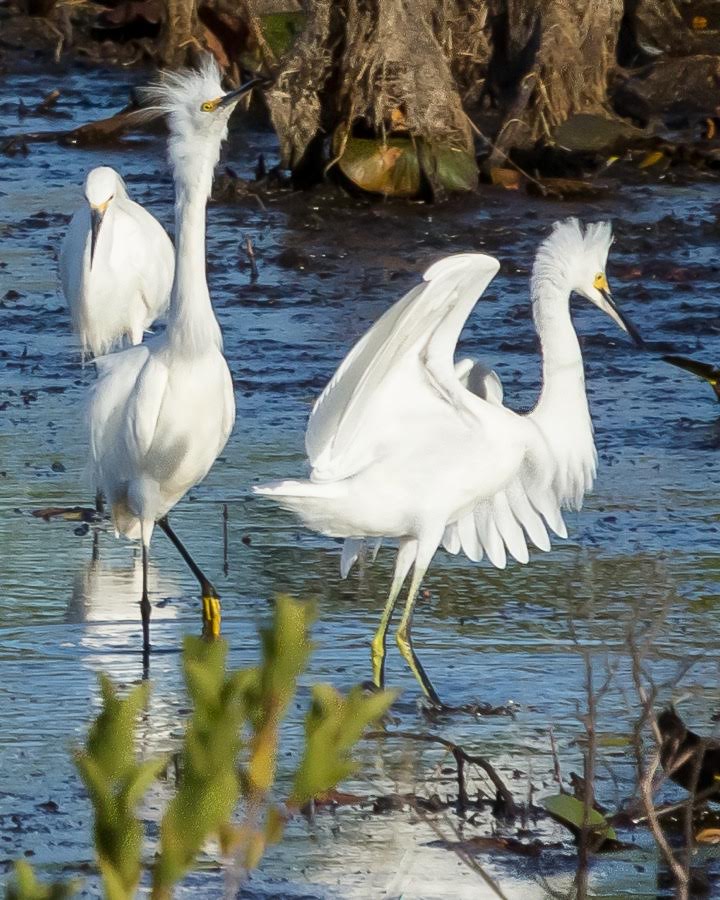
This photo and next, dancing flapping Snowy Egrets with their yellow feet.
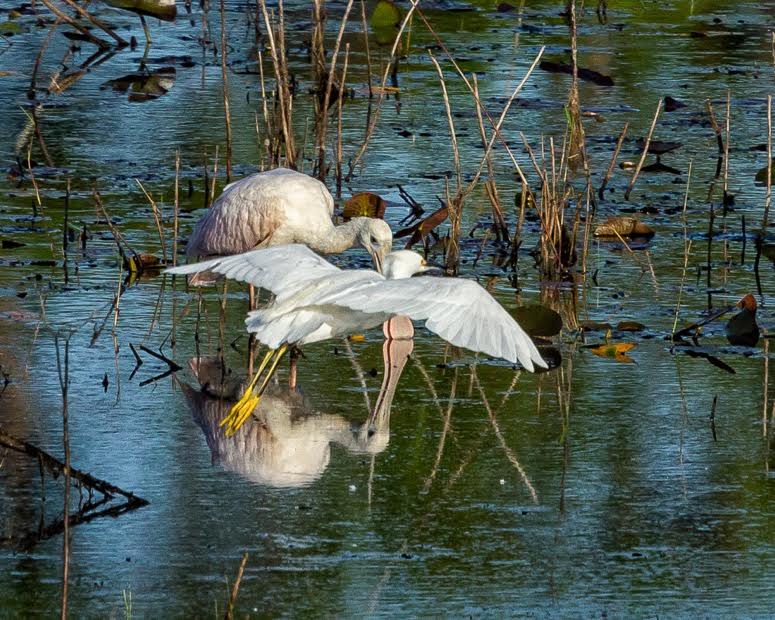
So today’s bird party was a gregarious jumble of spooners, ambushers, and a yellow-toed wolf-pack each doing its own thing. Opportunity for everyone.
To go one paragraph further, the plants seem to do the same. Marshes can be quilts where single species form acre-sized patches. The borders between the patches are often sharp, or not. Why do marsh species often sort into monospecific stands?
I think about that at Wakodahatchee Wetlands and Green Cay Wetlands, vast constructed marsh areas of shallow reclaimed water. These two sites with full sun, constant water, and nutrients galore nourish millions of grateful marsh plants in a conditions “as good as it gets.” They do not have 100 per cent perfect conditions, as there may be limited oxygen in the mud, maybe some toxins in the water, or odd nutrient imbalances, but let’s pretend a shallow sea of fertilized sewer water is the perfect setting for those species thriving there. Great blankets of pickerel weed, arrowhead, bulrushes, spike-rushes and others look like a giant paint by number composition.
We might think the big species patches may merely represent each spreading out (most of them have rhizomes) from random points of origin until they bump into another patch—like expanding bacterial colonies after sneezing into a petri dish. But it’s not so simple. In the Google Earth helicopter view of Green Cay below, the species patch pattern relates to borders, structures, canals, cypress domes, and other physical variations an observer can see, let alone physical influences too subtle to spot. Some species compete better along the boardwalk, some near the wooded hummocks, some near open water. There’s competitive exclusion afoot. Even aggressive rhizomatous marsh species seem to divvy up the seemingly near-uniform wetland into divergent niches.
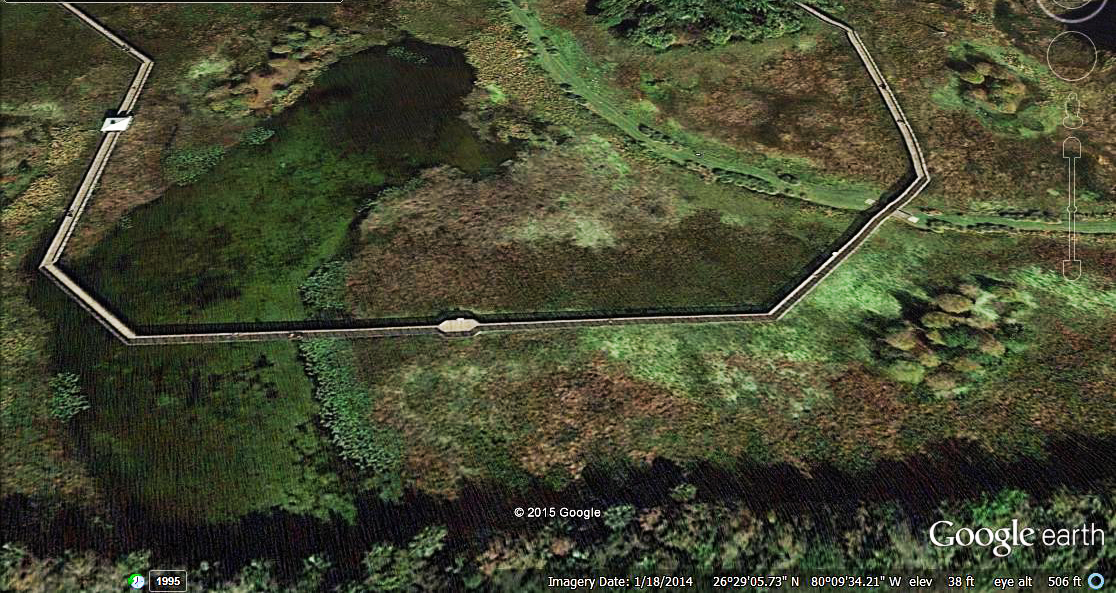
Green Cay, the species patchwork isn’t random. It seems related to the boardwalk, waterways, and islands.
 John Bradford
 George Rogers
 George Rogers
 Dee Staley
 Treasure Coast Natives
Laure Hristov
July 18, 2015 at 12:37 am
Thanks for the great pictures! Love the Spoonbills!
George Rogers
July 18, 2015 at 10:04 am
Hi Laure, I like them too. In my life a rare treat, but out in force yesterday.
FelicityRask
July 18, 2015 at 5:12 am
Really glad you are back and once again scattering your wonderful thoughts and humor along the way …
Felicity Rask, VA
George Rogers
July 18, 2015 at 10:59 am
Hi Felicity…terrific to hear from you!…was just up in VA last week.
theshrubqueen
July 18, 2015 at 8:06 am
Hi George, very enjoyable post – I am going to send it to a friend who is an illustrator and wanted to come down here to paint watercolors of the bird life.
George Rogers
July 18, 2015 at 10:05 am
What could be more fun than painting Florida birds!
FeyGirl
July 18, 2015 at 11:18 am
GORGEOUS! I love this park… It took me a long time to find it, too. 🙂
George Rogers
July 18, 2015 at 2:54 pm
I keep meaning to take canoe or kayak up there…so much to explore so little time