RSS

Category Archives: Uncategorized

Tassel Flowers, Twin Species with Twin Hairs

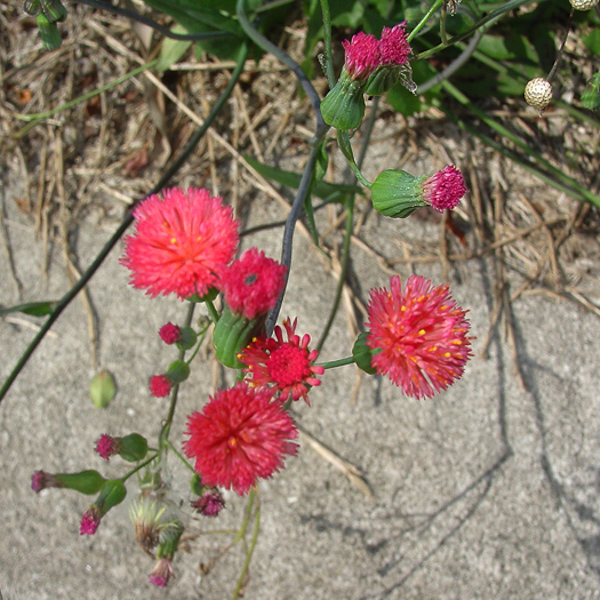
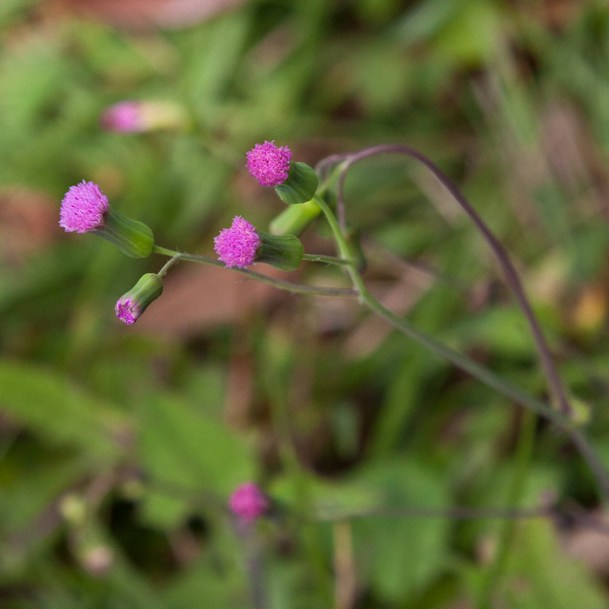
Emilia fosbergii (usually red, with variations) and Emilia sonchifolia (lilac)

(Emilia is a personal name, but the identity of Emilie or Emile is lost history.  Raymond Fosberg was an American botanist.  Sonchifolia means “leaves like Sonchus,” a related genus.)

Asteraceae


Twins!  One with red flowers, the other with lilac.   Every person within the ranges of these two beauty weeds has noticed their bright flowerheads somewhere.    Venus’s paintbrushes.  Native to the Old world,  they grow from the boondocks to Wal-Mart parking lots, often together.    Can’t miss em’.
Emilia fosbergii 3 (1)

Emilia fosbergii, flowers usually red.  By John Bradford.
Emilia fosbergii 4

Emilia sonchifolia, typically lilac.  By John Bradford.

Being so similar, ultra-closely related, and often mixed, I wondered if the two might form hybrids, especially because flower-color intermediates exist.   The tweeners look like obvious hybrids.   But watch out, “obvious” conclusions send innocent convicts to the chair.

There is hybridization afoot, but not what we were thinking.  It happened long ago:   Emilia fosbergii is  the result of an ancient cross between Emilia sonchifolia and another species.    Botanists who study these plants suspect the “other” species to be the red-flowered Emilia coccinea which occurs in the U.S. only as a garden flower.    So did you catch that, E. sonchifolia is a “parent” of E. fosbergii.

The hybrid origins of Emilia fosbergii help explain the color intermediates in a new refreshing light.   One parent species, E. coccinea has bright red to orange flowers, the other parent, E. sonchifolia has lilac blossoms.  Our hybrid species E. fosbergii usually (in Florida at least) tends to be red, and varies to pink or light violet.  In short, it can resemble variably either or its parent species.   It has a full set of chromosomes from each, thus the genetic blueprints for each.
Emilia fosbergii paired hairs

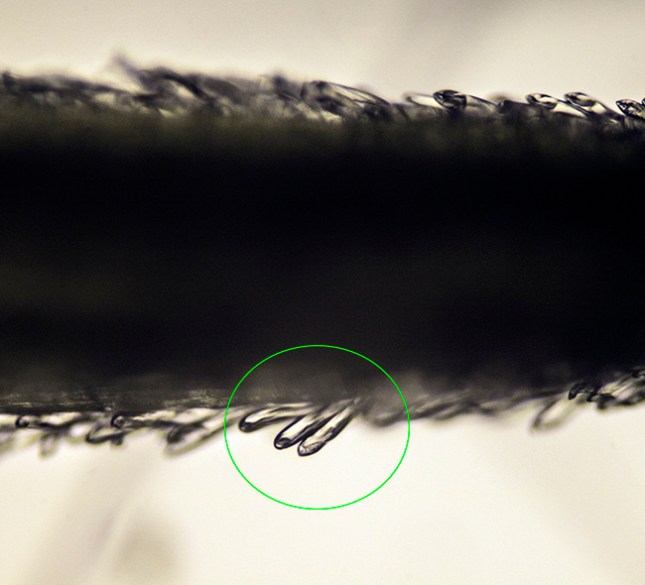
Twin hairs on the “seed.”

The Emilia fruits resemble dandelion “seeds” suspended from a parachute.   The tiny seedy paratrooper (technically an achene) has an unusual feature, twin hairs, side-by-side hotdog-shaped outgrowths.    Recent studies reveal paired functions for the paired hairs.  The first function is to serve as intake ports for water entry as the seed contacts wet soil.   Little “roots.”  The second function is a bit root-ish too:

To release mucilage…remember mucilage glue?…to fix the seed to the soil particles.  It still has a parachute attached and may otherwise blow around, disrupting germination and establishment.

Emilia fosbergii 6

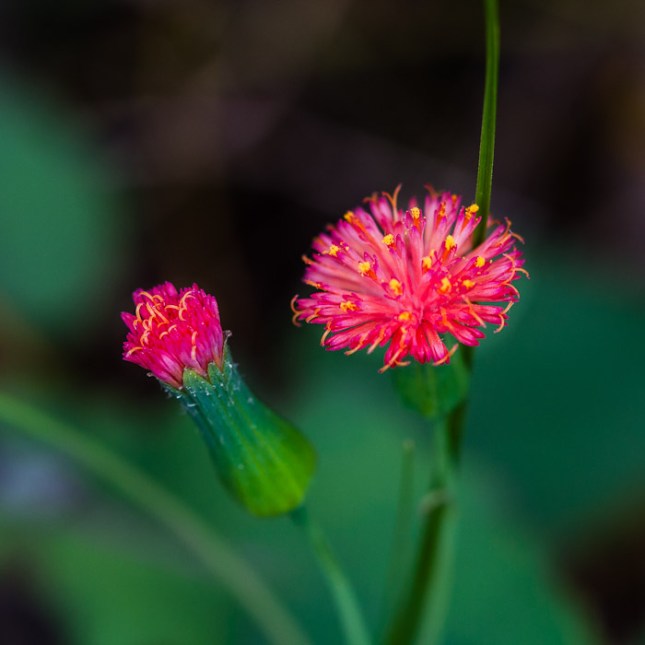
E. fosbergii, so pretty. By John Bradford.

*To rephrase more precisely for those who care:  Emilia fosbergii appears to be an allotetraploid potentially of African origin with one subgenome from diploid E. sonchifolia (well substantiated) and the other subgenome (speculatively) from a diploid biotype of E. coccinea which has diploid and tetraploid biotypes.
 
5 Comments

Posted by on July 20, 2017 in Tassel Flowers, Uncategorized


Alligator-Lily, Palmer’s Spider-Lily

Hymenocallis palmeri

Amaryllidaceae

(Hymenocallis means beautiful membrane in reference to the white funnel at the flower center.   Edward Palmer was a Civil War doctor-turned botanist who discovered today’s species in 1874 at Miami.)

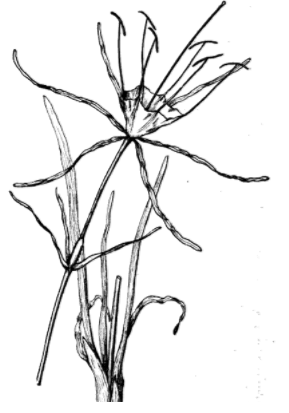
Hymenocallis etching

Etching of Hymenocallis palmeri from 1888. This is probably based on Edward Palmer’s collection.

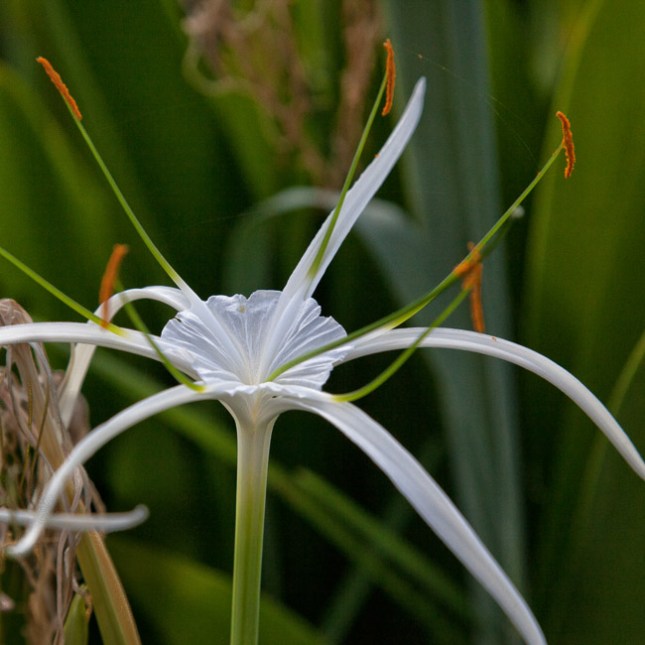
Some species are born to be stars with celebrity good looks.  Alligator-lily is one.  Circumstances prevent a Friday field trip, so the replacement is a wet meadow down the road from my house, a rainbowland of violet meadowbeauties, white painted sedges, shocking pink Bartram’s rose-gentians, yellow xyris,  and much more, including alligator-lilies, so showy and so odd.   The spider-lily genus Hymenocallis is native to the Americas, and in gardens worldwide.  Several species occur naturally in Florida.

Hymenocallis latifolia 3

Hymenocallis latifolia, by John Bradford

Alligator-lilies beautify most of south Florida plus a satellite outpost a little to the north, preferring wet habitats, usually sunny, such as wet prairies or soggy meadows.   Sunny and wet will matter again in a moment, so hold the thought.

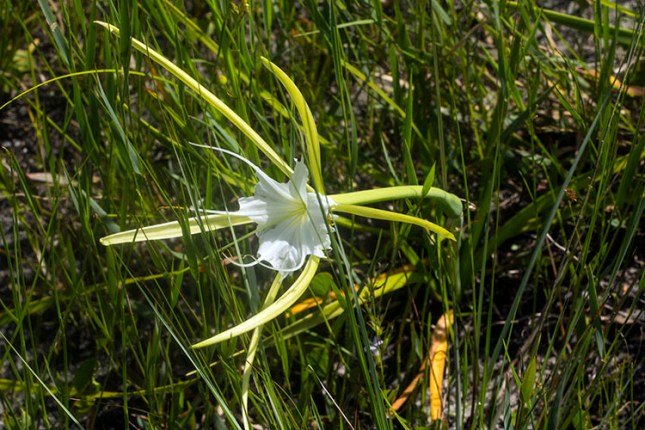
Hymenocallis palmeri at Botanica July

Alligator-lily

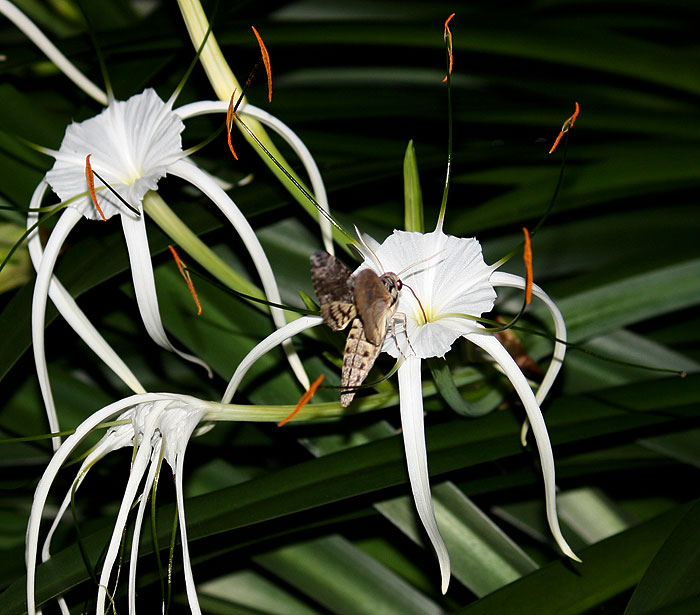
The flowers are huge, white, fragrant,  nectar-filled,  and fancy in silhouette.   Vaguely funnel-shaped, they have a narrow tube as long as your hand.     In other words, textbook moth-pollinated, almost exclusive to hawk moths sporting proboscises like flexible knitting needles uncoiling to probe the tube.

Pollinate here:  CLICK

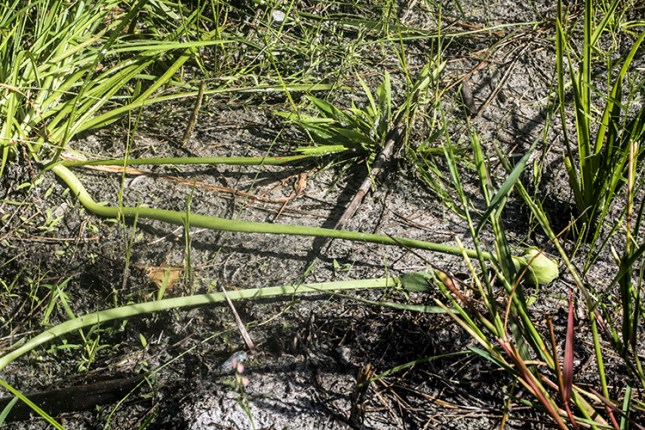
All that is well documented on the internet, so with that low-hanging fruit plucked we shall plod  onward to  the actual low-hanging fruits.  As low as snake spit.  Spider-lilies have a fruit-seed system rare in the green world.   The fruits start out normally as pods atop the flower stalk.    As the seedpod enlarges and gains weight the stalk flops to the ground like that aforementioned snake.

Hymenocallis palmeri on ground 2nd day

Green snakes

The flimsy pivot point is at the stalk base, and the seedpod is the snake’s head.

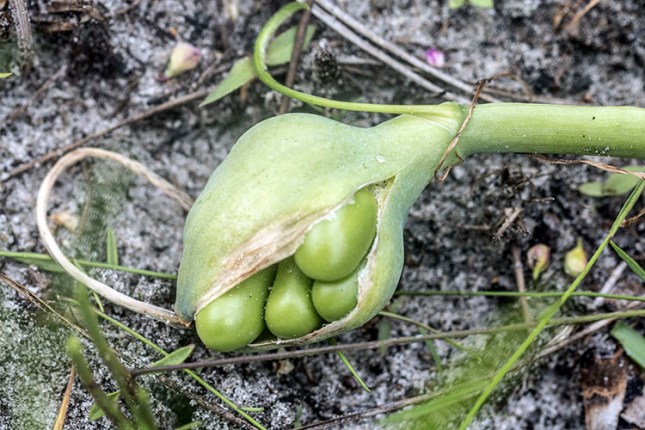
The grounded pod splits open and reveals the enlarging succulent green seeds.   The embryo is a mere undeveloped speck at this point.   And here begins the seed weirdness Louisiana botanists Muriel Whitehead and Clair Brown studied painstakingly in the 1940s using a different Hymenocallis species.

Hymenocallis seeds

The seeds look like green grapes.
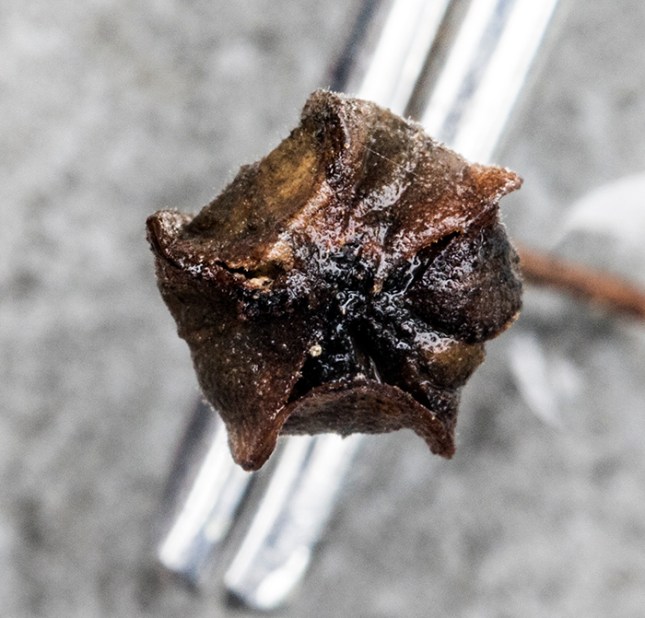
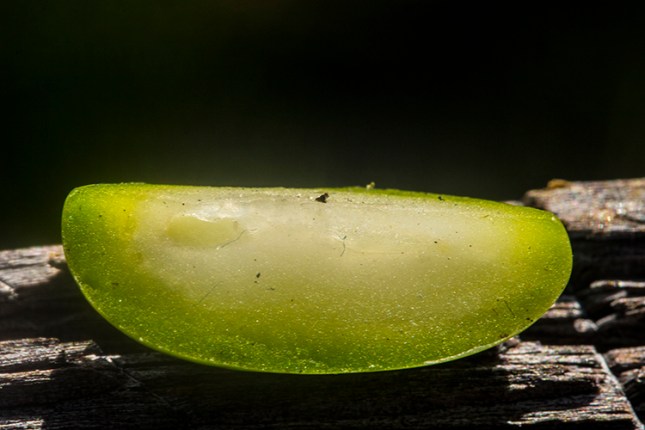
Instead of forming hard dry seed coats and going dormant like a proper seed, the spider-lily seeds behave more like independent plants.  They simply remain green and grow on their own before germination.   They photosynthesize on the ground apart from the mother plant,  feeding that little nub of an embryo  until it gets big and sprouts forth in about a month.   The thick green soft living seed coats have a unique system of  veins, resembling those in a leaf, adequate for the job of distributing the products of photosynthesis.   They even have stomates, which are the microscopic  gas exchange valves typical of photosynthesizing leaves, not normally on seeds.

Hymencallis palmeri cut seed with embryo

Seed cut open like a quartered melon.  The immature embryo top left.  The seed coat is soft, succulent, green, and photosynthetic.

To summarize,  most plants pack their seeds pre-release with a developed embryo, nutrition for it, and hard layers of protection to go dormant and then reawaken in the right place at the right time under the right conditions.    This plant, by contrast, drops an independent living soft green seed onto the moist mud to handle its own nutrient production to bring an unformed embryo to mature germination.

And now pesky ones may say, “well you covered the base of feeding the embryo, but what about protecting it?  These seeds have no seedcoats to block pests.”    True,  but these are wickedly toxic  plants.    The seeds in the photo above are glossy green and unbothered.

Hymenocallis grasshopper lighter

Unauthorized personnel.   Is the grasshopper (Aptenopedes sphenarioides probably):  rendering itself poisonous borrowing toxins from the plant?  And/or eating the petals as the least toxic parts?


3 Comments

Posted by on July 14, 2017 in Spider-Lilies, Uncategorized


Hempvines

Mikania scandens, and related species

(Josef Mikan was a botanist in Prague.  Scandens means climbing.)

Asteraceae (The Aster Family)


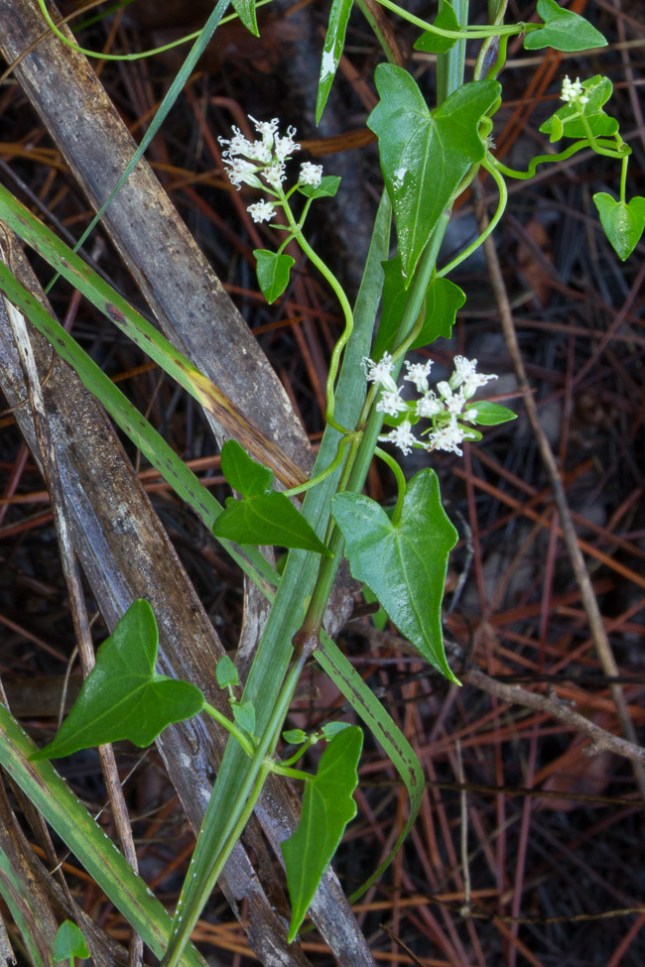
What did Charles Darwin do after rocking the world with evolution?    The aftermath was a little anticlimactic, like a retired CEO heading the homeowners association.    One thing Darwin did was study climbing vines, and one of his climbers was Mikania scandens.   He queried through international correspondence if Mikania scandens always twines in the same direction as it climbs.  Darwin sent letters on sailing ships.    I used Google Images, and every Mikania I see there cranks counter-clockwise.   (Would they go clockwise below the equator? (Just kidding.) ((I think.))

Mikania scandens 4

Mikania scandens wrapping counter-clockwise.  By John Bradford.

John and I rocked the world today working on insects and frogs in Savannas State Park near Jensen Beach, FL, a perfect place to trip over Mikania scandens.

Florida has three species of Mikania:   Mikania scandens, the similar M. cordata, and the reason I’m mentioning the trio:  The exotic invasive Mikania micrantha is called Mile-a-Minute Vine growing 60 MPH and blanketing acres in the wink of an eye.   Good thing it is, I hope, sprawling only across the Miami-Dade Area.   But all things do have their good points, and a smothering rampant vine is just what you need if you have something to hide   Camouflage is how it served during WWII, the military helping to spread it around the tropical world.   War has odd ramifications, such as that (dud) hand grenade a bicyclist stumbled upon, almost literally, recently trailside in Jonathan Dickinson State Park, aka WWII Camp Murphy.

Mikania cordifolia 2

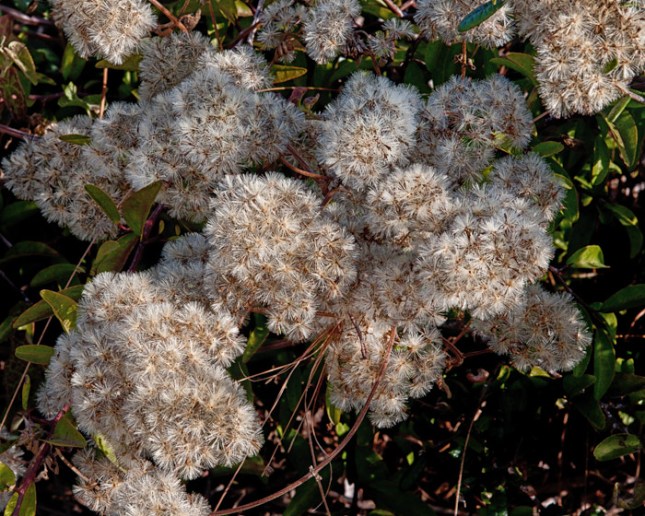
Mikania cordifolia in fruit. By JB

Our bio-peek today is about hand grenades, tiny ones, if the story that follows bears scrutiny.   Please know that the tale resembles the prosecutor’s case…made-up to account for the facts as we know them.  Innocents have gone to the chair on occasion.

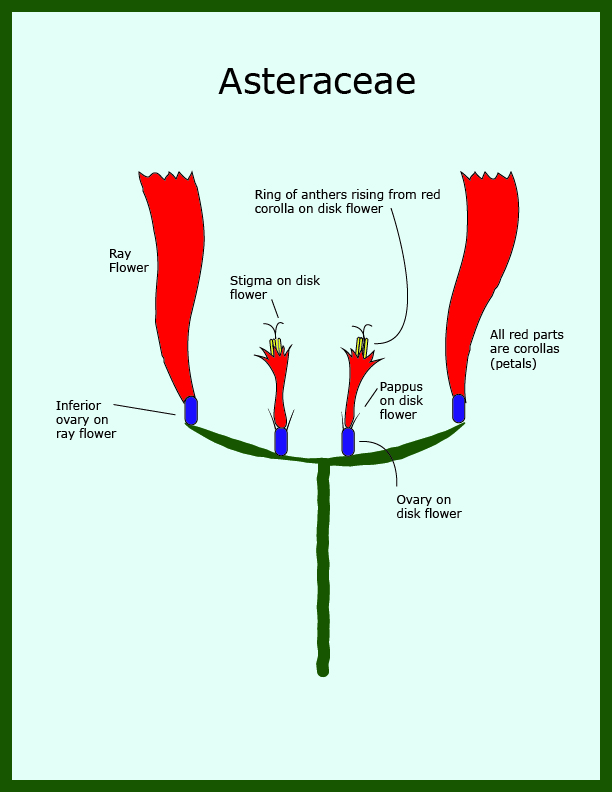
First a little background.   In the Aster Family, where Mikania belongs, the flowers are crowded into dense clusters called heads.   The flower bases are packed together side-by-side vertically like stems in a vase.    Each base matures into a fruit similar to a seed, so let’s just wink and call it a seed (if you prefer, call it an achene).    Packed with sugars and starch, seeds are good to eat.

Asteraceae

Diagram of an Aster Family flower head.  The flower bases (ovaries in the caption, blue) are packed together vertically and become the “seeds.”   In real life they are jammed together, not separated as in the diagram.

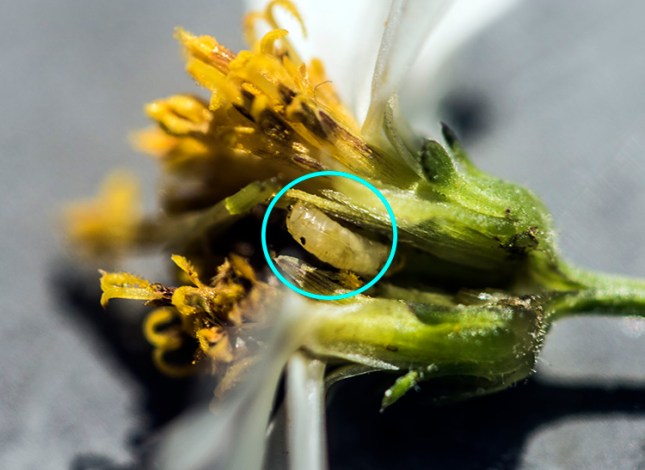
Seed pests are a pervasive torment for members of the Aster Family.  Little troublemakers, often tiny maggots, nestle down among the maturing “seeds” and damage them by nibbling.

Bidens alba with larva circled

Maggot enjoying the “seeds” in a related species, Bidens alba.   The plant needs defense.

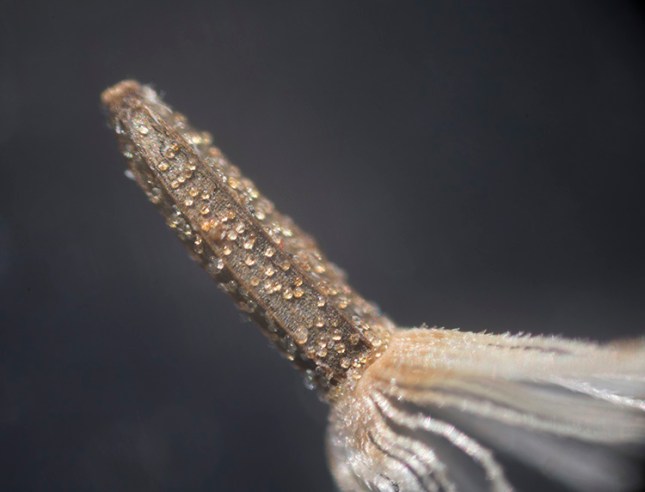
The crowd calls out DE-FENSE, DE-FENSE.   Here come those micro hand grenades…packed in among the seeds.    Under a microscope little hard grainy translucent spheres cover the seeds.  The little death bombs (if my speculative interpretion of their purpose is correct) are a handbook recognition feature for Mikania scandens.  (M. micrantha can have some as well.)

Mikania scandens achene with gems

“Seed” (achene) removed from the flower head covered with what I think are anti-maggot death bombs.  The white material to the lower right is a parachute…think of a dandelion for familiar related species with parachute seeds.

A loathsome larva has to nibble and wriggle past the tiny spheres to get to the tasty seedflesh.  They break loose easily and perhaps even stick to the pest infusing it transdermally with toxins like “the patch.”

Defensive weapons need some zip, and our species has plenty to give although I don’t really know if the seed-covering gems contain the secret sauce.   That sauce is beyond toxic.  Its diverse ingredients include a wicked compound named for the plant, mikanolide.  It (and maybe its associates) block the enzyme DNA polymerase.  That may sound harmless without a reminder of its necessity in forming DNA, the genes, the info center for every living cell.   Nuking the DNA would be the same as yanking the motherboard from my laptop on my lap.   Poisons don’t get much more direct or universal than that.

So clearly Mikania has the right stuff  to destroy ANY living cell,  whether it be a seed-munching larva or a malignant human tumor.   (Please do not eat the weeds.)  Tilted more toward that tumor,  mikanolide-based therapy has made it to the U.S. Patent Office.

 
5 Comments

Posted by on July 7, 2017 in Hempvine, Uncategorized


Tags:

Kiss Me Quick Puts All Its Eggs in One Basket

Portulaca pilosa

(Portulaca comes from Latin for little door,  which is the pop-open lid on the fruit revealed below.  Pilosa refers to the wool woven into today’s story.)

Portulacaceae, Purslane Family

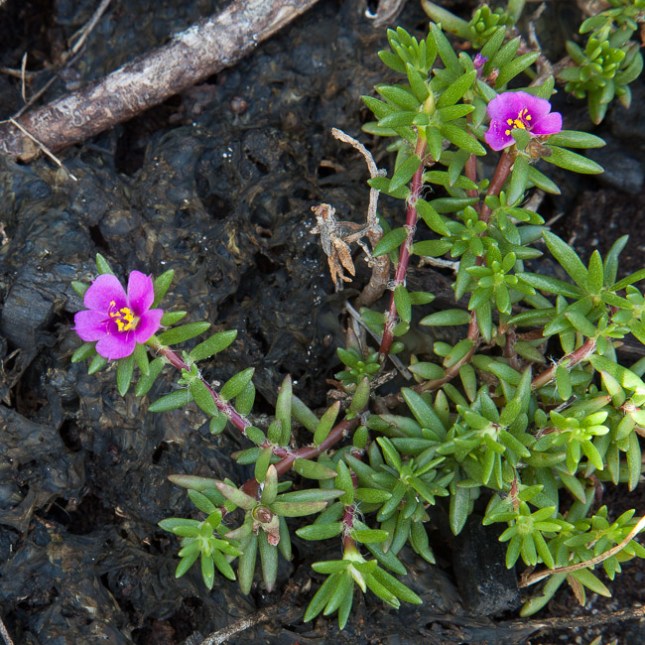
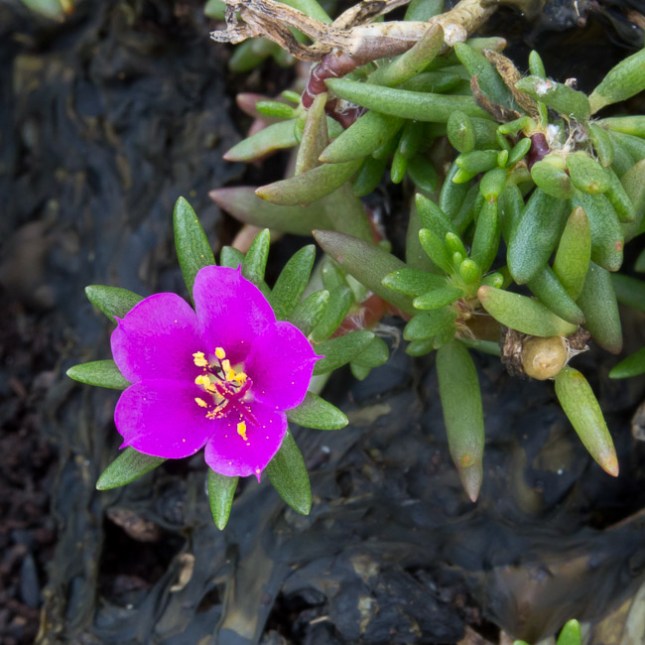
The Haney Creek Natural Area by Jensen Beach, Florida, was today’s warm trudge.   Ninety four degrees?    John’s and I focused more on arthropods than on flowers, but natural areas never disappoint botanically.    Loving the carcinogenic sun and being all pretty was Kiss Me Quick, a native Portulaca, a genus familiar to most gardeners for vibrant colorful flowers.  KMQ fits the bill with shocking purplish dayglo blossoms on succulent foliage.    It looks like a desert plant,  all showy-blossomed and succulent,  and it sort of is, at least around here, on the blazing bare sand where little else dares to root.

Portulaca pilosa 4

Kiss Me Quick.  See  whiskers on it?  Pilose means woolly.   By John Bradford.

The name Kiss Me Quick comes from the activist flowers open early in the day and withering as the shadows lengthen.    Another name is Chisme, Spanish for gossip presumably because the species spreads like salacious secrets in the garden club.  Or it seems to.

Spreading is certainly facilitated by tiny seeds that get around and the ability to grow anew from busted stem fragments.    But when you see the species scattered around hither and yon, is recent dispersal the full truth?   Probably not.   If you denude an area and expose bare sand, our species may rise from the grit spontaneously.  The light-activated seeds reportedly can lie dormant in the dirt awaiting their moment in the sun. Sometimes the habitat comes to the plant that waits.

Portulaca pilosa 6

By JB.

Did I say native?   Probably accurate, but “native” is hard to define with intercontinental weeds.   This species is widespread globally, and graces many U.S. states.  It is variable and looks different at different ages, in different habitats, and in different regions.   Hints in botanical writings suggest drier habitats may spawn more wool.
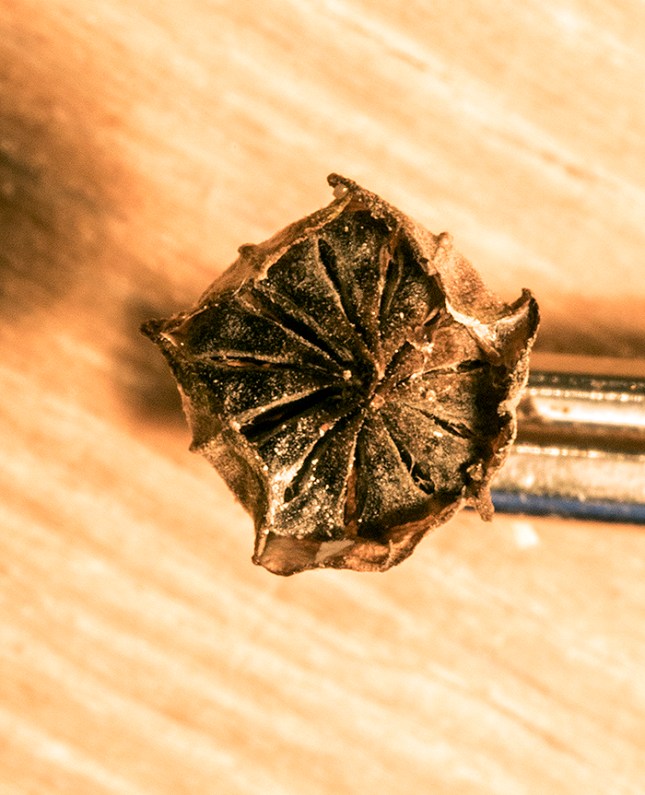
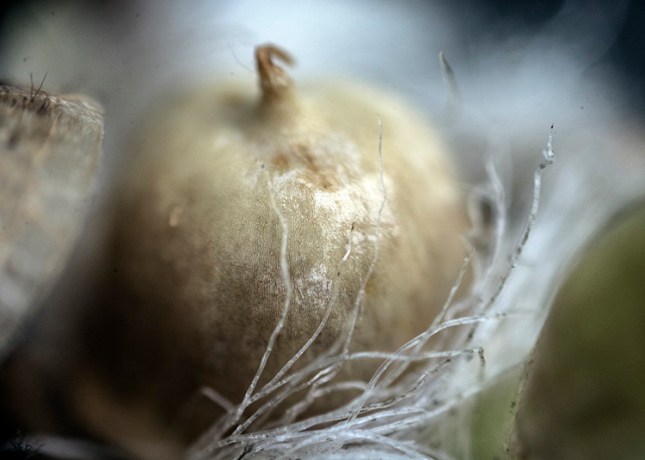
Long woolly hairs occur up and down the plant, forming a dense nest immediately under and around the delicate fruits.  The dry hollow fruits can nestle in the nest like Easter eggs set in that shredded green grassy cellophane confetti in Easter baskets.   And probably for essentially the same protective reason:  the plants “puts all its eggs in one basket,” that is, its delicate fruits held aloft in the terrible places this species tolerates.  Heat!  Sun!   UV!  Wind!   Bugs!    The wool seems to protect the fruit from some combo of those scary perils.

capsule closed 2

The egg-shaped fruit in its woolly nest on the top of the plant.

basket

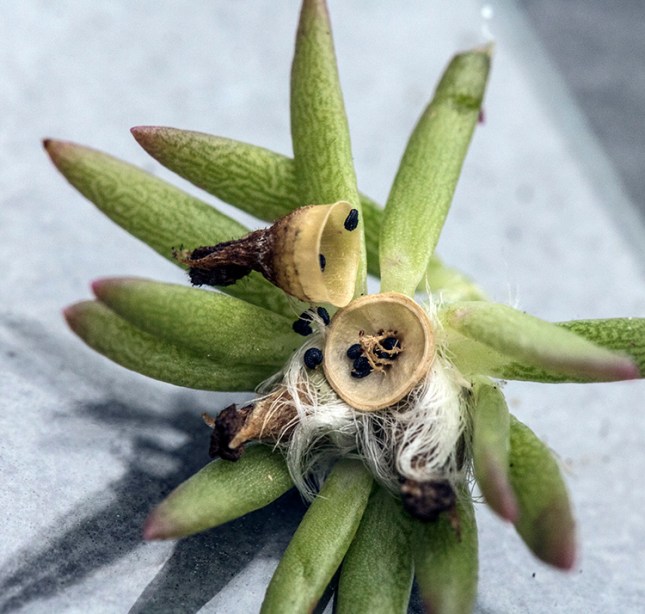
Let’s extend the basket of eggs analogy further.   What if your basket contained  pop-open plastic eggs?   The ones where the top half comes off to expose yummy candies within.    That’s is exactly how the Kiss Me Quick fruit works,  like a plastic egg.     Its top dome pops off to reveal the “candies,” which are the seeds inside.

portulaca open cap

The fruit, with the top half popped off and the black seeds exposed.

egg open


The End

 
2 Comments

Posted by on June 30, 2017 in Kiss Me Quick, Uncategorized


You Can’t Keep a Good Fern Down

Small Leaf Climbing Fern

Lygodium microphyllum

(Lygodium means flexible. Microphyllum means small leaf)

Schizaeaceae


This morning John and I pursued minor projects in Kiplinger Wildlife Preserve, in awe of the imperialistic Small Leaf Climbing Fern,  a gift that keeps on giving from the Old World, first recorded in Florida during Elvis, escaped during the Beatles.

Lygodium microphyllum 1

Going up!   By John Bradford.

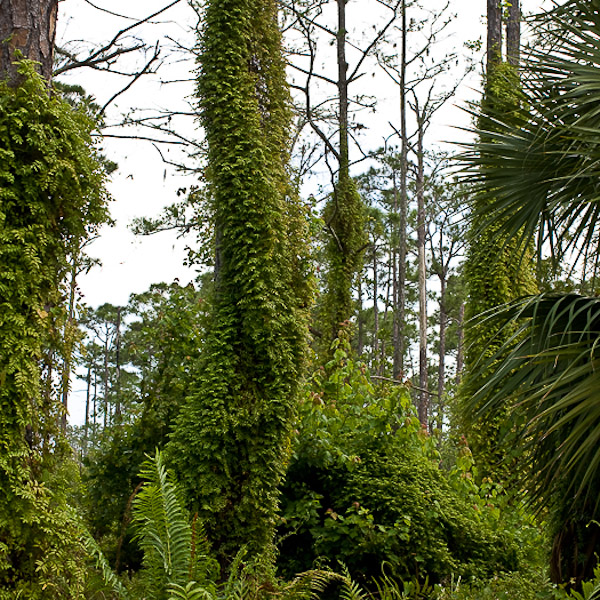
Its massive growth is matched by  massive attention to its peskiness on the Internet. No need to be the millionth post on that.  For those unfamiliar with the problem, probably not Florida residents, this fern can smother a tree in the wink of an eye, climb high into the canopy, spread fires, and even reportedly snare a deer.

Lygodium microphyllum 5

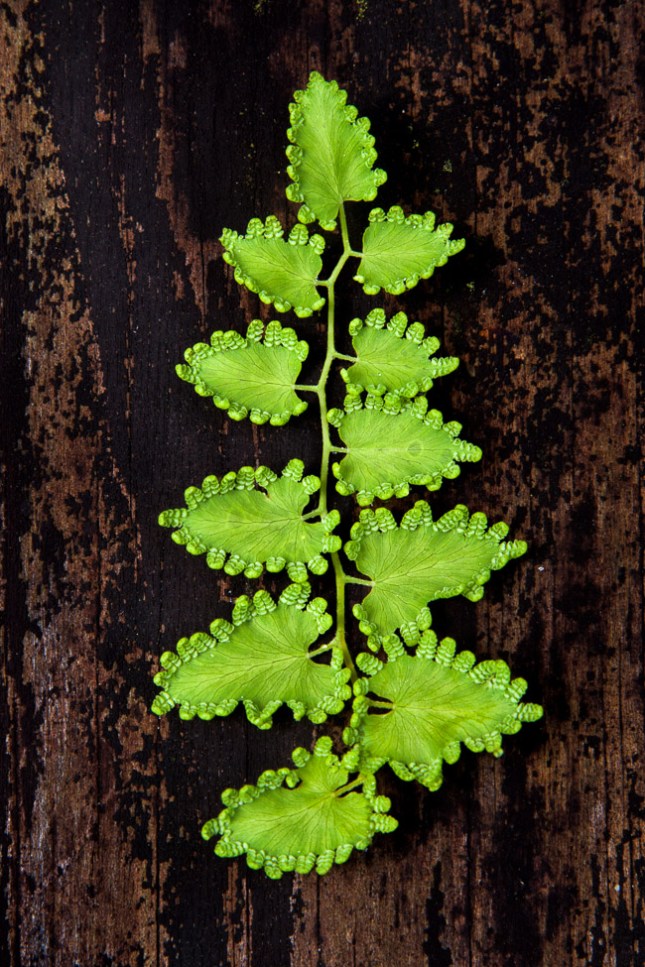
Spore-bearing leaflets. By JB

Rather than rant on about invasiveness, it might be more interesting to explore the biology of this super-weed.  Two invasive Lygodiums compete to own Florida:  Lygodium microphyllum is  common around Palm Beach County.  Lygodium japonicum is more prevalent northward.   Farther north still across the Florida state line comes the native Lygodium palmatum.  The invasive species grow like lightning, L japonicum as much as three inches a day.

Lygodium frond segment

Leaflets along a small stretch of one long rising leaf.

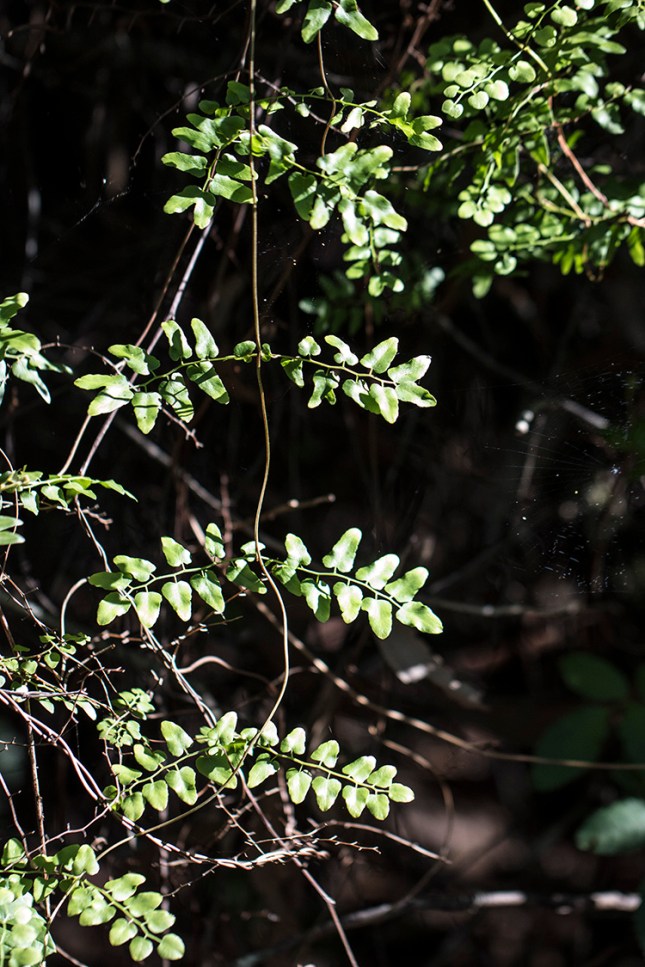
These clambering vines are not really vines.  The entire aboveground  climber is a leaf, a frond, although division into leaflets along a stringy center gives the false appearance of a leafy stem.    But no.  The true stem is at or below ground level,  launching the immortal ever-lengthening leaves skyward to go forth and multiply.    The individual leaves climb 30 feet or more.

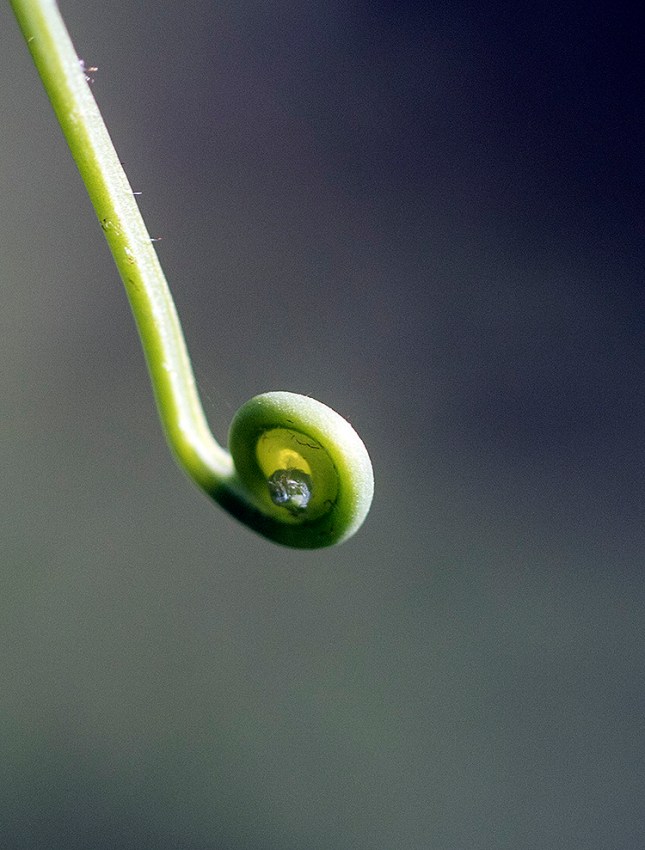
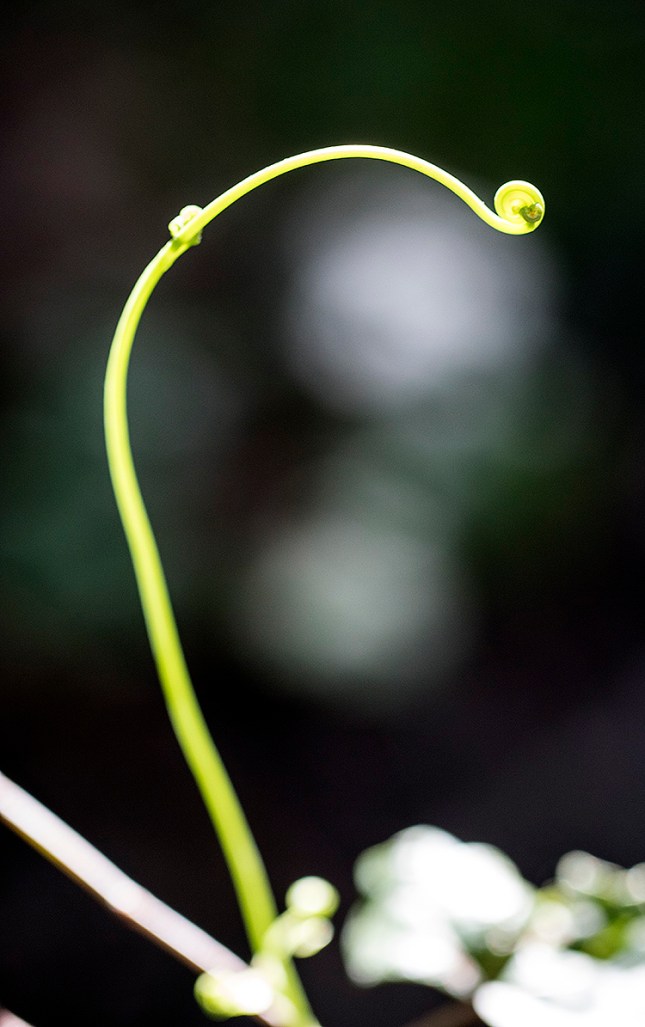
And here is how:    The tip of most any fern leaf (frond) is a curl called a crozier.   Normally the crozier uncurls, and that’s that.  But this is no normal fern.  In Lygodium the crozier never uncurls.  It just keeps on lengthening the leaf.    The leaf portion behind the crozier stays bare like a thin twig and forms a hook.  The hook rotates on its own, and also blows in the wind.   All this twistin’, and hookin’; and blowin’ is an effort to hook onto something to climb.   When that happens, let the rise ensue until the leaf snakes to the top of the host, then the hooky business resumes seeking a taller host.  Upsie daisy!  Below the hooky region the older regions broaden out into the characteristic leaflets,  hundreds of them like lights bulbs strung on a wire around a used car lot.

Lygodium microphyllum crozier

Climbing Fern crozier

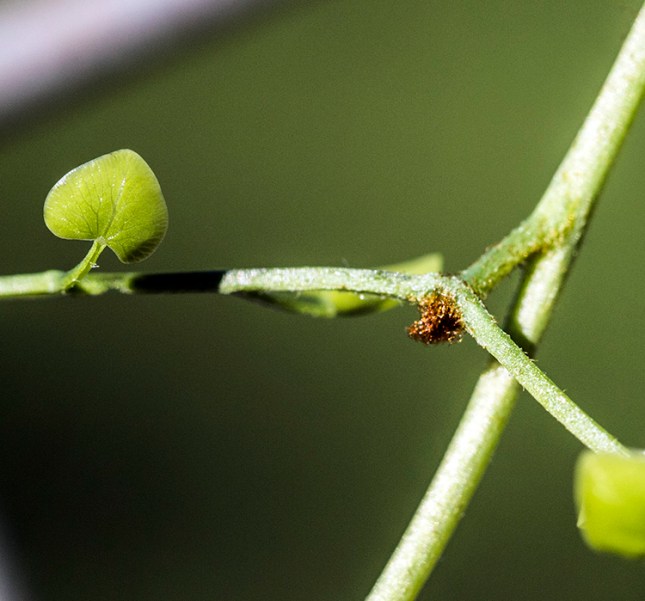
If a leaf extends high up into the tree and then breaks off, oh my, what a disaster.  But no, wait, there is a safety mechanism.  Along the leaf are fuzzy rust-colored buds ready to grow forth and save the day.

That the leaves rise directly from the “roots” allows direct immediate nutrient interchange between leaf and “root.”   Such efficient root-leaf commerce has turned out, it seems, to allow for especially enriched roots to cope with bad soil, not to mention fuel that magical leaf growth.

Lygodium microphyllum stem tip region

Hooked leaf tip, crozier at the very end.

Botanists have shown…at least under some circumstances…the plants to grow equally well in bright sun and deep shade.  They do not care.   Wet places are favorite habitats, pine woods will do, and even sometimes dry scrub.    It’s all good!   Flooding seems to boost spore production, and that is a deliberate segue:

Ferns reproduce by dust-sized spores blowing in the wind.  One individual Climbing Fern can produce astronomical numbers of spores.  There has been concern that workers exterminating the fern get their clothes contaminated with spores, spreading the pest unwittingly, helping it rather than wiping it out.

Lygodium microphyllum bud

Fuzzy bud on leaf.

Watch the hook helped by wind seek a new host to climb:   CLICK

When the baby Climbing Fern  grows from the spore it matures as female with a trick. She releases hormones to make the  nearby babies mature male as automatic mates.

If that fails, the female develops its own sperm-producing organs and fertilizers itself.

There’s no stopping Climbing Fern.

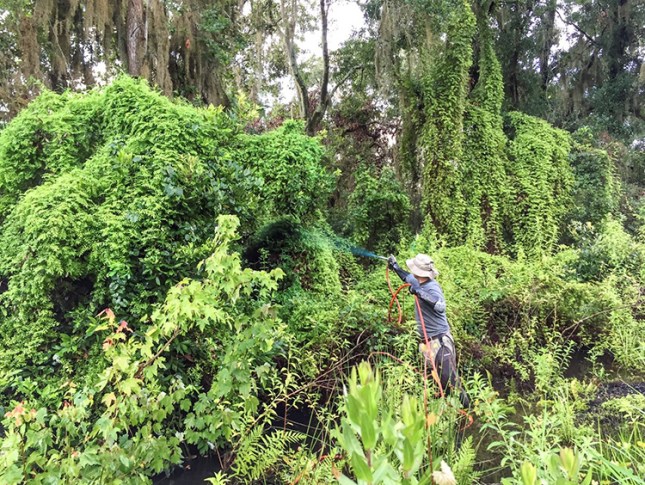
Lygodium microphyllum being sprayed by John Lampkin with permission

Photo courtesy of John Lampkin.

 
5 Comments

Posted by on June 23, 2017 in Uncategorized


Ornithocoprophily, A Bacterial Surprise, and Hungry Bunnies

Silvilagus palustris

Leporidae


After serial thwarts the last couple Fridays, John and George finally hit the muddy road today, mostly to think big— to shoot broad-perspective video of a marsh in the Kiplinger Nature Preserve for a project evolving under John’s  video genius.    (We’ll return to that in due course.)  Thinking big shifts the focus from wildflowers to the forest.

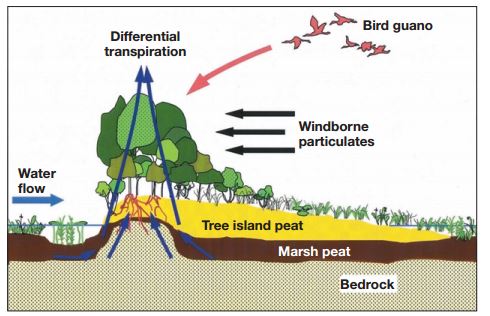
In a Florida marsh, an obvious fact from a distance is that our feathered friends prefer certain trees for roosting and more.    And if birds occupy an individual tree or clump much of the time,  guano showers below.    Fertilizer!  On Florida’s otherwise awful, nutrient-poor, sandy soil.  That’s gotta matter!

To go to the extreme case, consider “tree islands” with rookeries.   Biologist Paul Wetzel and collaborators in 2005 reviewed the relationship between rookeries and Florida tree islands, with points to ponder.   Although bird manure is not the only source of phosphorus enrichment in a “tree island,”  it can account for 20 times that from other sources, and 3000 times that from atmospheric fallout.  Such super-fertilization can generate “luxuriant” growth persisting up to 50 years thereafter, although the overall effects on species composition need attention.  In smaller venues with lower levels of deposition the floristic effects need study.  What I really want to know if the main broadleaf tree of the Everglades and a beloved roosting tree,  Pond-Apple, which is prominent in Kiplinger,  practices ornithocoprophily (love for bird dung).

tree island

What bird dung does.  (From Wetzel et al.  Front. Ecol. Enviro. 2005.)


Tree fertilization technicians at work:  PECK HERE

While still up in those well fed trees, look at one of the commonest pants there, Ball-Moss.    Not really a moss, this species is Tillandsia recurvata, an epiphytic Bromeliad and relative of similar Spanish-Moss.

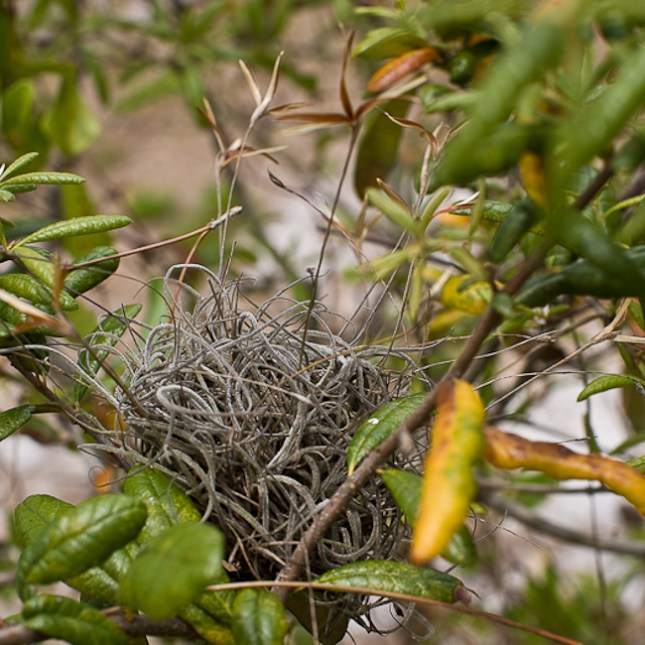
Tillandsia recurvata 2

Ball-Moss in a tree, by John Bradford

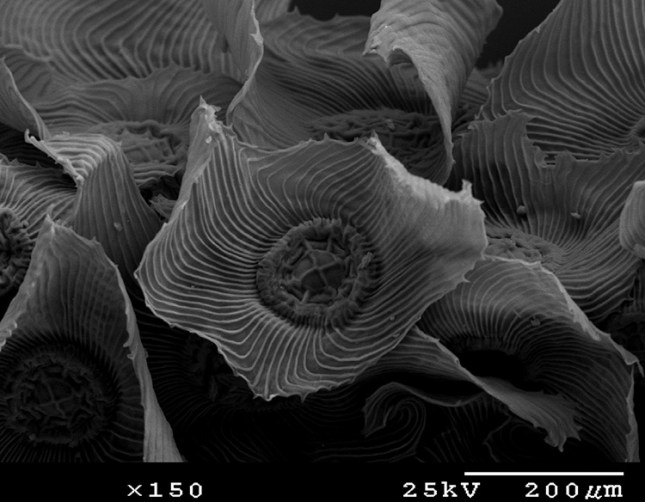
To see Ball-Moss go peek up any oak tree, or even a telephone wire.   This little airplant thrives up high clinging to twigs where soil nutrients are not.   The species captures rainwater under beautiful microscopic leaf scales.  All good, but is that enough for “fertilizer”?

Spanish moss (Tillandsia usneoides) 4

Scale from Spanish-Moss, close relative of Ball-Moss. (Courtesy of Dr. Robert Wise, UW Oshkosh)

Back in 1994 ecologists M.E. Puente and Y. Bashan didn’t think so, and uncovered a surprise:  nitrogen-fixing bacteria haunting the tissues of Ball-Moss.  Nitrogen fixation is the process of converting inert nitrogen gas from the air into ammonium a plant can use.    This is most famously the domain of legumes with their own bacteria, but more and more non-legumes with nitrogen-fixing powers are turning up.   The bacterium in the Ball-Moss is Pseudomonas stutzeri, which would be nothing but anther boring Latin name except for two things:

Thing 1. The same bacterium has surfaced as a nitrogen fixer in a grass.

Thing 2. The same germ is a minor human pathogen. CLICK FOR DETAILS

Oh no, does that mean handling Ball-Moss exposes a person to potentially deadly bacteria?    Technically, yes.  In practice, I have no idea.  But in any case it underscores the little hobgoblins lurking in the weeds around us.

The bacteria feed the Ball-Moss, and the Ball-Moss helps this rascal with dietary fiber. ONE FINAL CLICK


3 Comments

Posted by on June 16, 2017 in Uncategorized


Carolina Ash, Pop Ash

Fraxinus caroliniana

(Fraxinus is an ancient name for ash trees.  Caroliniana is self-explanatory.)

Oleaceae (Olive Family)


If you live in Florida and become nostalgic for woods with a “northern feel,” go to the shore of a river and get among species of ash, hickory, jack in the pulpit,  maples, and more.  Feels like Ohio.  Even a little fall color from all the poison ivy.   I always take special pleasure in coming upon Carolina Ash, so much so I invited  one into my yard where it has become a pretty shade tree.

Fraxinus caroliniana 2

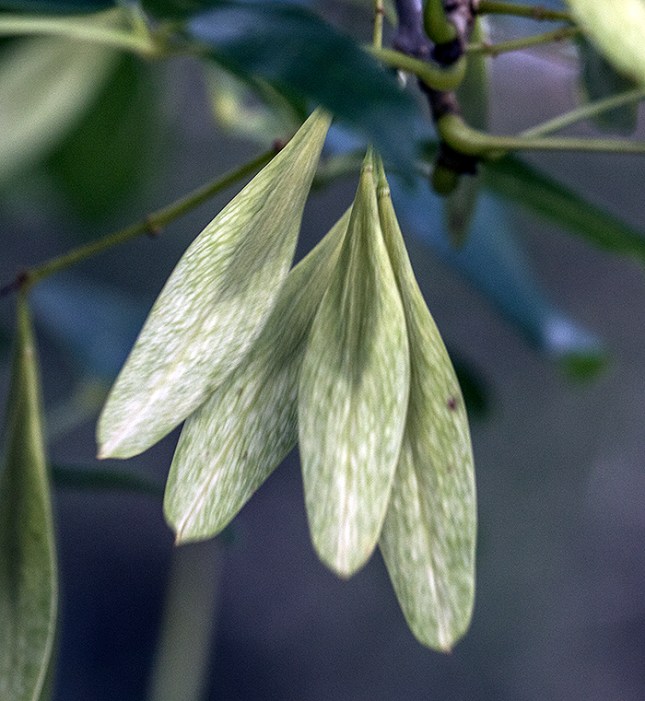
Carolina Ash leaves and samaras.   Photos by John Bradford.

Any ash-fancier must dread the exotic Emerald Ash Borer beetle destroying thousands of ashes in northern states.   The pest is expanding southward, and Carolina Ash is likely susceptible along with our other species.  So far so good in Florida.

Fraxinus caroliniana 1

The trees are separately male and female with tiny non-showy wind-pollinated flowers.   As with most wind-pollinated trees, the species is deciduous.  They do not seem at first glance to fit in the Olive Family, as olives have pretty white insect-pollinated flowers and big fleshy fruits.     But if you had a magic transformer wand you could morph an olive into an ash.  All the fundamentals remain the same, just with different points of emphasis.     In fact, there are missing links, including a species of “Flowering Ash” with showy white flowers, and several species where the two sexes have not split into separate individuals.     The most interesting link is olive oil.    Everybody knows olive oil, but I’ll bet Rachel Ray never tried extra virgin ash oil.    In some places edible oil is squeezed from ash seeds, which otherwise have little resemblance to an olive beyond the oil and a single seed.

FRaxinus caeoiniana samaras

Ash fruits look like an olive run over by a steamroller.   The fruits are smashed flat into an elongate green wing with a seed embedded at one end.     Such winged fruits are properly termed samaras, a great name for a sailboat.     The party line in every botany textbook is that “the” function of a samara is to flutter away on the wind  to scater the seeds.    OK, we can stipulate to that, but could there be more to it?

Various botanists over the years have suggested that the big flat green wing helps feed the embryo embedded in it.   Samara wings have been shown to photosynthesize, and thus serve as a solar baby-food makers intimately attached to the baby.  As a subjective observation, the samara veins look like feeding network leading straight to the seed.  Although sporadically discussed and obviously plausible,  the Gerber Hypothesis could use a measure of  hard-data research.  Then the question must be addressed,  and if sustained, does the samara feed the baby even after dropping from the parent tree?

 
3 Comments

Posted by on June 9, 2017 in Uncategorized


Indian-Hemp

Sida rhombifolia

(Sida is an ancient name for a different plant.  Rhombifolia describes the leaf shape.)

Malvaceae (Hibiscus Family)


Once upon a time, before the era of polyester leisure suits, natural fibers ruled, and Florida was a place to research and grow fiber-bearing species.    Fiber plant importation here predates the European invasion probably, as our “native” Florida agaves arrived it seems at the hand of prehistoric people no doubt to supply strings, hammocks, and fishing nets.    Florida’s first prominent Euro-horticulturist Dr. Henry Perrine introduced more agaves, most notably sisal, now an invasive exotic species.  Dr. Perrine perished by homicide before Florida fiber fun hits it prime.

Urena lobata 1

Caesarweed, a fiber species.   Today’s flower photos by John Bradford.

Fiber species are mainly tropical, and the Sunshine State was home to avid 19th and 20th Century plant introducers.    It is tough to cite the exact time, purpose, and unsub in a plant introduction, so to keep it general, let’s just say some species came to Florida as dental floss.   And, yes, fiber plants have served oral hygiene where there’s no Walgreens on every corner.

An incomplete list of fiber species still in Florida follows:

Bowstring-Hemp (Sansevierias, the “Snake Plants” in pots and gardens, breeders used to hybridize Sansevierias  in search of fabulous fibers)

Caesarweed (Urena lobata, now it sticks burrs on our shirts)

Flax (Linum usitatissimum, also giving seeds to muffins)

Hemp (same species as ganja)

Indian-Hemp (not really a hemp)

Jute (Corchorus species,  gunny sacks and upscale couture)

Kenaf (Hibiscus cannabinus, save the forest, farm paper)

Manila-Hemp (Musa textilis, a banana of all things)

Ramie (Boehmeria nivea, related to the native false nettle)

Sisal (Agave sisalana, and other Agave species)

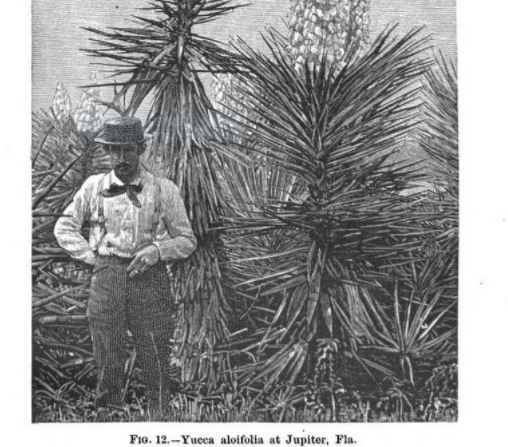
Yucca (Yucca species)

yucca

This photo published 1893

There are more but lists are for losers, so to get to today’s hot topic:

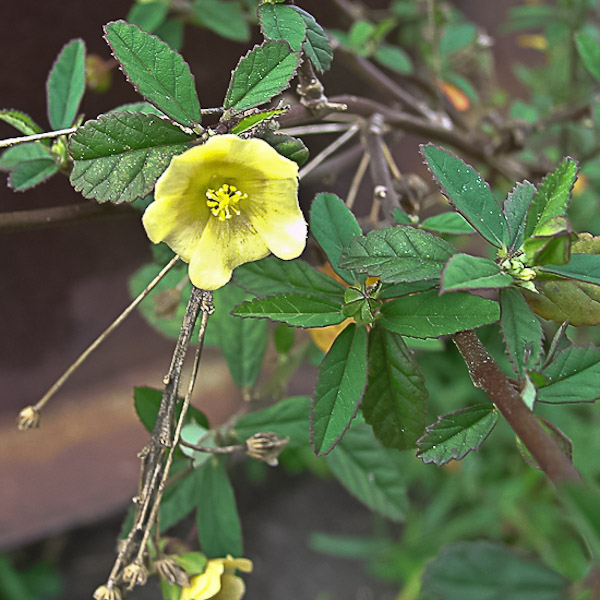
Sida rhombifolia 1

Indian-Hemp

Indian-Hemp is a classification mess, in a complex of variants you may or may not interpret as separate species.    Native to Florida?  Some say yes, but my favorite general reference, Flora North America, calls it an introduction from the Old World, and I’d not quibble.  Importation from India gave Indian-Hemp its name.  If you want to see Indian-Hemp in Florida, take a walk.  An encounter will likely ensue.

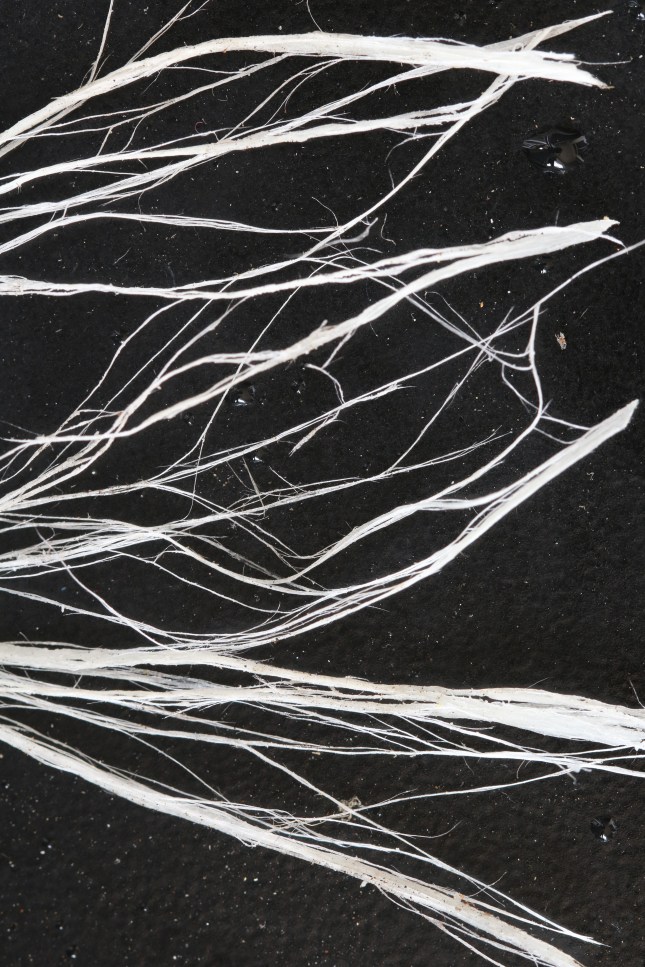
IMG_1475

Indian-Hemp fibers

Every plant species has history in human medicine…it gets boring…but we have finally found the species applied by somebody somewhere to counter every known ailment, from alopecia to zits.  And for those itching to boil and gobble the world of green, be careful, today’s species reportedly causes abortion among other damages.   The species also induces vomiting, but contemporary politics is more effective for that.   All in all, Sidas are chock full of drugs and stuff, with one ingredient especially interesting…ephedrine.

The stimulant ephedrine crops up in human medications, legally and not so much.     By far the best- known botanical source is the genus Ephedra, very weird desert plants having seeds but no flowers, giving the “kick” in Mormon-Tea as well as to the Chinese beverage ma huang, not to mention diet pills, inhalers, and much more.  Ephedra is about as unrelated to Sida as possible, so what the heck is ephedrine doing in our backyard fiber weed?   In any case, smoking Indian-Hemp is a reported use…obviously a nitwit idea.  I wonder if ephedrine or similar alkaloids are behind that dangerous passtime.

To wrap it up with a curiosity, the fruit starts out looking like a pie.  And it winds up with the same fate, sliced into triangular segments, each acting like a separate fruit,  out of one, many.     Sometimes triangular  flower parts (sepals) wrap around the pie from below,  embracing the pie and holding its slices in place.   Although an obvious possibility, I can’t say for sure the embrace is a function of the weather. Today was rainy and gray, and the grip was tight, however.

Sida rhombifolia fruit wrapped in sepals

The fruit with the pie slices hidden by the triangular flaps bent up from below.

Sida rhombifolia fruit pir slices cooler tone

Protective flaps bent back, and the pie slices exposed.


4 Comments

Posted by on June 2, 2017 in Uncategorized


Elliott’s Milkpea Basking in Climate Change

Galactia elliottii

(Galactia refers to milky stems on one species.  Botanist Stephen Elliott lived in Beaufort, SC, where he was first to collect this species.)

Fabaceae (Legumes)

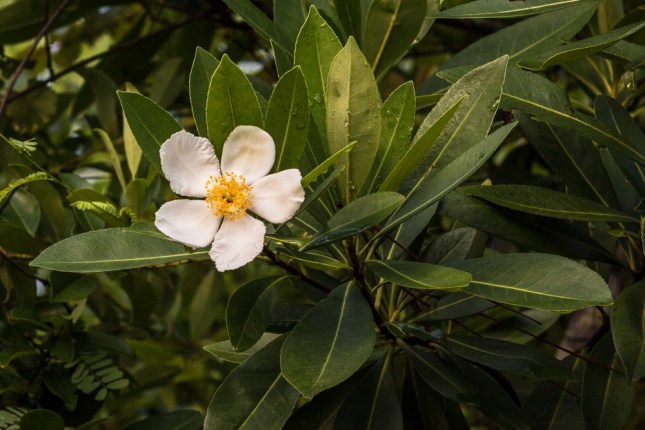
Today’s visit to the Kiplinger Nature Preserve in Stuart, Florida, saw the first big blooming loblolly bay flowers of the season, a relative of tea and camellias featured some time ago in this blog.

Gordonia lasianthus 17

Loblolly Bay, by John Bradford.  All flower photos today by John.

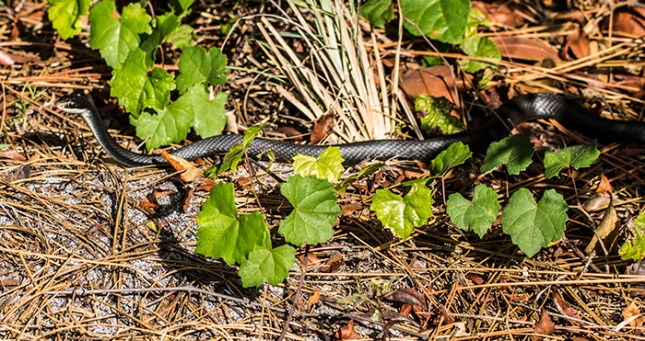
Today is Wednesday, not the usual Friday trip, due to travel plans. Crabs were crab-walking all about, and a black racer popped up for a peep at us.

snake

This was white-flower day, with the loblolly bays,  tarflower, pineland asters, and the plant of the day, Elliott’s Milkpea.

Galactia elliottii 4

It seems to be designed perfectly for where it lives:   largely in pine flatwoods and scrub.  In short, it has to live conditions ranging from sunny to shady,  where fires pass by,  where water is intermittent, and  where the world’s poorest soils strive to stifle growth.  The plants possess extremely log underground runners,  a rapidly growing twining stem able to sprawl, spread and climb over the ground and over shrubby companions,  tolerance for shade or sun alike, and leaves with adjustable positions.    The most noteworthy and most-studied adaptation is its nitrogen-fixing root nodules.

Although most legume roots “fix” nitrogen, that is, extract it with bacterial help from the air and transform it into fertilizer,  this skill seems to matter especially in the sterile world where Elliott’s Milkpea holds forth.     Nitrogen is scanty in the sterile leached white sand of scrub, where much nitrogen fixation is the work of microbes in the surface crust.      Pine flatwoods soil is sterile too…sandy,  often poorly drained,  and with a dark layer that presumably blocks nutrient exchange.

Galactia elliottii 10

For reasons such as these, Elliott’s Milkpea has become a guinea pig for ecologists asking questions concerning the effects of rising carbon dioxide concentrations.     Closely related is the relationship of rising carbon dioxide to  nitrogen fixation, and what better test subject than a vigorous pea living in a natural sand box?

Nitrogen fixation and carbon (dioxide) have a direct link.    The symbiotic nitrogen-fixing bacteria are paid in carbon for their ammonia fertilizer a swap.   So then, a plant using carbon to buy nitrogen might enjoy a boost if given more carbon to trade.    Biologist B.A. Hungate at Northern Arizona University and collaborators studied today’s species exposed to artificially high carbon dioxide over several years.      At first, elevated carbon dioxide boosted nitrogen fixation, presumably an advantage to the pea plants and thus potentially capable of messing with species balance.   After approximately a year, however, the boost disappeared, probably because, especially in awful soil, resources other than carbon and nitrogen became limiting.   I might make my car go faster by putting the pedal to the metal, until an empty gas tank (or a state trooper) become limiting.  What runs low, according to researchers, might be the element molybdenum.


3 Comments

Posted by on May 24, 2017 in Uncategorized


Spanish Needles, Beggarticks

Bidens pilosa

(including populations traditionally called Bidens alba)

(Bidens means two teeth. Pilosa refers to hairiness.)

Asteraceae


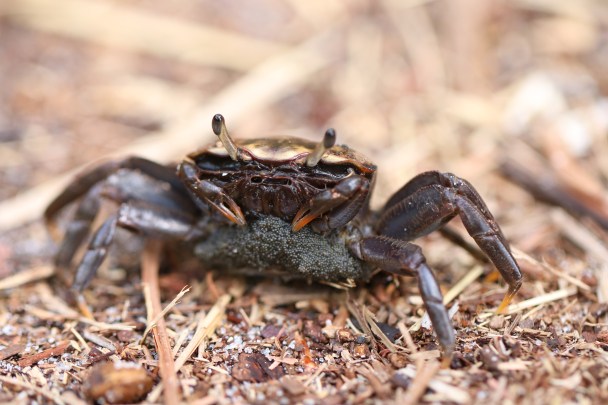
Wildlife was abundant today in the Kiplinger Natural Preserve where John and I greeted a friendly osprey, fiddler crabs waving their fiddles in the mangrove mud,  a young land crab posing as a giant spider, and a photogenic corn snake too quick for photos.

IMG_1002

Got eggs?

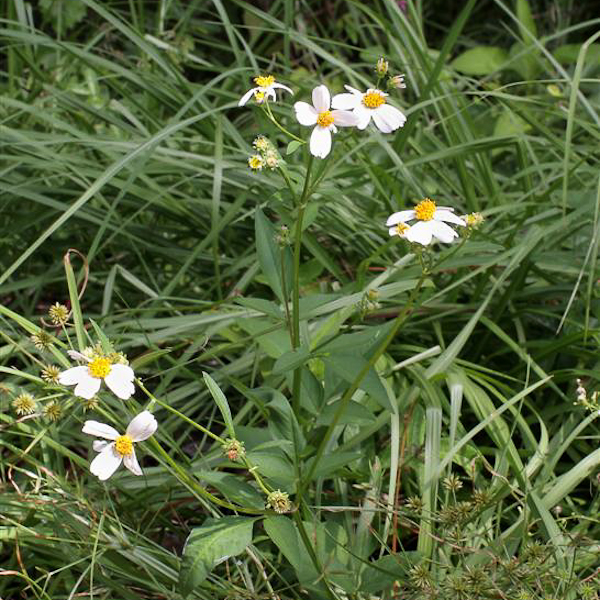
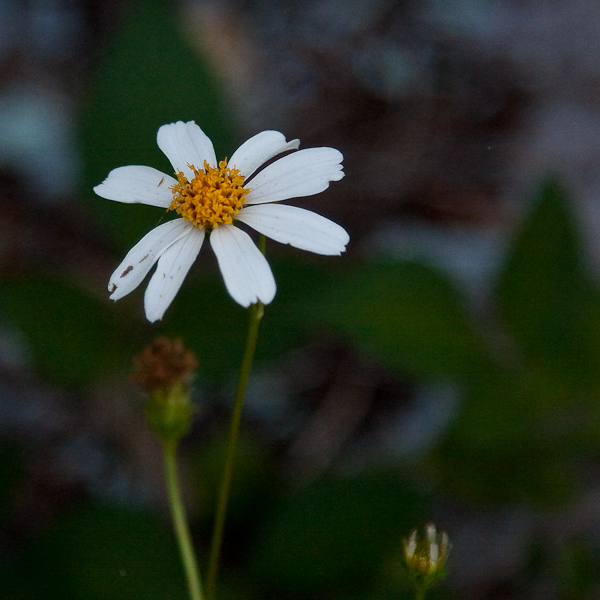
Anyone who knows me knows that I find the rare attributes of common species far more interesting than roaming to see rare species.  It takes work to know the species literally in our own back yards, including Kiplinger.   You couldn’t have a commoner weed than Spanish Needles; they are everywhere, and the yellow and white flower heads decorated the trails (and our socks) today.

Bidens alba

Spanish Needles by John Bradford

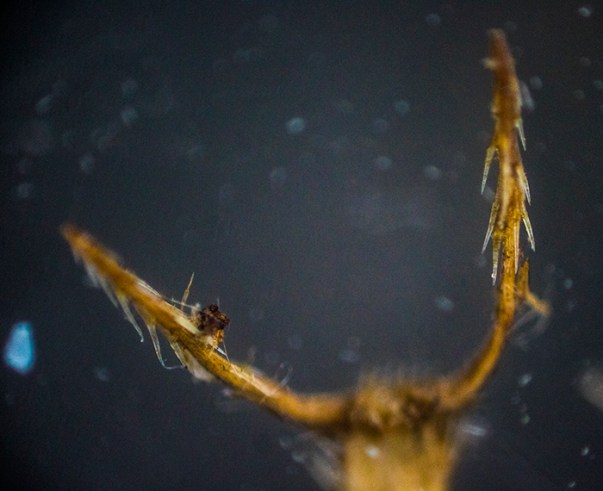
We all know this species, if not as a wildflower, at least as the source of sticktights in our shoelaces and pants cuffs.  They have been known to disperse in the clothes dryer from the trousers of an innocent botanist to his spouse’s apparel, eliciting muttering.  The stickers are well designed, a pair of barbed devil horns on the tip of the seedlike fruit.

Bidens alba horns

Ouch

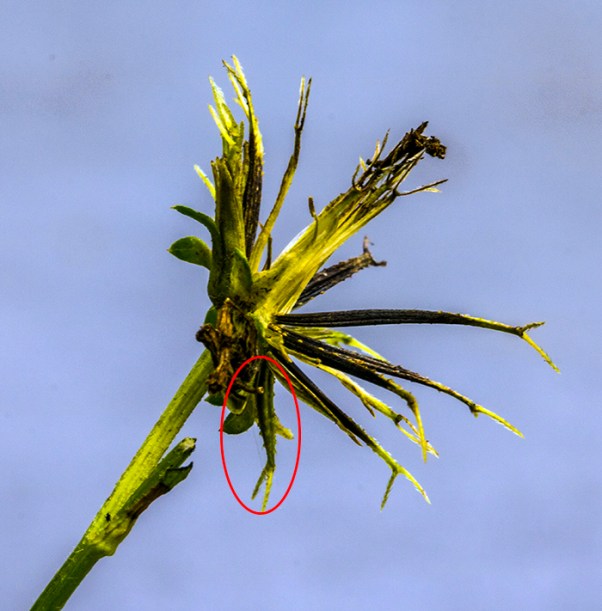
The fruits of this and some other members of the Aster Family have a second oddity, studied in depth by botanist O.J. Rocha in the mid 90s.  It is something you can see easily while walking the dog.   The headlike fruit cluster has two different types of fruits, or intergrading extremes.   Those at the center of the cluster are longer (let’s call them the central fruits) than those toward the edge of the cluster (edge fruits).

Bidens alba fruiting head

Cluster of fruits.  The central fruits are larger than the edge fruits (small one in circle).

The two fruit types have different jobs. The long central fruits  germinate quickly, and are more quickly relocated away from the mother plant.   Their job is to get far away, and spread the species now.

Bidens alba bare middle

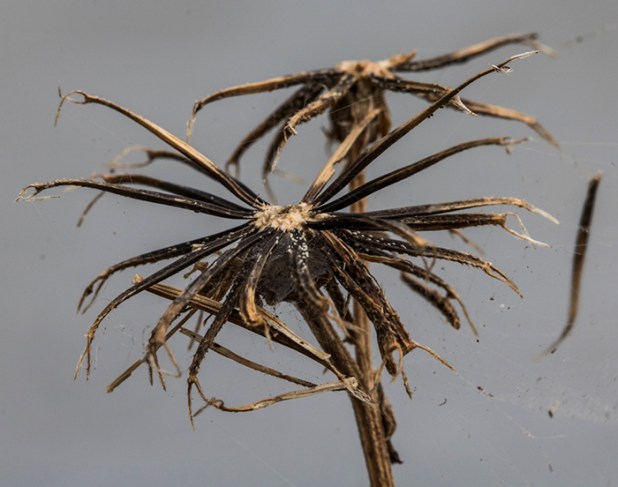
Older fruit clusters.  The central fruits are disappearing.  The edge fruits remain.

By contrast, the edge fruits are reluctant to germinate, probably resist taking in water,  tend to require light to sprout, and cling to the mother plant.     Their job is to repopulate the home site eventually, persisting for who knows how long in the soil waiting for the prior generation to perish and open new opportunity.  Their requirement for light is apparently the cue that the parents have vacated. It would be fun and easy to compare the longevity of the two different fruit types buried in the soil.

Ever notice how Spanish Needles always look free of insect damage, even when the plants around are in tatters?   The species is a witch’s brew of toxins, including poisons researched as potentially destructive to human tumor cells.  One ingredient is PHT (phenylheptatriyne).   PHT smites your foes by destroying membranes.  Everything has membranes so the effect is broad spectrum, beating down such enemies as membrane-bound viruses, bacteria, insect pests, probably us, and competing vegetation.  Contrary to advice by those who feel the most interesting thing about wild plants is eating them…a penchant I’ve never fathomed…just fuggedaboutit!  Unless you are the dainty sulfur butterfly using today’s species as larval host.

Bidens alba 2

By JB

 
5 Comments

Posted by on May 19, 2017 in Uncategorized